When Games Workshop announced Warhammer 40,000 11th edition, it declared that the narrative of the 41st millennium would shine through even in competitive play. On the surface that seems like a reasonable goal; fun tournament play only needs an unambiguous set of rules and enough balance between factions that every army has a few viable paths to victory. Nothing says that such a game can’t also generate a strong narrative – so why is it so hard to unite competitive and narrative play?
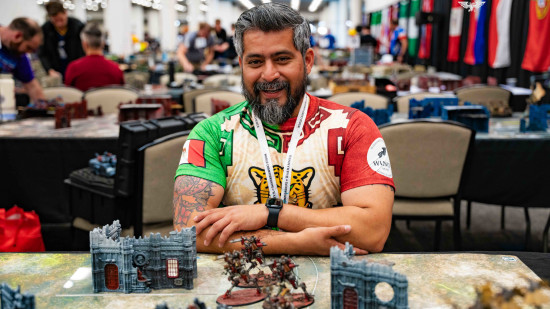
The thoughts for this article came about while interviewing world-class Warhammer 40k players for an ongoing series of interviews. Every one has been among the nicest people I’ve ever interviewed, and the sheer joy they take from competitive play is rooted in a love of the universe and the game. Yet the way they perceive the game is on a different plane from how many players might see it – and I think it speaks to a split within Warhammer 40k’s identity.

Aligning player motivations
Warhammer 40k was not originally designed as a competitive game. As played from original Rogue Trader rulebook, the game was effectively an RPG, complete with game master and narrative scenarios. Simply finding out what would happen could be just as much fun as the tactical challenge of the battle.
That’s a good summary of the the “narrative” play mode; playing to see how the story unfolds. It’s not at odds with trying to win the game – after all, if you’re the commander of your army then it’s in character to try and win – but it’s a subordinate goal, a mandatory component of the story and the game rather than a principle reason to play.
To understand what it really means to play to win, I turn to an essay by the fighting game designer David Sirlin, called Introducing… the Scrub. To play to win you must abandon any self-imposed limitations that aren’t encoded into the game; if the rules permit something as a path to victory then, mentally, so must you,
This isn’t the same as trying to “win at all costs” by being a dickhead; you can be a good sport and still play to win. But it does mean dropping pet units from your army list if they don’t perform, playing the mission no matter how silly or out of character the narrative becomes, and genuinely considering the game in the abstract, without any narrative lens.
A match played this way can still generate a good narrative, but it will happen incidentally, as a byproduct of the players playing to win. 10th edition was particularly weak at generating stories in this sense – it asked players to stand units on pie plates, so they stood units on pie plates, and the narrative was extremely pie-centric.
The new 11th edition mission system seems like a direct response to this problem. It aims to give players objectives that correspond to the capabilities of their army and are balanced against their opponent’s equally appropriate objectives. If it works, playing to win should generate memorable stories, and pursuing the story of your force should point you at victory.
It’s a noble goal, but it faces some well-entrenched obstacles.]
Exposing the reality of the game
Competitive players play to win, and to do that, they need to genuinely understand the game. While this includes finding points-efficient units and high-damage combos, it also means seeing the game as it truly is, not how it presents itself. But what even is Warhammer 40k? It’s not like a Warhammer 40k story, that’s for damn sure.
Because Warhammer 40k lets one player activate their whole army before their opponent can act, alpha-strikes are a major factor: if a player can deploy sufficient force all at once, they’ll delete so much of their opponent’s list that they are effectively out of the game. That risk is amplified by 40k units dying quite easily.
This puts pressure on players to keep their troops in safe staging areas behind line-of-sight blocking terrain. From these safe positions, the core challenge becomes projecting the right amount of their forces to complete their objectives and spoil the enemy’s objectives without losing an unsustainable amount to the enemy counter-attack, all while trying to erode the enemy faster than they are eroded.
As well as this game of threat projection and force conservation, 40k is a game of board control. The strict sequence of move, then shoot, then assault, means that enemy models in play at the start of the turn create a boundary beyond which (non-flying) forces cannot advance. Models aren’t just fighters, they’re the boundary of territory, defining how far into the enemy forces you can strike or claim objectives, and in which phases that might happen.
Then there are threat dimensions to consider. Different weapons are strong into different targets in 40k, or effective at different distances, and it seems that in 11th edition, Battle-shock and Detection Range will also be meaningful dimensions which will determine the effectiveness of units on the battlefield. This adds further considerations in list-building – what kind of questions will your force ask, and which will it be able to answer?
Multiply that by the roughly 30 Warhammer 40k factions and their different approaches to solving this conundrum, and you have a fascinating gameplay puzzle. But simply seeing this is like seeing the code of the Matrix – the raw truth of a game, in the abstract, does not have heroes, villains, and a scenario, it has players and their objectives.
When someone who doesn’t see the game that way battles someone who does, it can feel like they’re fighting Agent Smith. Learning to play the game like this inevitably means letting go of a certain mystique – the game that exists in your head, or in the conventions of how you play with casual friends.

Warhammer 40k is at odds with itself
For all that modern 40k has been overhauled multiple times since the first edition, there’s still a lot of Rogue Trader in it. The scale of miniatures, the number of models on the board, the fact individual infantry have individualised loadouts, the stats models do and don’t have, these were all determined when genuinely ‘playing to win’ was not a major motivation the game designers considered.
So while the newest version of 40k is pretty clean, it’s still a chimaera. It has elements left over from when it was a primarily narrative game. These draw the attention of people who get into the game because of the narrative, or who started with an earlier edition; but they don’t necessarily do anything very impactful in the actual game of 40k.
40k is a game of threat projection, force conservation, and board control, with a few dimensions of threat in which models can be strong and weak. Understood that way, much of Warhammer 40k isn’t gameplay, it’s just the process that handles the maths of the gameplay: the number of dice rolled each turn; the variety of different abilities; the granular differences within a squad of infantry in a game that contains massive tanks. You could simplify most of them without damaging the big-level stuff that makes 40k interesting as a competitive game, and also speed up play – if you abandoned a lot of 40k’s legacy.
Such a streamlined system could actually be more narratively satisfying if you went even further and changed the scale of the miniatures. 32mm is a skirmish scale, a scale where individual models have personality and the fantasy comes from their heroic exploits. Shrink the game to 15mm, a scale where the fantasy lies in the actions of a whole army capturing objectives and breaking enemy positions, and the narrative would suit the area controlling gameplay of 40k much better.
Obviously GW is never going to decommission all those incredibly popular miniatures, so 40k will continue to have a split identity. Supporting narrative play and competitive play at the same time means aligning everything so that the fantasy the game portrays is the same as the reality of playing to win. I’m genuinely hopeful that 11th edition’s new mission system will shrink the gap between them. But I think it would take a lot more work to close the great rift for good.
But what do you think? There are lots of things I haven’t touched on in this article, particularly around the pragmatics of competitive play, or concepts of sportsmanship and how they differ in casual, narrative, pick-up, and tournament settings. Come and say hi in the Wargamer Discord community if you want to talk about this.
 Source: Wargamer