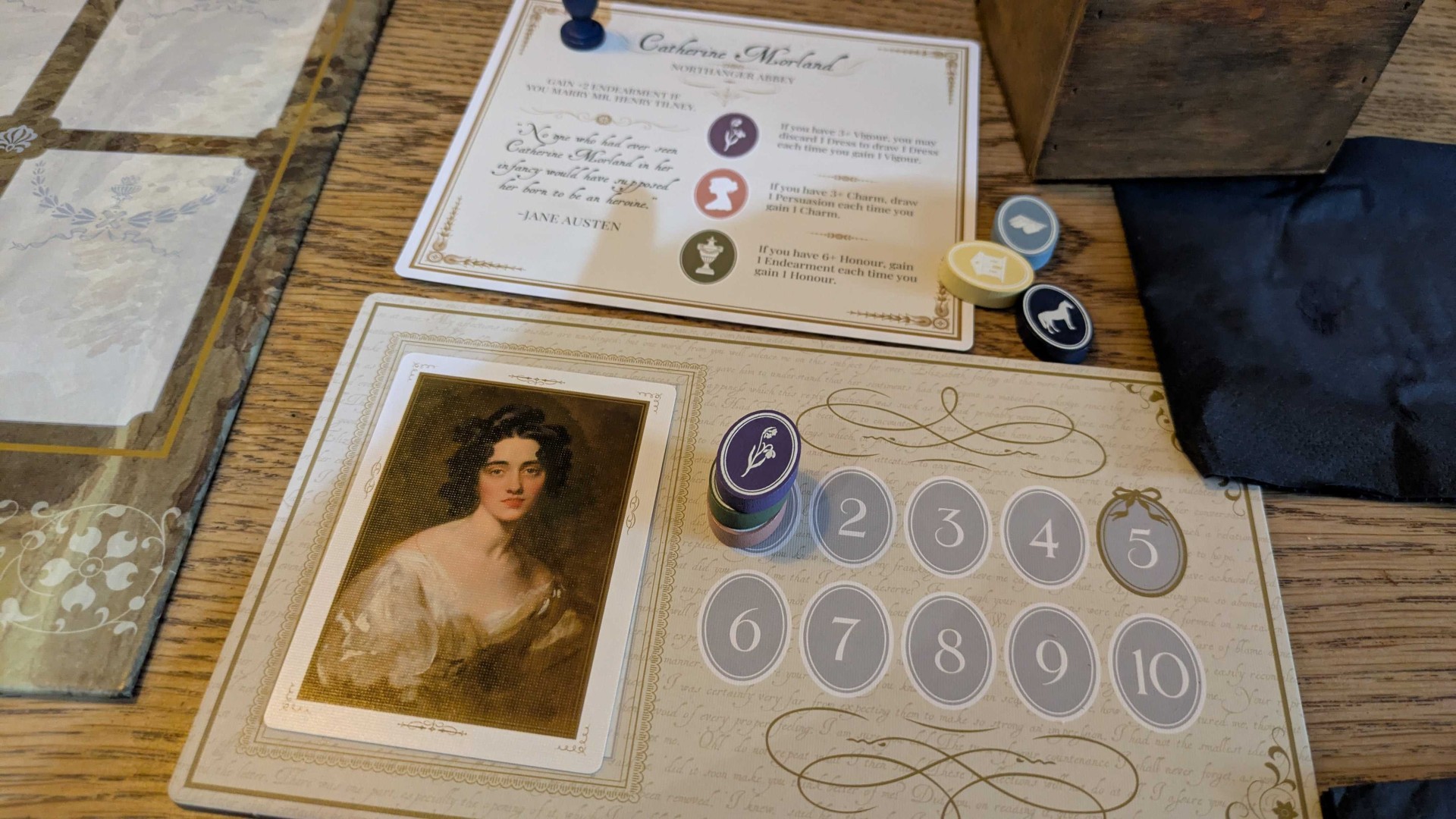
Endearment, a new Jane Austen board game, recently released. There are many ways it stands out, from high-end visual design to a relatively uncommon theme – one where you play a classic regency heroine hunting for the best marriage match.
Something else about it really stood out to me, though. It was a social media comment on one of the game’s ads, asking “why can’t I play as a man?”
When I ask Endearment’s designers, husband and wife Amy and Dusty Droz, Dusty tells me: “I did notice that particular thread exploded”. “I don’t think it’s malicious.” “People are just like ‘I want to play as Mr Darcy too, so my wife and I can both play’.”
Malice or not, it’s a question with impact. In 2018, Tanya Pobuda saw similar critiques of One Deck Dungeon, a board game whose illustrations only featured women. This inspired her to pen one of the most important essays in tabletop history: Assessing Gender and Racial Representation in the Board Game Industry.
Pobuda pointed out that white females only appeared on board game cover art 20.1% of the time, while women of color featured 6.6% of the time. “There is a disheartening study which points out that consumers are more likely to find a sheep on the cover of a board game than a woman”, she writes.
Endearment’s overwhelmingly female representation, then, is more impactful than it might first appear. I don’t believe it’s a coincidence when Dusty Droz tells me “85% of our customers are women”.
“I get a lot of emails from husbands and partners, and they’re like ‘I always take my wife into the game shop, and she sits and looks at her phone and never touches any of them'”, he says. “‘But this time, she walked over to Botany [a previous Dux Somnium game about flowers], picked it up, and wanted to bring it home.'” “I get one or two of these emails a week”, he says.

What is a ‘wife board game’?
Dux Somnium’s games fall into a strange category: the ‘wife board game’. It’s hard to pin down the term’s origin, but female board game designers tell me they’ve heard the phrase for decades.
“I used to see it in the forums”, Roberta Taylor, designer of Creature Comforts and Octopus’ Garden, tells me. “There was always somebody asking ‘what are good games I can play with my wife?’ when what they meant was ‘what games can I play with someone who doesn’t want to play a huge, thinky battle?’.”
Most hobbyists understand its implication: the ‘wife board game’ is one that will convince a wife, a complete beginner, to try out their spouse’s most beloved hobby. It might come with other loaded assumptions – some may believe a ‘wife board game’ is low-complexity, for example, or prioritizes theme over mechanics.
“It’s always been very gendered”, Taylor adds. “It’s very much this idea of a game that’s shorter, lighter, and less aggressive.”
Connie Vogelmann, designer of Apiary and Wyrmspan, is also familiar with the stereotype. “There’s this concept of ‘my wife won’t play this game’, and I’ve never heard the inverse”, she tells me.
The stereotype of women being inexperienced gamers runs deep. “I remember looking at a BoardGameGeek post from a decade ago about a drafting game called Fields of Green”, Vogelmann. “This guy said ‘I played it with my wife, and I tried to do an all-field strategy (which is very clearly not a thing), while my wife built a bit of everything. She crushed me. The game must be broken’.” “That’s an underlying feeling, I think, in a lot of the hobby”, Vogelmann says.
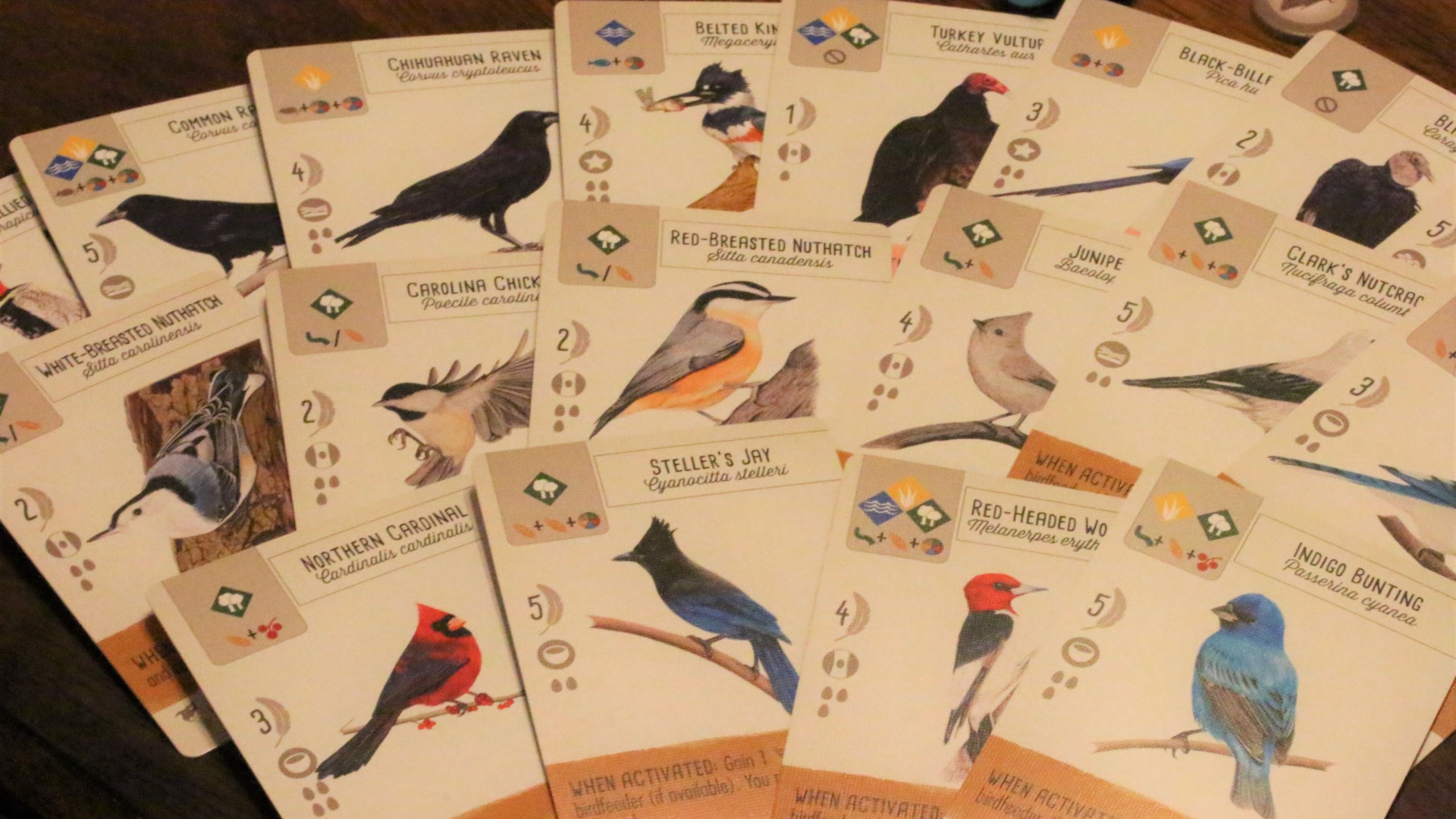
Perhaps no one is more familiar with the wife board game than Elizabeth Hargrave. “You would not believe how many times people have said ‘Wingspan is the first game my wife or girlfriend will play with me”, she tells me. “I don’t think I’ve ever heard that for Wingspan, where a woman says it about her husband.”

“When Wingspan came out, I remember someone in the industry came up to me at Essen”, she adds. “They were like, ‘it’s so great you made a board game for women’.” “I was like, ‘I did not make a board game for women.'”
There are many interpretations of what board game themes are ‘male’ or ‘female’ (a binary, I want to point out, that doesn’t represent all board game players). Vogelmann, for example, lists “dudes on a map games, trading in the Mediterranean games, and Roman Empire games” as ones that come across as stereotypically male.
Meanwhile, designer Danielle Reynolds (Caution Signs, HerStory) says “party games and conversation games” are generalized as ‘female’ genres “because there’s a stereotype that women are more in touch with their emotions”.
Hargrave rightly points out “any type of game could potentially appeal to any type of person”. “I don’t think it’s a hard and fast rule that certain types of games appeal to women more than men, but on average, I do think we see some patterns.”

What does the data say?
According to The Primary Motivations of Board Gamers, the four most popular motivations for men were ‘need to win’ (13%), ‘discovery’ (11%), accessibility (10%), and ‘strategy’ (10%). The least popular motivations were ‘social fun’ (6%) and ‘aesthetics’ (7%).
Women, in comparison, were least motivated by ‘conflict’ (2%), ‘discovery’ (4%), ‘strategy’ (4%), and ‘social manipulation’ (5%). Their most popular gaming motivations were ‘accessibility’ (18%), ‘social fun’ (16%), ‘chance’ (12%), and ‘need to win’ (12%).
In a 2019 Tabletop Network presentation, Hargrave combined this data with social media statistics to explore the gendered preferences of tabletop gamers. “Jamey Stegmaier starts a Facebook group for each Stonemaier Games board game”, she tells me. “He pointed out, a year or two in, that the Facebook group for Wingspan had noticeably more women than any other of his games.”
Only Pandemic could rival Wingspan’s gender diversity, with 30% of that Facebook group being female. Hargrave has several theories about what makes these games appealing to women, from co-op gameplay to colors statistically preferred by women on the box.
Plus, “if you look at the box art [of Pandemic], they made a very intentional choice to include both women and men of multiple races.” “I really think that could make a difference”, she says. “I don’t know how much, but it’s more than zero.”
The wife board game, it seems, is not an entirely false idea. Data (admittedly, limited data that relies on binary genders and internet usage) suggests that women make up less of the hobby board game space – and they’re often drawn to distinct game types.
Family board games
It’s not enough to present these numbers, though. It’s also important to consider why these conditions exist. Several of the women I spoke to suggested one clear reason that women might prefer lighter social board games: children.
Amabel Holland (Irish Gauge, This Guilty Land, City of Six Moons) puts it best. “Historically, household and reproductive labor gives women less time to have these kinds of hobbies.”
Danielle Reynolds echoes this. “I think the reason people still use the ‘girlfriend game’ idea is, like many hobbies in the world, board games are geared towards men – because men have free time, and women take care of the kids.” “There’s still a lot of these tropes that we fall into.”
Many studies have shown that household labor – in particular childcare – remains unequal in heterosexual, two-parent households. According to the US Bureau of Labor Statistics, men spend one hour more per day on leisure activities than women.
As Roberta Taylor puts it: “maybe your partner would like a heavier game, but if you expect her to take care of the baby every time it fusses, it’s not a wife board game you’re looking for.” “It’s a ‘new parents board game’, but that’s always seen as a ‘her’ thing.”
Reynolds also points out these factors also disproportionately affect BIPOC communities. “Historically, this is a community that had to work more jobs and more hours.” “They have less time, and they have less income to spend, so hobbies like board games don’t tend to appear as much.”

“There’s no women here”
Women who can find the time to play board games and attend conventions have often found another barrier in their way. “When I talk to other women gamers”, Hargrave says, “I hear stories about walking into board game stores and people assuming you came to the wrong place”.
Many of the women I spoke to pointed out that, in recent years, gaming events have become more diverse and welcoming. However, almost all of them had stories of sexism to share. “When my daughter was in high school”, Taylor tells me, “we would occasionally play Magic: The Gathering”. “When a middle-aged woman would walk into a store to buy Magic cards, they simply didn’t know what to do.”
Taylor shares another story about her first board game convention, the year her game Octopus’ Garden was nominated for an award. “I walked in with my friend, and she immediately froze”, she tells me. “She had been a victim of sexual assault as a young person, so she was way more aware of gender dynamics than I was, and she immediately said ‘there’s no women here’.”
“It can be difficult to feel comfortable within that space”, Holland tells me. “When I used to go to conventions, I remember talking to someone who was really into military history and war board games.” “The convention had a wargaming corner, and she was talking about how she didn’t feel very welcome there.”
“The people running it heard, and were like ‘I don’t know what she means – anyone can come here’.” “And I said ‘yes, but you have to actually reach out and fight to bring people in – show them that you’re not going to make sexist assumptions towards them’.”
All this creates something of a self-fulfilling prophecy. Hidden factors like household labor or fear of sexism limit a woman’s access to the hobby, and, when she doesn’t show up, many men assume this is because she is less interested in board games than he is. They perhaps don’t stop to consider why that woman fails to turn up to the table.

By design
These factors don’t just affect who is playing the board games, either. As of 2026, only 10% of the BGG top 100 credits non-male designers. Women make up roughly half of the global population, but they are still underrepresented in board game design.
Connie Vogelmann tells me the lack of diversity in design “holds the hobby back”. “The more that we welcome in different voices”, she says, “the more we’re going to experience a range of games.”
“I also think there are a lot of pitfalls that can be avoided”, Holland says, “especially because so many games are made by people engaging with cultures and realities that aren’t their own”. “It is tremendously important to have a diversity of voices, and to change the idea of who can be a game designer.”
Additionally, Danielle Reynolds says, “something that keeps women less recognized is that most women design for the mass market space”. “Mass market games typically don’t put designer names on boxes – or even in the rulebooks.”
“The original Monopoly was designed by a woman. A woman designed Jenga. Many people will never know that, because there’s no name.”
One major example of this is Peggy Brown. “For anyone who doesn’t know, this woman has designed literally over 100 games for the mass market space”, Reynolds says. Brown’s website currently lists 198 board games she’s designed. That’s more than many of the hobby space’s most respected creators – Jamey Stegmaier, Corey Konieczka, Vital Lacerda, Matt Leacock, Cole Wehrle, and more.
“Stop asking ‘where are the women?'”
Many of the designers I spoke to agree that the biggest responsibility for change lies with board game publishers. Amabel Holland, herself a trans female game publisher at Hollandspiele, says “publishers act as gatekeepers for which games get on shelves”. “It behooves them to actually reach out and look for new voices that might not feel they can approach you.”
Roberta Taylor echoes this. “One question publishers need to ask is: what are they actively doing to see more designs from underrepresented groups?” “Stop asking ‘where are the women?’ and start asking ‘what have I done to make there be more?'” “Are you looking for women’s initiatives to support? Are you actively seeking out these designers?”
I asked several major board game publishers what they were doing to encourage more women to enter the board game industry. I received a reply from just one: Hasbro. Natalie Cross, senior director of global communications at Hasbro, told me about the Women Innovators of Play program that launched in 2023.
“Women Innovators of Play features a free virtual program of talks and panels with inspirational industry leaders”, she tells me. Most of the examples given include Hasbro executives, but NASA astronomer Dr. Michelle Thaller and designer Elizabeth Hargrave also feature.
“Women Innovators of Play also features an annual toy and games design challenge, searching for the next great woman-led mass market toy or game and supporting the career journeys of women toy and game designers”, Cross adds.
“Last year’s winners were selected from more than 130 global submissions.” “Each winner received a $10,000 cash prize and the opportunity to spend a day at Hasbro’s headquarters, where they met with internal teams and industry experts to further develop their ideas and gain insight into the product development process.”

“Building on the success of Women Innovators of Play, we also launched Girl Innovators of Play in partnership with Girl Up, a girl-centered leadership development organization”, Cross says. “This program includes an Innovation of Play bootcamp, a dynamic hands-on program for girl leaders throughout the globe to learn and engage with prominent women leaders at Hasbro and the inventor community.”
Cross says Hasbro currently accepts game idea submissions through an online portal. “We also proactively source ideas through our global inventor network, industry events, and targeted outreach programs like Women Innovators of Play.”
On an individual level, Reynolds also advocates for more designers becoming mentors. “The easiest way to get a game signed, honestly, is to become a content creator, create a publisher network, or go to shows and networking events”, she tells me. “And when you do that, if you have an established designer introducing you, it’s so helpful.”
Moving further down the ladder, players can do their bit to make the hobby more welcoming too. As Roberta Taylor says, it can be as simple as “educating players about how we use gendered language and how we talk about representation in games.” “We still deal with completely tone deaf representations of things like colonialism, and the more people say ‘hey, this isn’t comfortable’, the more those people sitting on the sidelines will start to feel safer.”

Back to the beginner
The wife board game, divorced from its gendered connotations, is simply a board game for beginners. Each woman I spoke to had a different origin story when it came to board games, and their preferred genres all differed. But they all had one thing in common: their advice for bringing new gamers into the hobby.
The key to getting your wife to play board games is simple. You need to treat her like an individual person.
“You need to meet people where they are”, Elizabeth Hargrave tells me. “That’s not necessarily by starting with the easiest game, though that’s often the right answer.” “Sometimes, people are really motivated by the subject matter of a board game.” “If you want to bring someone in, you need to think about what they’re interested in”, she adds.
“When people say to me ‘Wingspan is the first game my wife wants to play with me’, I have always wondered: what other games have you offered to play with your wife?” “Were they super aggressive? Were they super male-coded? What was going on that meant Wingspan was the one that broke through?”
Dux Somnium has built an entire business on such ideas. “We design most of our games to be like games that Amy and her friends would enjoy”, Dusty Droz says. Amy herself says “theme and accessible gameplay” are the key to inviting newcomers to your game. “If you find a theme that a non-gamer is interested in, then it’s easy to get them to the table.”
As Elizabeth Hargrave says: “There really is a game that’s right for every person at this point”. The ‘wife board game’ can be whatever she wants it to be.
Want to talk more about the best board games? Join us for a chat in the Wargamer Discord.
 Source: Wargamer