


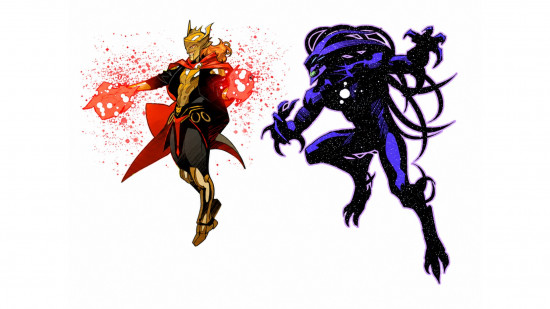
Justice League Unlimited The Roleplaying Game, the first official DC RPG in almost 20 years, begins crowdfunding today on Gamefound. Publisher D20 Culture worked with DC writer Mark Waid to create a “huge homage to the comic industry”, CEO Peterson Rodrigues tells us. Waid’s input comes with an added bonus, and it’s one that’s pretty huge for Justice League lovers. The JLU TTRPG will debut two brand-new, canon villains.
The Justice League Unlimited comic debuted in 2025. It features all your favorite DC icons, plus plenty of up-and-comers that have been invited to partner with the planet’s greatest heroes. Mark Waid, co-creator of the series, tells us he worked with D20 Culture to ensure authenticity and continuity for the TTRPG.
“Being able to bring that to the table has been a joy for me”, he says, “and I think it’s been helpful for the game designers to talk about what is in current continuity”. “What can we do with the game to reflect what’s happening in the Justice League Unlimited comic book that I’m writing at the same time?” “I was able to come through and you contribute villains, brand-new characters, and brand-new ideas with an eye towards how we can use them in the comic book going forward.”
The two new villains, Pasquinade and Chernobog, “bring entirely original threats into the DC universe”, an official press release says. Pasquinade is a god of satire that warps reality for pure mockery, and Chernobog is a cosmic being of darkness and entropy that even Superman is threatened by.
“When I created Pasquinade and Chernobog, I wanted villains who would challenge heroes in ways that couldn’t be solved by simply throwing a punch”, Waid says. “They’re threats that demand teamwork, difficult choices and ingenuity, which makes them especially exciting in a roleplaying game.”

This is apparently a through line in the wider TTRPG, from pre-written adventures (or ‘issues’ to character creation questions. “I play a lot of games, and many are basically fetch quests”, Waid tells Wargamer. “This is not that game. You’re not rewarded for your feats so much as your ability to do the right thing in a complicated situation.”
“It’s a game built around heroism”, he adds. “That’s one of the things I really like about it – it’s not just a clone of another system, it has a unique feel to it.” “Getting your points and level ups is dependent on you behaving like a hero.”
Rules-wise, this is a cinematic, mid-complexity, D20-based system. Heroes of varying ‘tiers’ (a category that measures their power and popularity) band together to play through ‘issues’ (sessions) run by the Editor.
You can play a party of existing DC characters, or you can create your own. Each ‘archetype’ is based on a famous figure, so you can play as a Dark Knight, Genius, or Champion of Tomorrow of your own devising. So far, so comic book.
Heroes have six attributes: Potency, Accuracy, Agility, Resistance, Mind, and Spirit. These, plus any circumstantial bonuses, modify your D20 rolls in your favor. So far, so TTRPG.

From here, though, things are a little different. Heroes have a unique resource called Plot Points that allows players to control the narrative. They might spend a Plot Point to create plot armor, dodging an otherwise lethal blow. Maybe they want to turn a failure into a success, or they want to establish a new fact about the world.
“As the GM, I don’t want the burden of storytelling to be just mine”, Rodrigues tells Wargamer. “I want the players to contribute. Plot Points work exactly that way.” “It’s a real way for players to be connected to the story on a more personal level – not just reacting, but actively shaping it with the Editor.”
Anything is possible with Plot Points, but overusing them can trigger a roll of the Crisis Die, which adds catastrophic consequences to the story. The Editor can also spend an Editorial Point to throw more spanners in the works. Conflict is essential to any great superhero story, after all. It’s so crucial, it’s even tied to your level ups.
Original player-characters increase in power thanks to Ascension Points (PAX). These are awarded at the end of an issue, and how many you get depends on how willing you are to take part in the narrative – warts and all.
“You can also get PAX if you really involve your character’s Limitations in the game”, Rodrigues says. Each archetype (your ‘class’, effectively) has one standard Limitation, and you can add another of your choice. These represent your character’s weaknesses, because every hero has them.

Including them in the narrative is a sure way to net PAX. “If at any moment during an adventure you say ‘the villain’s plans target where my loved ones live, so she might be in danger’, the Editor can give you extra PAX points because you helped tell the story”, Rodrigues explains.
The narrative nature of this progression means characters evolve at different paces, but this is apparently by design, “because the game can accommodate characters from different Tiers”. “We recently played a game with Superman and Blue Beetle”, Rodrigues says. “It’s not like D&D where a seventh-level character can’t play with a level-two character.”
PAX is useful because it allows you to purchase new Powers. These are the superhuman abilities that define your hero. Whether you’re a regular human with incredible martial skills or a full-on flying, laser-eyed Kryptonian, you’ll use Powers to save the day.
All the hits are present in the Power list. That means super strength, flight, speed force, force fields, power rings, and telepathy. There’s even a passive ability called Superhero Landing that lets you enter combat with an Initiative bonus. It also means martial arts, swordsmanship, marksmanship, tech-based exoskeletons, and plain-old human intelligence.
D20 Culture promises a tabletop RPG as flexible as it is faithful. The JLU TTRPG has been designed to accommodate pretty much any comic book fantasy you can dream up – while also diving deep into the big questions that make the medium so compelling. The crowdfunder runs until August 21, and you can find out more on the official Gamefound page.
Want to talk more about the best tabletop RPGs? Why not pay us a flying visit in the Wargamer Discord?
 Source: Wargamer

