


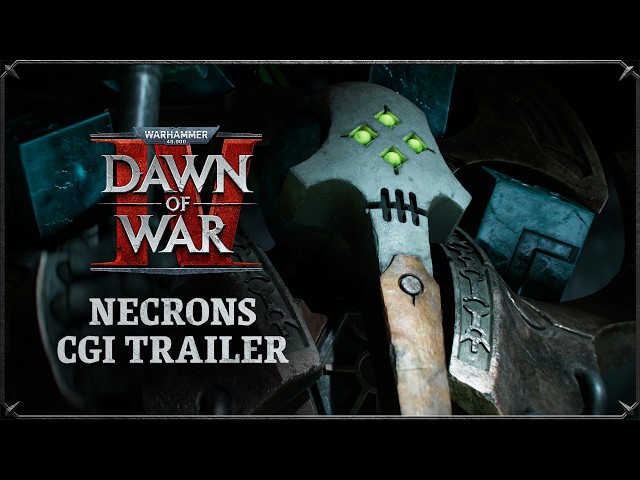
In Warhammer 40k‘s lore – and occasionally in the tabletop wargame’s competitive meta – the Necrons are an apocalyptic threat. The remnants of a galaxy-straddling civilization that has lain dormant for aeons, their technology is at the very limits of what is possible, and their gradually awakening legions are without number. To find out how King Art Games hopes to turn that brief into a balanced faction for Dawn of War IV multiplayer, I spoke to senior game designer Elliot Verbiest.
“There were three core pillars that we knew we wanted to bring forth for the Necron gameplay”, Verbiest says. “A relentless forward advance… their remarkable durability, how difficulty it is to get rid of a Necron unit, and the various teleportation trickery that they are capable of”.
“This comes together very, very nicely, it creates a number of archetypes for this type of RTS faction that’s kind of slow but very durable and very powerful that has difficulty repositioning their forces, especially early on in the game, but as they progress and become more powerful over the course of a match, they gain different tools for their toolbox that allow them to cover for their specific weaknesses.”
It seems quite lore appropriate that, thanks to their incomprehensible technology, Dawn of War 4‘s Necrons don’t play by the same rules as anyone else. That starts with their economy, which completely ignores the Requisition other factions have to muster from holding control points: instead, the Necron economy is driven by their Dominion of the map.

Dominion is “this area that spreads out from their structures, and the more of that area that they can cover and protect for themselves, the stronger their economy becomes”. Dominion spreads visibly across the map in a way that might remind fans of older RTS games of Blight from Warcraft 3 or Creep from Starcraft.
Then there’s that durability. Thanks to the Necrons’ self-repairing necrodermis and reanimation protocols, “even if you fell them, they rise back”. “Unlike any other faction, their units automatically regain their HP and members free of charge”.
The team also considered including the Resurrection Orb, a familiar part of the tabletop game and the original Dawn of War that allows a Necron Lord to mass-resurrect the warriors around them. Verbiest says that “feels great if you’re the person who’s doing that, but a lot less so if you’re that player’s opponent”, and “there wasn’t really a tool or a method that other players could deal with that in a meaningful way.
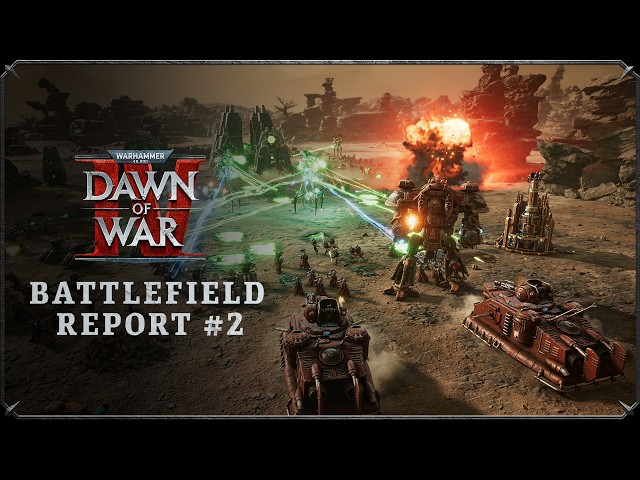
So instead of a Resurrection Orb, Necrons now get Resurrection Galleries, a structure that allows them to select a specific kind of unit, and “whenever that Necron unit anywhere on the map falls, then it will automatically be regenerated over time” free of cost, emerging from the Gallery. “That helps to create that feeling that you’re making progress against the Necrons and you’re clearly defeating all these units, but they somehow keep coming back”.
Again, this feeds into the Necrons as a relentless faction. It’s also a single point of failure: destroy the Resurrection Gallery for a unit, and all the deceased units waiting to be resurrected are permanently gone. Similarly, while the Necrons’ Dominion based economy is easy to spread with certain cheap structures, defending those buildings across a large territory is a real problem for the slow moving robots.

While most Necron units move at a relentless trudge, they are capable of explosive turns of speed thanks to a variety of teleportation technology. “For example, Translocation Science is a stratagem that Necrons always have access to regardless of which commander they pick, and allows them to very quickly teleport units from one place on the map to another.” Necron’s smaller turrets can teleport too; units can hop into a pocket dimension and emerge from gateway structures; the colossal Necron Monolith can both teleport itself and act as a teleporter beachhead for Necron infantry.
We haven’t seen gameplay footage for the full Necron roster yet, so it’s not clear how units like the melee-centric Skorpekh Destroyers, or the C’tan Shard of the Void Dragon, will play within this general set of capabilities. But the central rhythm that Verbiest describes seems extremely apt to the Necron’s identity as a Warhammer 40k faction. They don’t play fair, but not in a flashy, tricksy way like the Aeldari or sorcerers of T’zeentch – they simply don’t pay attention to paltry mortal concerns like ”rules’, or even ‘death’.
All evidence suggests that Dawn of War 4 is shaping up to be one of the best Warhammer 40k games ever made, and I can’t wait to play. Do you know which faction you’re planning to main? Let us know in the Wargamer Discord community!
 Source: Wargamer

