On Monday, Games Workshop revealed the rules for the new Land Speeder unit coming in the launch box set for Warhammer 40k 11th edition, and with it the changes to the rules for flying movement. By the golden throne, we’ve got some good news – you won’t have to understand Pythagoras’ theorem to optimize your flying moves any more!
The new rules for flying are super simple. Each time a flying model makes a normal, advance, fall-back, or charge move, it can choose to ‘take to the skies’. This costs two inches from its maximum movement as it launches itself upwards. While it’s flying high, the model ignores any distance it moves vertically, can move through any and all terrain, and can move through any and all units on the battlefield.
Are the current rules for flying movement the worst part of Warhammer 40k 10th edition? Not at all – that would be the rules for pivoting. But the rules for flying units moving over terrain are buried in the ‘core rules updates and rules commentary’ PDF, a 35 page admission of guilt for all the flaws in the base game.
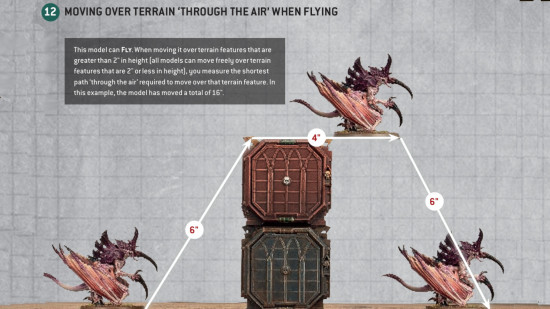
Flying movement in 10th edition has rules that get worse the more accurately you want to apply them. When a model moves onto and then over terrain in 10th edition, you measure its path through the air. That means a diagonal move up to the lip of the terrain piece, then a horizontal move until the back of the model’s base is completely clear of the terrain, and then another diagonal move down on the far side.

This means that, to calculate exactly how far a flying model can move beyond an obstacle without picking it up and physically moving it, you’ve got to work out diagonal movement distances using Pythagoras’ theorem. Time for some algebra, folks.
Using whichever units of measurement you like, if you have a model with maximum movement m with a base of width b that intends to cross an obstacle h tall and w wide that is a distance d away, you’ll be able to place the front of its base this far beyond the obstacle:
√((m – √(d2 + h2) – w – b)2 – h2 ) + b
The new rules will allow a model with an eight inch move to leap on top of a four foot tall impregnable fortress wall, so we’re not entirely free of absurdities in 11th edition. But that’s much less fiddly than holding your models up in the air on the far side of a barrier and measuring diagonally down from them – and it’s much cooler too.
Which rules do you most want to change in 11th edition? Let us know in the Wargamer Discord community.
 Source: Wargamer