


 It’s well-known around Board Game Quest Headquarters that I’m a big fan of the World of Ulos universe from Thunderworks Games. Entries like Cartographers and Roll Player are favorites, and even games with less cachet like Lockup hold a special place in my gaming collection.
So when BGQ’s above-average leader Tony Mastrangeli rolled into the office one cloudy Tuesday morning with a package from Thunderworks, I was intrigued and—dare I say—excited by the prospect of checking out the next entry in the ever-expanding lore of Ulos. It was bound to have a clever design and a bunch of nifty components. I snatched the box, thereby staking my claim on the review rights.
Tony tried to say something about the game, but I ignored him (as every member of the staff typically does) and hurried back to my BGQ-bicle to open it up. To my surprise, the game inside wasn’t part of the Ulos universe. It was also a small box adorned with cute characters and seemed to only hold a bunch of cards. I was disappointed. I was confused. I was angry with Tony (not about the game, but I’m pretty sure he ate the last croissant in the break room). Would the game be good enough to overcome the Ulos-sized hole in my expectations?
Fliptoons is a deck-building, autoplaying card game designed by Jordy Adan and Renato Simoes for 1-4 players. It takes 20 minutes to play and does not take place in Ulos.
Gameplay Overview:
The premise of Fliptoons is thus: players take on the role of talent agents who are looking for animal actors to fill out the cast of the next great show. To do this, they will need to find new actors to replace the mediocre ones they started with. In game terms, players all have identical starting decks and will use whatever fame (both the game’s currency and points) they accumulate each round to buy new cards and get rid of unwanted ones.
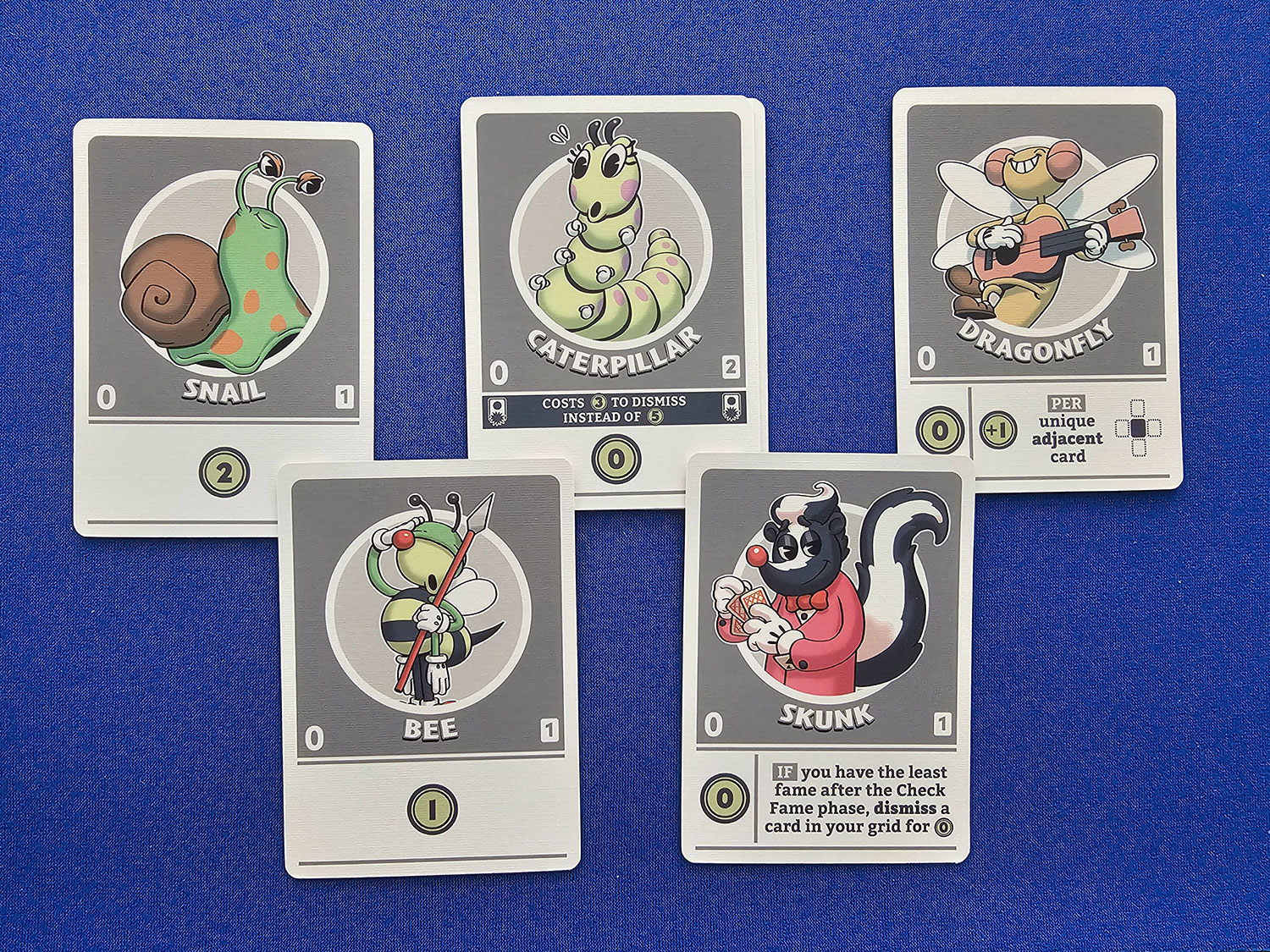
Each round, players will deal out cards from their deck to form a 3×2 grid in front of them. (Some cards will modify this arrangement slightly; more on that later.) Players have no control over the order the cards come out, but the order is important as it impacts the value of the cards in most cases.
The starting Dragonfly card, for example, grants points for unique orthogonally adjacent cards, so if that lands in one of the corners, its value is lower than if it’s in the center. After everyone has flipped over their toons (GET IT?), all players set their fame value for the round.
In turn order, everyone will have a chance to either buy new toons from the market or dismiss cards from their grid. As toons are purchased from the market, they are refilled with new ones from the deck, but each toon has a rank, and the market is always priced from lowest rank to highest. It costs 5 fame to dismiss (most) toons, and they are removed from your deck and grid permanently, but can still be referenced by other cards when counting fame. After this is done, players grab all their cards, shuffle, and do it all over again.
The game continues like this until one player hits 30 fame in a single round, which triggers the endgame. The player that hit 30 gets a bonus card worth 3 fame for the following, final round. Whoever has the most fame at the end of this round is the winner and is the best toon talent agent in all of Ulos Flip Valley.
Game Experience:
After the first round of every play of Fliptoons, players new and old generally have the same comment: “Is that all there is to this one?” And the answer is yes. You buy some cards, flip some cards, and then do it again. And yet—against all odds—it’s remarkably fun. Hunting for card interactions that will work with the cards you’ve previously acquired is the “strategy” of the game, but it can be derailed by rotten luck in a hurry.
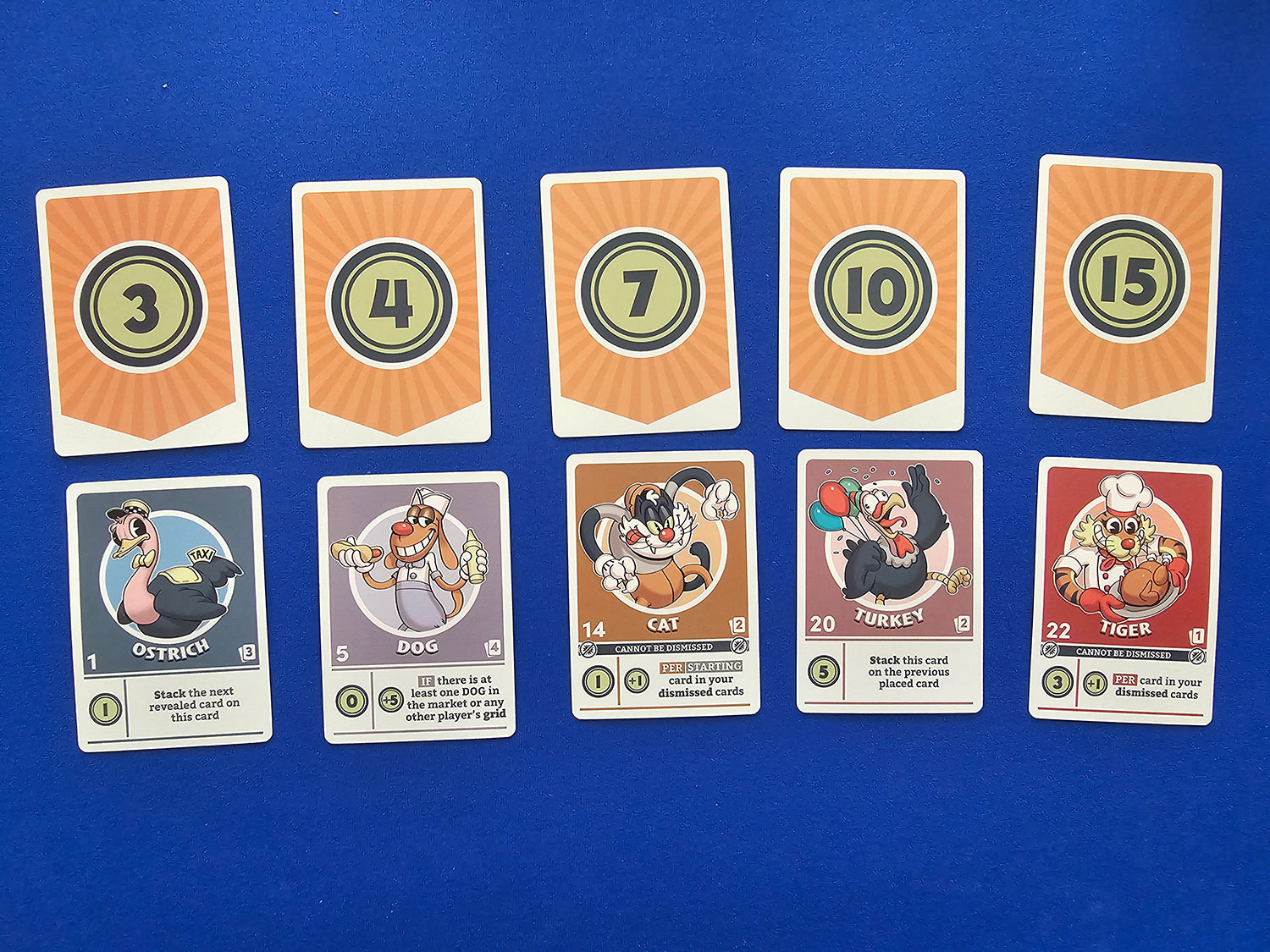
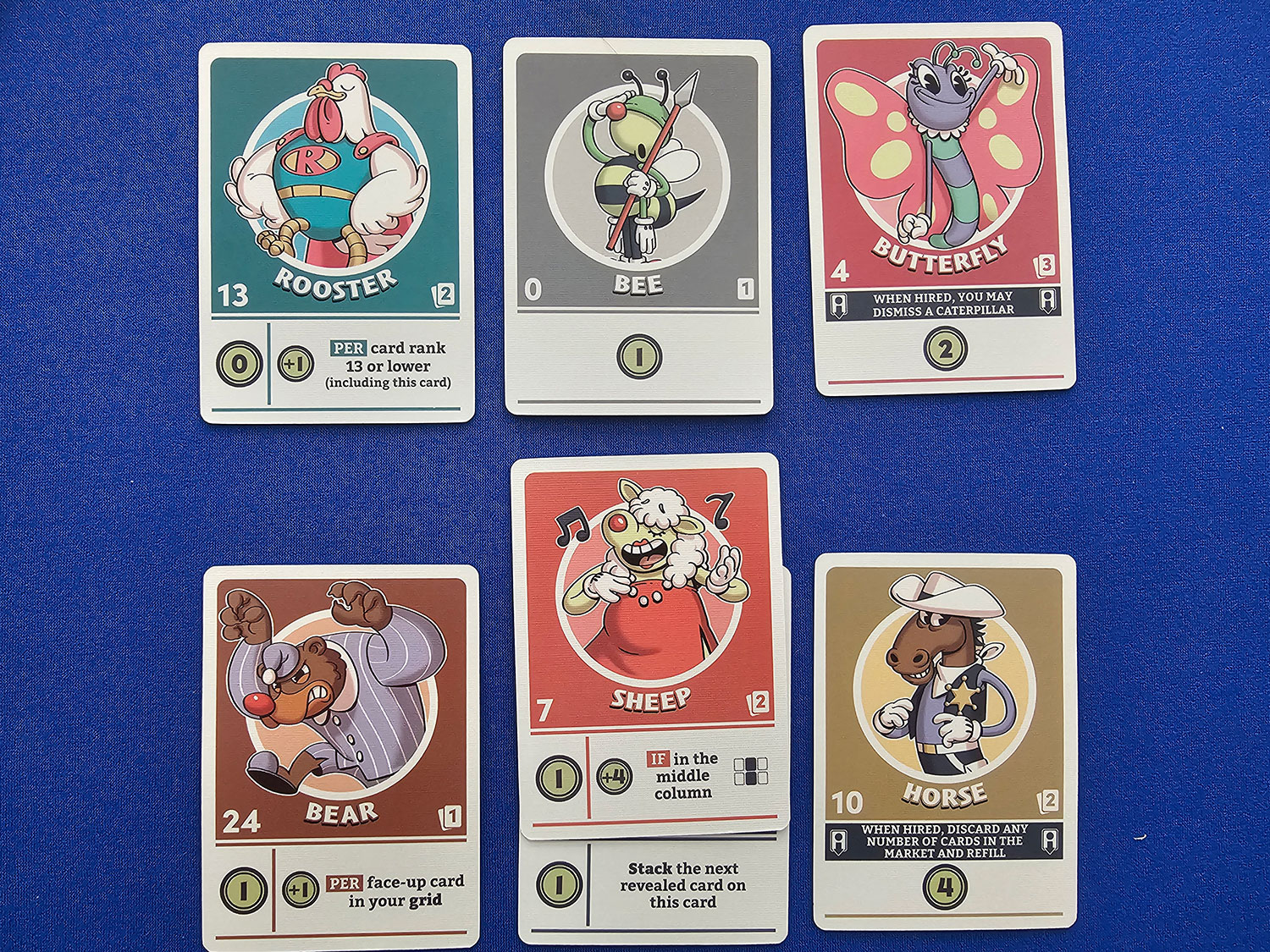
The Sheep card only scores if it lands in the middle column of a player’s grid, and I’m pretty sure I’ve only ever had that toon drop in one of the corners for me. Some cards interact with other players’ grids and the market itself (the Dog likes having company), while others—like the Monkey and Ostrich—will slightly move cards around in a player’s grid to give additional chances for fame. In a way, the decision space and chaotic nature of the turns are similar to Challengers, but the experience is more streamlined here, and the choices do seem ultimately more impactful (even if that’s only an illusion).
The game also has a surprisingly satisfying arc to it. After a turn or two, players might wonder how anyone will ever get to 30 fame, but things ramp up very quickly and, before long, everyone will be hovering around the 30-fame mark. The endgame is interesting as well. It’s not all about hitting 30 fame; the winner will be the one who does the best in the following round, which means setting up one good turn doesn’t guarantee victory. In most of my plays, the winner of the game was not the person who reached 30 fame first. It’s all about thinning one’s deck enough so that the higher-scoring cards can do their stuff.
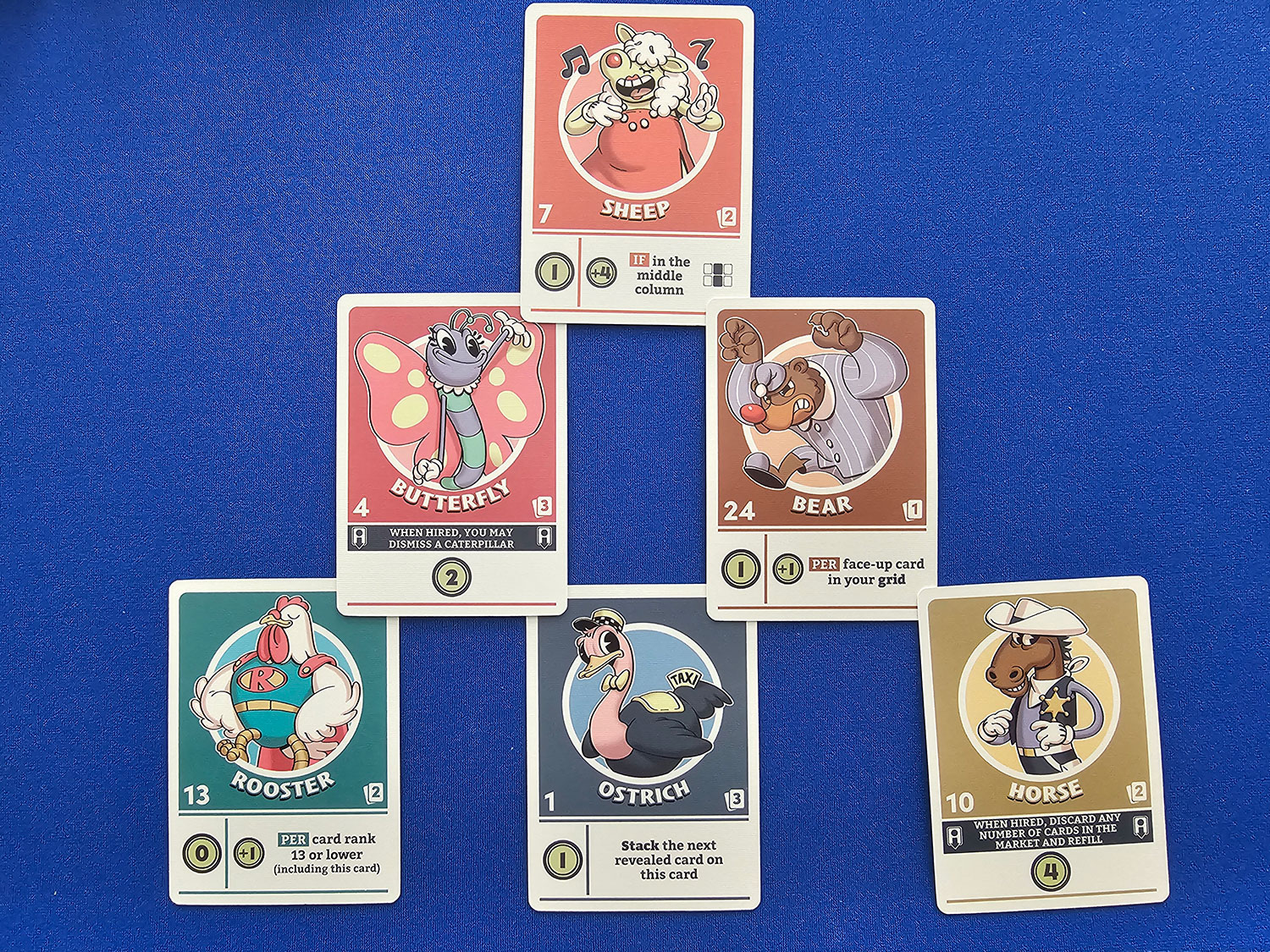
From a production standpoint, the game is very reliant on its art, and that is very successful. The graphic design is clean, and the characters all have the appropriate vibe for the look the game is trying to achieve. Bad Ulos jokes aside, Fliptoons feels like a world that’s interesting enough for its own spinoff games. I won’t pretend that the theme of the game fits the mechanisms perfectly (so I can cast these toons, but then they run on screen in a random order?), but for a fairly straightforward card game, the art and concept do a lot to make the game engaging.
Final Thoughts:
I was (and remain) pleasantly surprised by how much fun Fliptoons is to play. It honestly doesn’t seem like it will be any good as you read through the rules or even play a turn or two, but the fun sneaks up on you, and the excitement of flipping over a decent grid is way more compelling than it should be.
Autobattlers (and auto tableau builders and other games of that ilk) are all the rage right now, and Fliptoons is a great example of keeping that design simple enough (and the playtime short enough) so that the bad luck never feels crushing and the good luck comes frequently enough to offset it anyway. Not having to wait to trash cards is also a plus, and it offers an interesting choice during the game’s market phase between adding cards to one’s deck or subtracting one. The structure of the market also seems fair since the highest-ranked cards will always cost more relative to their lower-ranked counterparts. I’ve taught Fliptoons to kids as young as 8, to people not familiar with most of the mechanisms, and to hardcore gamers, and it has yet to disappoint.
Final Score: 4 stars. A punchy, fast-paced deck-building game with some neat twists on the automatic card play craze.
 Hits:
Hits:
• Great game arc
• Fun artwork
• Easy to play and teach
• Card variety
Misses:
• Theme, while fun, doesn’t really fit what you’re doing
• Bad luck can be frustrating

Source: Board Game Quest

