


The world of Dark Sun is a blasted, brutal desert wasteland dotted by bastions of civilization ruled by nigh-immortal sorcerer-kings.
If you saw D&D’s big new announcement at Gen Con, you know that Dark Sun is on the way next year. And that fans are hungry for its promise of more ‘mature themes’ and gory elements, which includes an animated segment that saw someone’s head getting ripped off and then hurled like a weapon in the middle of a fight.
But that’s the world of Athas. Dark Sun has always been one of D&D’s bleaker, more brutal settings. It’s baked into the blasted wastelands of a world with only the fading light of a dying star (the titular Dark Sun) to light the way. Now that WotC is prepared to revisit the setting in a year or so, it’s time to take a look at what makes Dark Sun so harsh, yet so appealing.
Athas: A World Built To Be Hostile
The world of Athas was different by design. Before we dive into the lore of Athas, it’s worth mentioning the principles behind it. This was a setting for darker, but still fantastic adventures. It wasn’t so much that Dark Sun was “gritty” as it was a place for heroes and anti-heroes struggling against the world itself.
Not to mention, magic, the defining element of any fantasy setting, was made into something dangerous and feared. Magic was the tool that defiled the world. In Dark Sun, arcane magic became synonymous with death and destruction. Divine magic? Almost nonexistent. Athas is not home to gods. It is a barren world, whose priests serve the elements. And, because the setting was developed alongside the Complete Psionics, psionics feature heavily in every facet of everyday life on Athas. So that said, let’s get into the lore of Athas.
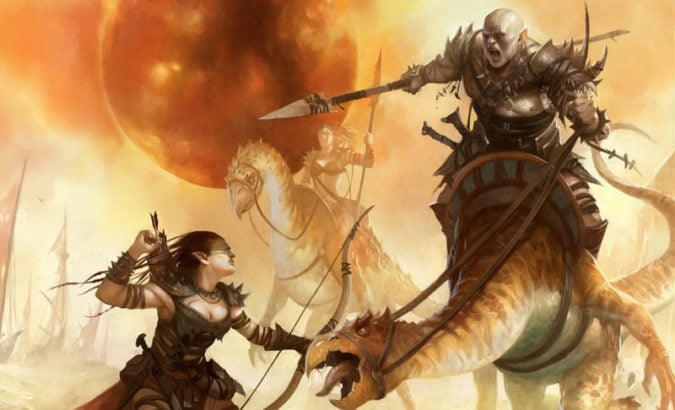
The history of Athas was not always as brutal as it is now. In fact, through the world’s five different major ages, there have been times of peace, prosperity, and even plenty. It all began back when the world of Athas still had oceans, in the Blue Age.
In this time, the halflings ruled the world with their potent magic. They not only were able to heal and cause things to grow, but they also wielded power to shape the building blocks of life, called Life-Shaping. Halfling “nature-masters” began to experiment on various life forms. Some experiments got out of hand, and the world’s water was changed to a deadly poison known as the Brown Tide. This was eventually reversed, but not until life on the planet was decimated. In order to reverse what they had done, the halflings turned the sun from blue to yellow.
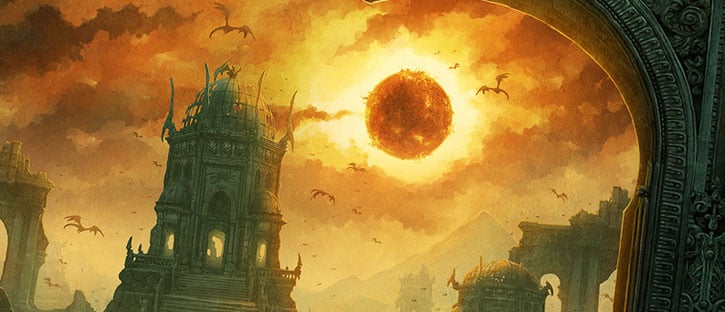
Thus begins the Green Age, when the halflings retreated from the world. But in the wake of their magic, new fertile lands were revealed. Athas went through a time of rebirth. The world became populous once again, with new animals and monsters (twisted by the lingering power of the nature-masters) as well as whole new peoples, including elves and dwarves and humans.
In this green time of plenty, people were said to have revered gods and the elements alike. It wasn’t until the end of the Green Age that primordial elementals would work to drive the gods (or at least the worship thereof) from Athas. But more importantly during this time, people discover they have psionic power as well as magic. And with this discovery came the first pyreens; powerful psionics capable of creating great wonders.
Wars Of The Sorcerer-Kings
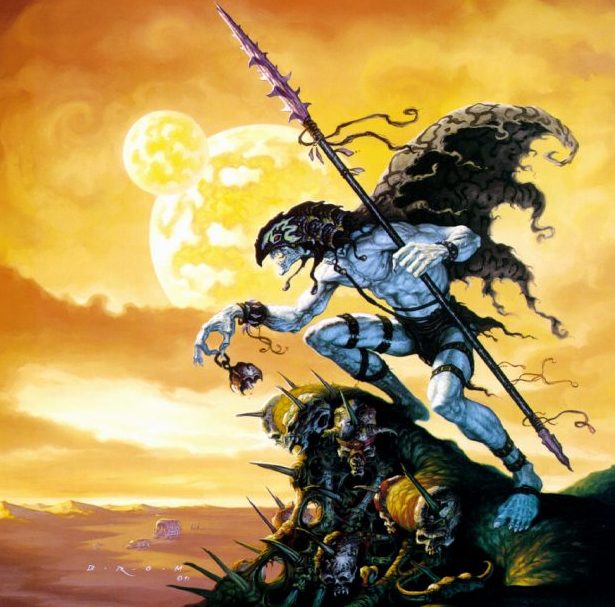
Among these Pyreen is Rajaat, a hideous but intelligent psion who discovered arcane magic. Rajaat then taught this power to many, ushering in the time of magic. But in his heart, hatred took root. And that corrupting hatred expressed itself through a magical process known as ‘Defiling’. It drained life from the world to fuel arcane power.
This power, Rajaat kept to himself and a few chosen followers. The First Sorcerer (as Rajaat is known) then began a great ritual of sacrifice and defiling that both transformed his most loyal followers into nigh-immortal beings of immense power and also drained life from the sun, turning it a deep crimson shade.
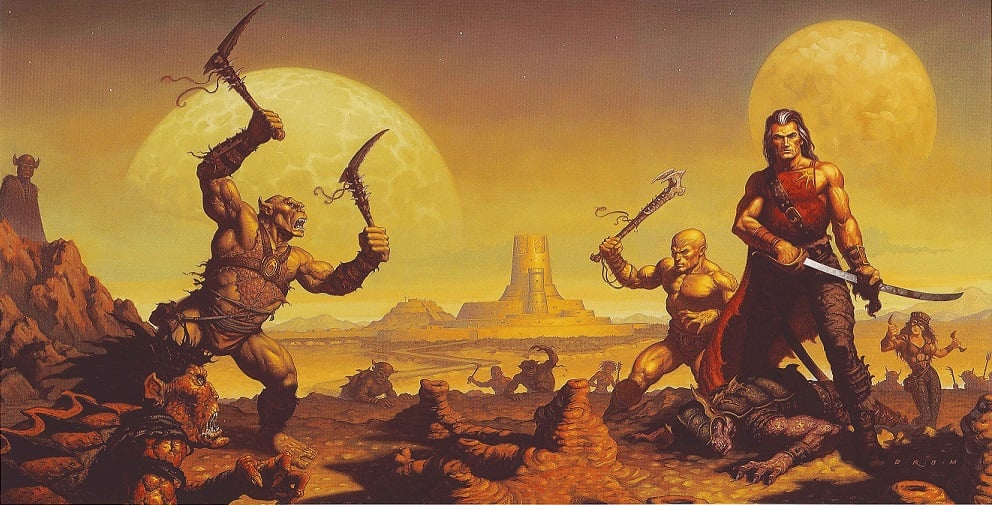
Thus began the Red Age. Fittingly, it began with blood, as wars known as the Cleansing Wars raged across the face of Athas for hundreds upon hundreds of years. But as this campaign of carnage was carried out, Rajaat’s Champions began to suspect their master might be wanting to kill all life on Athas. Naturally, they betrayed him and imprisoned Rajaat by separating his essence from his body and casting it into a void known as the Hollow, a place where nothing exists, not time, not light, not life.
Then begins the Brown Age, which is also known as the age of Sorcerer-Kings. During this time, Rajaat’s former Champions became known as Sorcerer-Kings. With tyrannical ambitions, they carved up the world and seized what power they could. They built or conquered territories whose shapes remain in place to the current day.

Now, Athas has reached the Age of Heroes. The world, at a boiling point, is pushed over the edge with the assassination of one of Rajaat’s Sorcerer-Kings, Kalak of Tyr, during a slave rebellion. In the chaos that follows are wars, strife, and revolutions in a post-apocalyptic world. The time is ripe for heroes to arise under the crimson light of the Dark Sun.
Of course, you’ll have to wait until 2027 to do that.
Don’t Miss:


Source: Bell of Lost Souls
