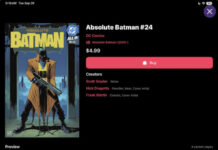

Right around New York Comic Con 2011, as DC was about to launch its “New 52” initiative amid a chorus of hype, ComiXology (then an independent company) rocked the industry by announcing that titles would be availably digitally on the same day and date as physical copies, exclusively on their platform. Publishers, retailers and fans held their breath. Was this the beginning of the end?
Turns out, not so much. In places like Japan, digital turned into a very big deal indeed, growing to something like 80% of the market in an extremely well-developed and mature region for comics readership. But in North America, 15 years later, despite all kinds of disruptions, new players, big money investment and innovations, it’s still its own thing, with opaque metrics, narrow margins and lots of promise if anyone can figure out the magic formula.

This week at the ICv2 Insider Talks on Thursday at NYCC (see “ICv2 Insider Talks“), I’ll be hosting Henrik Rydberg, CEO of GlobalComix, for a session looking at new data from their platform that might help shine some light on the relationship between digital distribution, IP popularity, trends in fandom, and retail sales of physical comics, books and merchandise. Here are a few things I’ll be looking for.
What role does digital play in the content ecosystem today? The big advantage to digital is the ability to precisely track sales and reading habits. This not only gives some clarity into who is buying what, but it can also reveal subtle relationships between content and reader interest.
WEBTOON has long touted this as a key advantage of their platform in developing new creators and new IP. When creators or publishers have insight into exactly who is liking particular developments in the storyline, where readers slow down or give up on stories, and which characters are triggering higher levels of interest, that can help them rapidly develop their stories in promising directions or give up on dead ends before they can sink a series.
And again, as WEBTOON is demonstrating through its pivot from distribution platform to co-creator of owned IP, those are not just issues for digital, or for publications. Anyone trying to build up the value of their content or licenses, or trying to decide which characters to spin off into toys or merchandise, might want these kinds of insights.
So is this information making its way through the industry? Is there a way that digital could serve not just as a sales channel but as a strategic indicator? I suspect Henrik has some thoughts on this.
What does digital tell us about fan trends and customer behavior? In the world of marketing, one thing brands are keenly interested in is when customers are starting to move from being browsers who may want to be left to themselves, to being buyers receptive to deals and offers. This is known as showing “intent,” and recognizing it at the right moment can be the difference between making a sale and driving someone away by being a little too aggressive and promotional.
If you are a seasoned retailer, you can probably spot this in your store from body language or other clues. But at scale, it is notoriously difficult to measure.
Digital platforms like GlobalComix, Neon Ichiban and WEBTOON have a variety of ways to measure intent in different dimensions. When does the occasional single-issue buyer become a digital subscriber? When does someone on a monthly subscription or free tier decide to spend extra for the latest issue or an early look at content? When does a fan decide to become a collector by investing in a premium feature, like one of Neon Ichiban’s digital remarques?
This information isn’t just useful to the platform. A studio with a tentpole movie coming out might be very interested in customer behavior around their licensed or adapted comics property as their marketing campaign is rolling out, because clues like this can be early indicators of box office momentum.
How does this work? What role does machine learning (the politically-correct version of AI) have to play in spotting these patterns? What are some of the key insights we can learn? Only one way to find out: ask someone who is doing it.
Why did digital take off in some markets and not in others? For markets like South Korea, the answer is simple: Northeast Asia was ahead of the rest of the world in identifying the mobile phone as an entertainment device, not just a communication device. So they developed a visual language of comics optimized for display on small screens, served up in snackable sized story bits. The content didn’t come from any other medium, so there wasn’t anything to lose in translation.
But here in North America, we’ve had a decade and a half to adapt, and digital remains pegged at a small fraction of print sales, regardless of the amount of investment, innovation, content and marketing pumped into it.
If you see print vs. digital as a zero-sum game, where any growth on one side comes at the expense of the other, then that’s probably just fine if you’re a retailer and livable if you’re a publisher. But we’ve known for a while that that is not how the market works with respect to comics. Fans who encounter material digitally eventually make their way into stores, conventions or online storefronts to buy physical merchandise. An upsurge in digital customers means some percentage of those readers will become long term fans with high lifetime customer value.
So what does new information tell us about the ability of digital to grow the entire market, or to grow print and merchandise to support digital sales for customers who prefer that format? I will be very interested to hear what Henrik has to say about that.
See you all at NYCC! The “Data Behind Digital” is just one of the sessions at this year’s ICv2 Conference at NYCC (see “ICv2 Insider Talks“), and a great chance to meet and network. Hope to see you there, on the show floor, at my AI panel (“AI And the Creative Industries: Revolt of the Humans!” on Saturday afternoon at 2:45 p.m.), or at the Marvel Age Panel Thursday at 11 a.m., where I’ll have a big announcement.
Safe travels everyone!
The opinions expressed in this column are solely those of the writer, and do not necessarily reflect the views of the editorial staff of ICv2.com.
Rob Salkowitz (Bluesky @robsalk) is the author of Comic-Con and the Business of Pop Culture, a two-time Eisner Award nominee, and a proud longtime contributor to Eisner-nominated ICv2.
Source: ICV2