D&D World of Warcraft is a momentous crossover between two of gaming’s biggest fantasy IPs. Wizards of the Coast isn’t taking the task lightly, but it’s also not planning to sacrifice an inch of D&D’s authenticity. This was confirmed at a recent press event, where senior designer Joey Haeck told attendees “we don’t want you to feel like you’re playing a videogame”.
This is most evident in the sourcebook’s dungeons. Two weeks ago, Wizards of the Coast revealed seven WoW dungeons that would feature: Deadmines and Shadowfang Keep (levels one to four); Blackfathom Deeps (levels five to 10); a Scarlet Monastery megadungeon (levels 5 to 15), Dire Maul (levels 11 to 15), Azjol-Nerub (levels 16 to 20), and Onyxia’s Lair (levels 16 to 20).
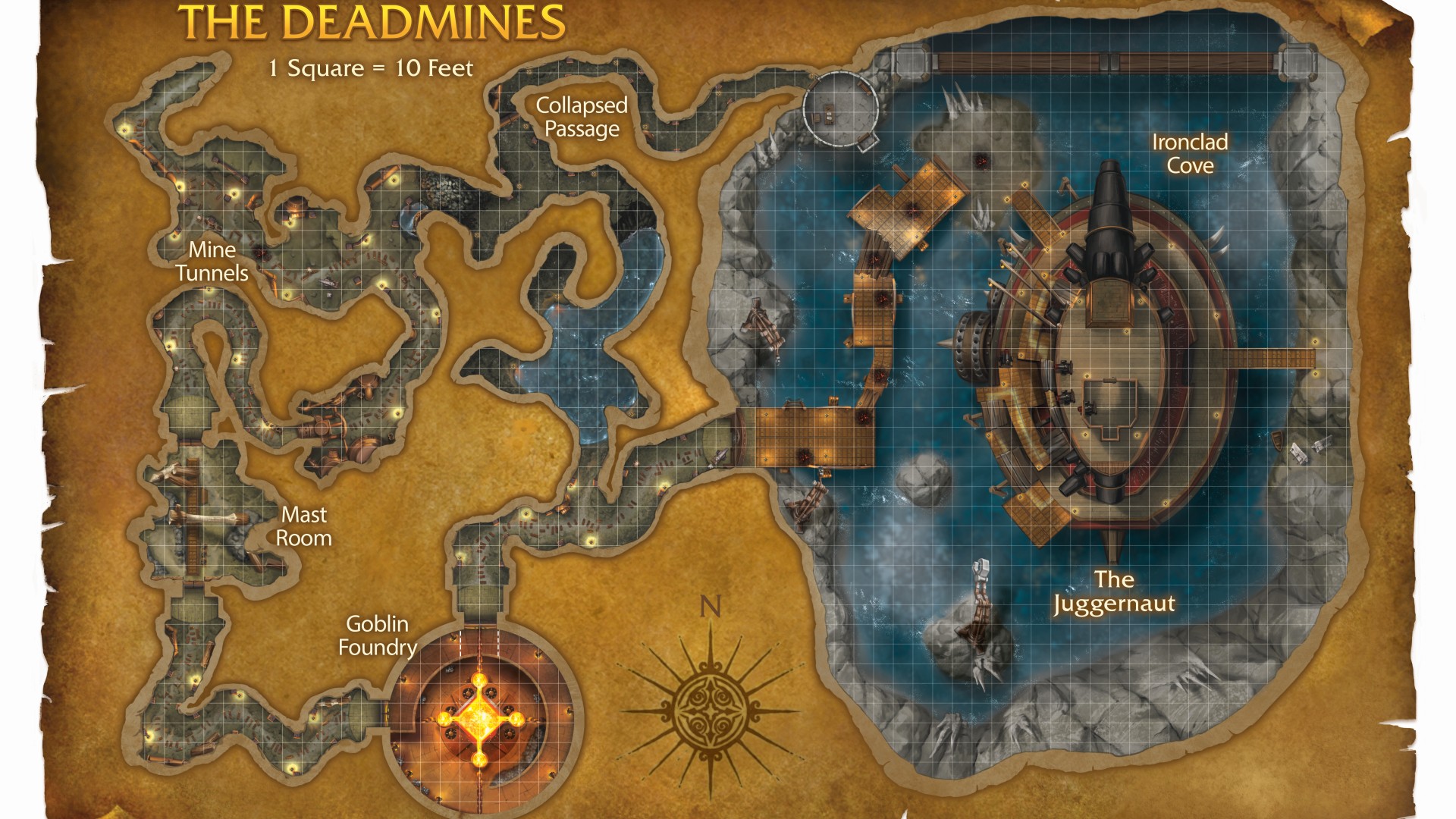
“We wanted to explore every nook and cranny and make a faithful translation”, Haeck says. However, the design team made some necessary deviations. Take the Deadmines, for example.

“The Deadmines is basically a straight line corridor, and in an MMO, that works really well”, Haeck tells us. “But D&D has a slightly different gameplay loop to it, where you don’t want to be just fighting things in a straight line – you want to be talking with NPCs, sneaking around alternate paths, and exploring what might be within the dungeon.”
“We’ve really focused on the qualities that make a dungeon sing in Dungeons and Dragons”, he continues. “The map of the Deadmines is basically identical to the game, but we added a couple of extra passages that were essentially lifted from the pre-dungeon elite zone beneath Moonbrook.”
“So, you’ve got undead coal miners working through their last acts of mortality.” “There are ways to sneak around some of the bosses or find alternate ways into the juggernaut area.” “We even have a sidebar, because we think this is going to be one of the very first dungeons that some people will ever play in D&D, and it serves as proof of concept for all these people.”

Similarly, Scarlet Monastery has “a couple of bonus passages and secret connections so it has the real feeling of a D&D megadungeon”. “Just like in the MMO, you’ll see some adventure hooks that guide you from one area to another”, Haeck explains. “Your goal for each dungeon is not ‘I want the Whitemane’s hat, so I’m going to beat everyone up, and that’s the end.’ Your character will want to be part of this world, and the way you interact with this world will have an impact on you.”
Blackfathom Deeps also focuses on more story-driven goals so it offers more than just “a combat slog”. “You’ll see a lot of its areas feature specific encounters, particularly boss encounters, but there are also tables of creature and non-creature events”, Haeck says.
“You can have characters take breaks, leave a dungeon, and come back”, he adds. “We want this world to feel real to you, so if you leave and return after you’ve killed a boss or two, they won’t have respawned by the time you return.” “Something else will have taken its place. Some chaos will spread that you could not have predicted.”

Even the full-on combat gauntlet Azjol-Nerub, “the most linear dungeon in the whole book”, uses adventure hooks to drive players forward. “Every single dungeon has these ways to tie the characters to the world.”
Principal game designer James Wyatt explains why “we’re not doing a word-for-word translation of any WoW game mechanics”. In short, “translating those two directly leads to a really unsatisfying experience”. “D&D players don’t grind. They don’t fight the same boss over and over, because that breaks your immersion.”
“The game you’re still sitting down to play is still D&D, in the setting of World of Warcraft”, he says. “It hopefully evokes the feeling of Wolf of Warcraft without making you do the kind of math calculations that an MMO is doing on your computer chip.”

To help evoke this feeling, Wizards is employing a few more design tricks. Two of these adapt common, existing D&D mechanics. D&D World of Warcraft will use Renown mechanics to track your relationship with major factions, from the Alliance and the Horde to smaller agents like the Steamwheedle Cartel. Many of the original game’s factions offer unique rewards if you increase your Renown with them.
Additionally, D&D is using its foraging crafting proficiencies to introduce WoW’s Professions to the game. These are split into gathering professions and production professions. Archaeology, Fishing, Herbalism, Mining, Skinning, Alchemy, Blacksmithing, Cooking, Enchanting, Engineering, Inscription, Jewelcrafting, Leatherworking, and Tailoring all feature. However, given how simple D&D’s crafting rules are, I can’t imagine they’ll hog much page space.
Loot also has a role to play, but it functions more like D&D loot than WoW loot. “It’s not a massive boss loot table like you’ll see in Warcraft”, Haeck says. “Unlike the MMO, you won’t be running these dungeons over and over again, trying to roll for the best piece – so we call out every boss’ most distinctive piece of loot.”

Lastly, D&D is bringing back “some design pioneered in Mythic Odysseys of Theros”. That’s Mythic creatures, which is D&D-speak for multi-stage boss fights. These creatures refresh their HP when they reach zero hit points, and they return with dramatically different abilities. “We have Mythic creatures as low as CR 4, and we have higher level Mythics that will refresh more than once”, Haeck tells us.
Dungeons and Dragons’ World of Warcraft supplement releases worldwide on November 17. If you want to learn more about the world’s biggest RPG, check out our guides to DnD classes and DnD races. Or, why not join our Wargamer Discord? We’re always happy to trade tips and table stories.
 Source: Wargamer