Two years after GW launched Warhammer: The Old World, it’s finally bringing out a two player Core Set. I’ve had my hands on a review sample for a week and a bit now, just enough time to start building the models, read through the books and pamphlets included, and get my thoughts in order about this now well-established game system. In this feature I examine the Core Set as an entry point to The Old World, and The Old World as a game in its own right.
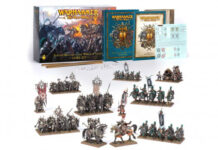
I’ll knock out the question of monetary value quickly – it’s a starter set, and so GW sells it at a bundle discount compared to buying the products separately. If you want to buy precisely the contents of this box – a revised core rulebook, starter armies for the Warriors of Chaos and Grand Cathay, some peripheral booklets and reference sheets, tokens, dice, and a fold out battle map on decent quality thin card – then this will be the cheapest way to get that. But is this a game worth playing, or a decent entry point to that game? Read on.

The models
Warhammer: The Old World has the most uneven model line of any made by Games Workshop. For most factions, the bulk of models are kits originally released for Warhammer Fantasy Battle at least a decade ago, plus a splattering of truly ancient models offered on an irregular made-to-order basis that really play into the nostalgia of long-term fans. The exception is the Chinese-coded Cathay, a brand new faction that debuted in 2025 specifically for The Old World.
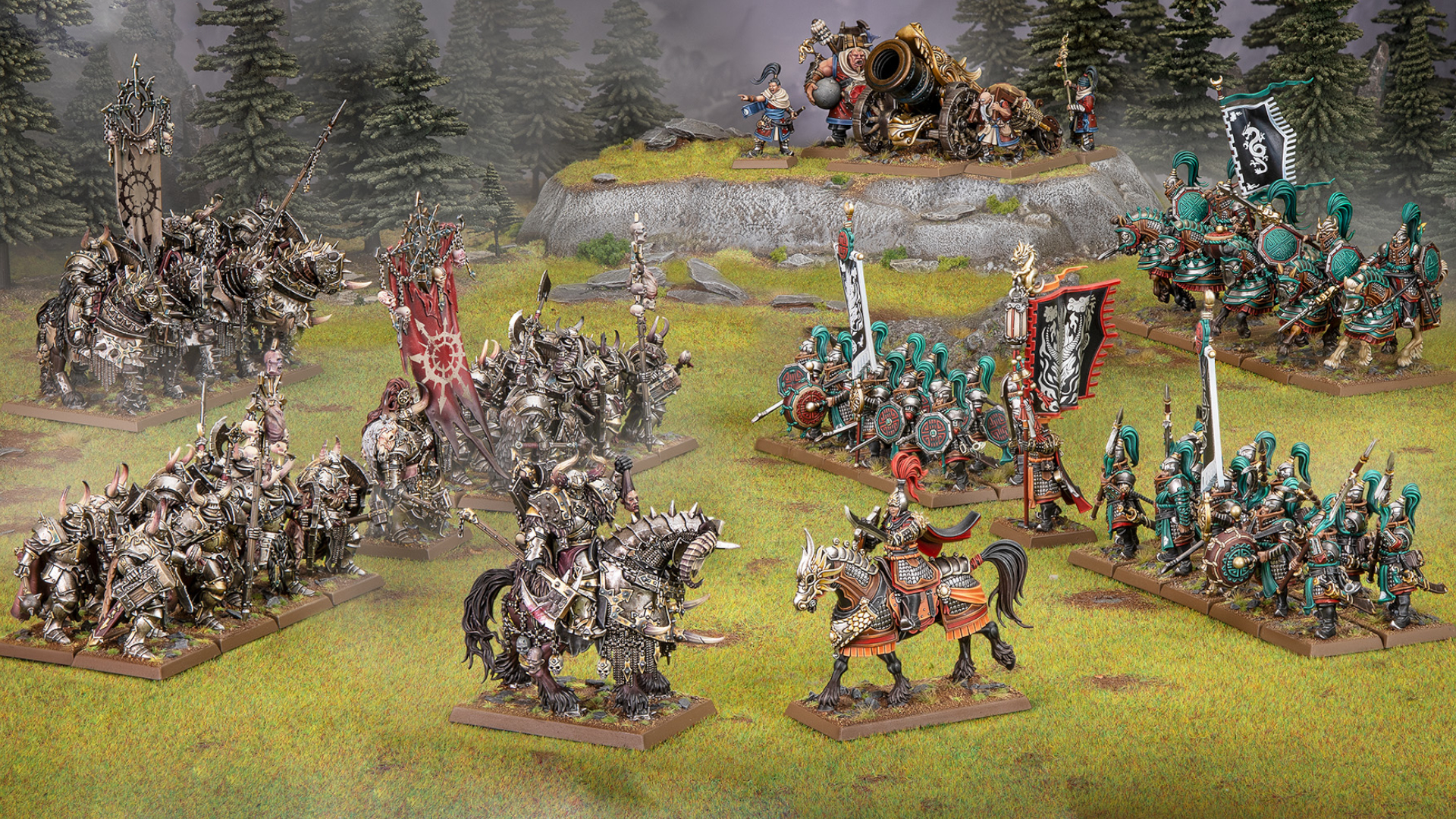
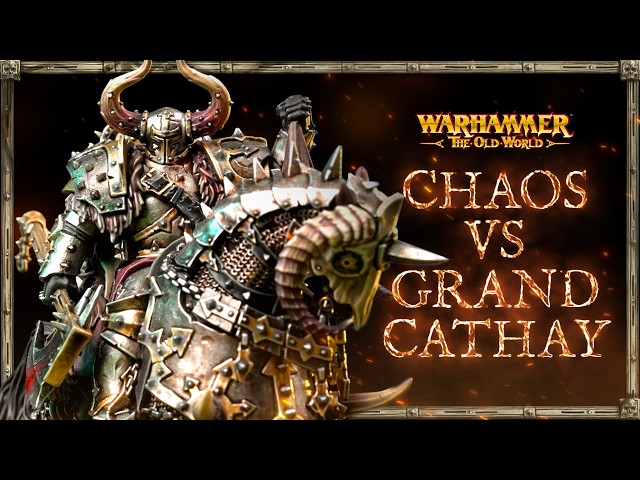
Half of the models in this box are those Cathay kits: a small force of Jade Sentinel infantry, Jade Lancer cavalry, a massive Grand Cannon or Rocket Battery, and a duo of Gatewarden characters, one on foot and one mounted. I’ve ignored them so far to jump into building the brand new Warriors of Chaos. This set contains sixteen Chaos Warrior infantry, four Chaos Knights on horseback, and another pair of characters, one on foot and the other on a huge daemonic steed.

Unlike the recent Chaos Marauders and their somewhat nightmarish two-handed weapons, these kits go together easily. The infantry torsos and legs are split into (around) three parts per model, and there’s a separate cloak, separate shoulder pads, shield arm, weapon arm, shield, and head. They’re monopose figures, but between the plethora of shoulder pads, helmets, and weapons, no two models in a unit should look identical.
I’ve noticed some issues with the spikes on the models – some of them are a bit blunted, in ways that suggest a casting error. It’s not so bad that I’d bother contacting GW for a replacement, but some people may be irked – hopefully it’s not something particularly common with these kits. Something that’s not an error but may be an issue is that a lot of these spikes have such fine tips that they’re prone to damage. It’s a self-correcting issue, as they’ll just end up blunted to the point they can’t be blunted any further, but be mindful of the risk if you’re painting the models for display or competitions.

Is Warhammer: The Old World a good game?
I love Warhammer: The Old World, but it’s a design mutant, an inelegant hybrid of many very clever ideas that add up to more than the sum of their parts but which also have jutting edges destined to trip you up. I can at least try and describe it for the newcomer: it’s a gritty rank and flank fantasy wargame, a game of positioning unwieldy units in preparation for combat that is either decided quickly or devolves into a grindfest; and it’s a whacky, high-randomness game of interdimensional rock-paper-scissors.
Let’s unpack that. One part of The Old World is a decent simulation of medieval combat – so decent that Games Workshop used to make a range of rules for historical wargames based on the system. Units are (usually) formed up into big rectangular blocks, and getting these unwieldy lumps into the best position within the evolving battlefield is a big part of the challenge. While you will kill models both with ranged weapons and in melee, it’s unusual to slaughter a unit to a man – more often you’ll break a unit’s fighting spirit, causing it to fall back. This happens most decisively in combat, with fast pursuers sometimes able to run down their fleeing foe before they can regroup.
It’s a game with a lot of high impact dice rolls. The artillery dice that determines how far a cannonball bounces; the charge roll for a cavalry unit; the small number of attacks a character makes in a challenge; the break test for a unit after it loses a combat; leadership tests to resist panic spreading to neighbouring units – this is a game where battles can swing on one or two unlikely dice results.
It’s also a very crunchy game. Between basic stats and a plethora of unit types and special abilities, models and armies can be strong or weak in many different dimensions. A unit could be fast yet not maneuverable, tough but ill armored, accurate but pillow-fisted, easy to kill but near impossible to break, and so on. Even without anything fantastical this would be a game where units and whole armies can get into very one-sided match-ups – fantasy elements take it even further.

A character riding a dragon makes for a good example. Big monsters are already hard for basic infantry to wound – their main weaknesses are being tarpitted by disposable or unbreakable troops and then chopped up by another unit with the right tools for the job, or being shot to death with massed cannon fire. But dragons can fly, letting them dodge unfavorable fights. Their lordly riders can gain Ward saves and Regeneration saves from magic items, greatly reducing the chance that they’ll ever take damage from a source other than a character specced to hunt dragons. They also hit like a melee character stapled to the back of a dragon. It doesn’t matter that they cost a quarter of your army’s points budget when they are, functionally, a nuke on a yoyo string.
That’s just one example. This is a system that’s notionally about medieval-style fighting formations which also accommodates Cathayan snipers riding hot air balloons, Wood Elves who fight like the Vietcong, and the sheer RNG of uncontrollable Goblin Fanatics. It’s a demented and also heroic attempt to logically answer an illogical question – assuming we model medieval warfare like this, what happens if we add in a bunch of fantasy nonsense like that?
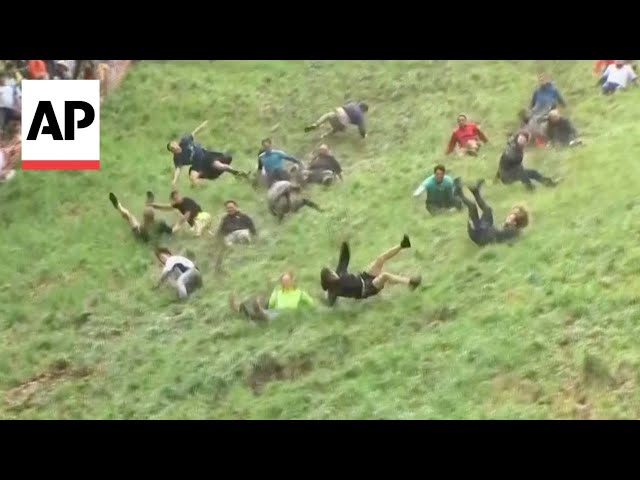
The result is mechanically quite complex, and demands that players have matching expectations of how they’re going to engage with the game – but it can be riotously good fun. Casual games (after a bit of wrangling over what is and isn’t fair play) will generate classic pitched fantasy battles, if prone to hilarious turns of misfortune. And some players make it work as a competitive game, in the same way that the town of Brockenhill in Gloucestershire has turned chasing a wheel of cheese down a nearly vertical hill into a sport.
Compared to the launch version of The Old World, the version in the core set – which incorporates some major post-launch errata – is somewhat more sane. The power of wizards and the often decisive impact of movement-blocking ‘vortex’ spells have been dialled back, poisoned weapons have been nerfed, and infantry blocks are more survivable and more likely to win combat.
The precise tuning isn’t to everyone’s tastes – buffing infantry has made it harder for cavalry to break their opponents decisively on the charge, for example, and that was their whole deal. But the fact that this game even functions is a wonder; that it comes remotely close to being balanced is a miracle.

Is the Core Set good for beginners?
Though I imagine the choice of models in this set was calibrated mostly around achieving a specific price point and ensuring every model was an Old World kit and not a re-issue from Warhammer Fantasy Battle, the result is a set with two perfectly playable little armies. Each force makes up a 600 point army for the Battle March play mode, and comes supported by a handy playbook with the full rules for both forces.
I haven’t tested them against one another – they seem roughly balanced. The Cathayans have the only ranged weapon in the set, an utterly lethal cannon which will reliably delete Chaos models, but – thanks to the low model count of the Chaos units – it doesn’t have any truly excellent targets. The Battle March army list recommends the Cathayans build their forces with just one block of infantry and one unit of cavalry, so their options for clever maneuvers will be quite limited – but that’s the way of things in Battle March.
Battle March is a very good way to play. With a very low points cap and added restrictions that curb the more fantastical elements of the game, new players only have to concentrate on a small subset of rules, all focused on the core of maneuvering with ranked units to try and ensure engagements fall in their favor. While the low unit count piles more pressure onto fewer dice rolls, the focus on each faction’s core units rather than their oddball specialists reduces the risk of deeply unfavorable match-ups.
To actually learn the rules from this box set you’ll have to slam head first into the tome of a rulebook. Revised to incorporate major errata that came out not long after the game launched, its a 352 page grimoire of which over 250 pages are actual rules text. You won’t need all of them to play with the models in the box – you can ignore the rules for spellcasting entirely, for instance – but there’s no digest to talk you through the essentials.
The inclusion of dice, templates – damaged in transit in the sample I got – and a decent quality fold-out battle map suggest that GW is targeting brand new players with this set. The complexity of the models, lack of hand-holding guidebook, and overall complexity of the game suggests that it expects those players to be whole adults, preferably already experienced with strategy gaming.
Final Thoughts
If you’ve been intrigued by The Old World but waiting for a good point to jump on board – perhaps because you wanted evidence that GW was fully committed to updating the old model ranges – then this is a good moment. The Core Set is a decent place to do it, too, a credible starting point for two armies that you can easily split with a friend and then bulk up with the soon-to-be-released Battle March box sets for each faction.
If you haven’t been intrigued by The Old World, then I’m not sure why you’ve read to the end of this article – thanks for reading, anyway! If it wasn’t clear from what I’ve said, I think the game is an acquired taste – like prog rock or particularly rancid cheese – I’ve developed that taste, but I won’t judge anyone who hasn’t. For those on the fence, the deciding factor should really be who you’ve got to play with and how your expectations of gaming align. Random bullshit is just an inevitability when playing The Old World, and you’ve got to laugh – if you can find a group with a similar sense of humor to you, you’ll have a great time.
If you’ve got thoughts on the new starter set – excitement, disappointment, ideas for how long it’ll stay current before we get a full second edition – come and share them in the Wargamer Discord community!
 Source: Wargamer