


What’s the point of magic items in Dungeons and Dragons? The Dungeon Masters Guide assumes that as players accrue levels they will also pick up a certain number of DnD magic items, suggesting that they’re supposed to be part of the power progression of a character – and having or not having a specific item can make or break certain builds. But D&D is stuffed with wondrous items with abilities that don’t easily map into flat power buffs, instead giving the players new tools for self-expression that become more rewarding the less the campaign focuses on combat. Like many things in D&D, it’s an attempt to please all kinds of player – but it could please specific kinds of players a lot more if it went either way, with items that are either better balanced for combat, or that don’t even try.
The earliest DnD editions hadn’t heard of the concept of ‘balance’ – the goal wasn’t to kill monsters for XP, it was to make it out of the dungeon alive carrying a lot of loot. Hostile monsters were just one of many kinds of obstacle, and it wasn’t assumed that the players event wanted to get into a fight. Levelling up was slow, combat was extremely lethal especially, and there was a whole expected metagame of acquiring hirelings, building up a political power base, and eventually fielding small armies of followers – options were found via lateral thinking, not on your character sheet.

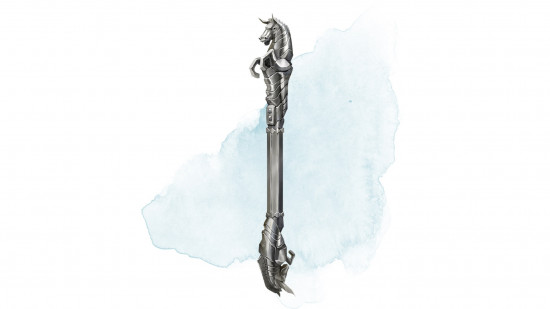
In this context, magic items were one of the most rapid ways to improve a character’s capabilities, but should be understood primarily as tools for problem solving and player expression. The classic ‘Immovable Rod’ makes huge amounts of sense in this system, an item with hardly any in-game rules ascribed to it, but incredible scope to be used in creative ways. But this framework can even transform how we see even the maligned +1 longsword.
Nowadays a +1 longsword is an incredibly boring magic item, but that’s all a matter of context. In editions of D&D without magical cantrips the ability to make magical weapon attacks is transformational – without it, an encounter with a ghost is a harrowing challenge that eats up the Cleric and Wizard’s very limited power and which the Fighter can’t assist in at all. That turns the +1 longsword from a tiny accuracy buff into a Metroidvania-style key gating access to many areas – and with so much influence over the party’s ability to progress, it’s easy for the DM to imbue it with narrative significance as well.
Its always been true is that, as players advance in power they will accrue magical items; it’s therefore reasonable to assume that the power of a character at a certain level is based not just on their level but also on a certain budget of magic items. A designer hoping to make balanced combat the core of the experience might reasonably aim to include this magic item budget in their calculations.
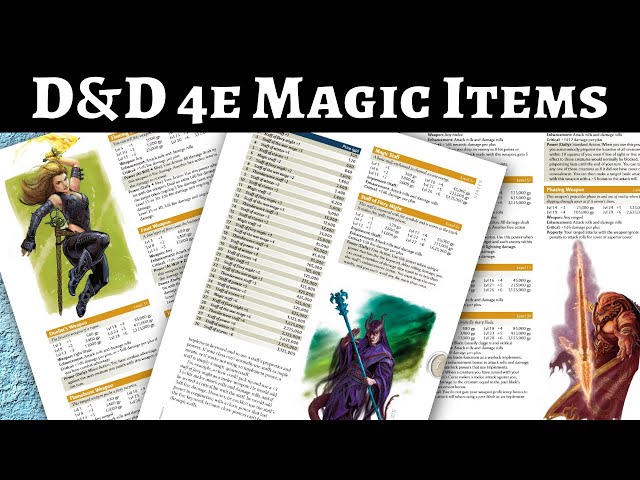
This saw its most effective expression in D&D 4e, which published a colossal library of combat-capable magic items, each with variants at different levels. YouTuber OldeGreyBeard goes in depth on how that system works in the video below:
The downside to this approach is that it’s very gamey and not very magical. If players are expected to incorporate magic items into their build, they need to have discussions with the DM about what they want to find in treasure chests, or magic items must be so prolific that players can easily buy or trade for what they want.
Still, if players want a game focused on challenging combat that rewards their skill in character crafting and tactical decision making, they may well like the trade-off, and the assurance that their weapon specialist Fighter will progress at the same rate as the Warlock. The emergence of games inspired by D&D 4e like Lancer and Gubat Banwa suggests there’s plenty of appreciation for this style of gameplay.
At the opposite end of the spectrum we have something like the Arcana system in the bronze age fantasy TTRPG Stonetop. Each Arcanum is unique, with distinctive powers that change how the players interact with the world in unusual ways. Minor Arcana require quests to fully unlock their powers, directing the action within the game’s open-ended campaign. Major Arcana offer incredible power but will gradually and irrevocably transform the character who wields them and the world around them – they can create whole arcs of the story.

D&D 5.5e exists in a middle ground; Artifacts like the Rod of Seven Parts or the Hand and Eye of Vecna are similar to those Major Arcana, and the Immovable Rod is right there along with the enchanted longswords and wands of magic missile; so too is the expectation that a character’s Armor Class and to-hit modifier at any given level will incorporate a certain number of magic item buffs. DMs can tailor the game towards either extreme, but it’s not a design that commits either way. If you find yourself at odds with that experience, you would do well to look at other games and even different editions of D&D.
If there’s another system, edition of D&D, or adventure with a great take on magic items that we haven’t mentioned, let us know in the Wargamer Discord community. If you happen to be looking for new magic items for your campaign, we occasionally come up with them here at Wargamer – here’s some for Ravenloft, and two sets of joke items to mess with players. We also have an article full of great advice on how to make loot way more exciting for your campaign.
 Source: Wargamer

