When I want to sling a spell, dodge a blow, or fell a foe, it’s the six Dungeons and Dragons stats that decide my fate. They’re the only thing standing between me and low rolls on the D20, so, it’s pretty key to understand how DnD stats work.
Need a reminder? Alright, let’s start simple. The six DnD stats are Strength, Dexterity, Constitution, Intelligence, Wisdom, and Charisma. You decide the starting value of these ‘ability scores’ during character creation, but they can be modified by certain character options (DnD races in 5e, for example, or DnD backgrounds in 5.5e).
Your ability scores are split into physical and mental stats. This classic Tumblr post gives an excellent description of what each of the stats allows a character to do, in terms of a tomato:
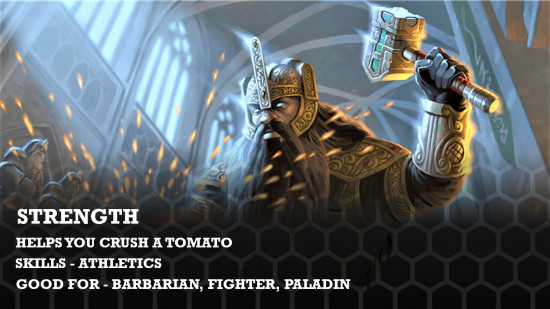
- Strength – helps you crush a tomato.
- Dexterity – helps you catch a thrown tomato.
- Constitution – helps you eat a bad tomato and not be sick.
- Intelligence – helps you understand why a tomato is a fruit.
- Wisdom – helps you recognize that a tomato shouldn’t be in a fruit salad.
- Charisma – helps you to sell a fruit salad made of tomatoes by marketing it as salsa.
The higher your ability score, the better you are at getting things done. Higher ability scores have higher ability score modifiers, and it’s the modifiers you get to add to rolls of your D20.
| Ability Score | Ability Modifier |
| 1 | – 5 |
| 2-3 | – 4 |
| 4-5 | – 3 |
| 6-7 | – 2 |
| 8-9 | – 1 |
| 10-11 | +0 |
| 12-13 | +1 |
| 14-15 | +2 |
| 16-17 | +3 |
| 18-19 | +4 |
| 20-21 | +5 |
| 22-23 | +6 |
| 24-25 | +7 |
| 26-27 | +8 |
| 28-29 | +9 |
| 30 | +10 |
Some stats also modify other parts of your character which aren’t used for rolls. For example, your Strength modifier decides your character’s carrying capacity, while Constitution affects your hit point maximum.
Need help picturing these stats in practice? I’ve got a few examples to help you paint a mental picture:

Strength
Here’s how much you could comfortably carry, depending on your Strength stat:
- 1 – A pet cat
- 2 – A box of paper reams
- 3 – A bag of dog food
- 4 – A husky
- 5 – A packed suitcase
- 6 – A truck wheel
- 7 – A punching bag
- 8 – A North Pacific Giant Octopus with a bag of hard candy in each tentacle
- 9 – An Irish wolfhound
- 10 – Three bags of cement
- 11 – A beer keg, plus some glasses
- 12 – A Russian gray wolf
- 13 – An adult male red kangaroo
- 14 – A large wardrobe
- 15 – Two toilets
- 16 – A bedroom dresser
- 17 – A tapir
- 18+ – A gray seal

Dexterity
Here’s what different Dexterity scores mean for a character:
- 1 – Barely mobile
- 2-3 – Badly uncoordinated, with little or no hand-eye coordination
- 4-5 – Often trips or stumbles, struggles with tasks that require manual precision
- 6-7 – Graceless, artless
- 8-9 – Sometimes clumsy
- 10-11 – Totally average
- 12-13 – Well poised and balanced, careful and crafty with their hands
- 14-15 – Moves elegantly, manipulates things carefully and precisely
- 16-17 – Capable of extremely subtle and precise manual tasks
- 18+ – The body of a ballerina and the hands of a locksmith

Constitution
Here’s what different Constitution scores mean for a character:
- 1 – Just about breathing
- 2-3 – Frail, brittle, permanently exhausted
- 4-5 – Usually sickly, little resilience
- 6-7 – Out of shape, prone to illness
- 8-9 – A little out of shape, a little more prone to getting sick
- 10-11 – Totally average
- 12-13 – Sturdy, in good health, pretty fit
- 14-15 – Tough, in great health, very fit
- 16-17 – Physically robust, almost never ill
- 18+ – A perfect physique, tireless, unyielding

Intelligence
Here’s what different Intelligence scores mean for a character:
- 1 – An instinctual animal
- 2-3 – A conscious animal
- 4-5 – Minimum level for sentience – struggles to reason logically at all or to retain information
- 6-7 – Dim, may struggle to connect ideas, often comes to the wrong conclusions from information
- 8-9 – Makes more errors than usual when reasoning, sometimes struggles to retain knowledge
- 10-11 – Totally average
- 12-13 – Can reason quickly, make novel connections among ideas
- 14-15 – Can reason rapidly and accurately, retain and process complex information
- 16-17 – Can understand, retain, recall, and reason with very complex information rapidly
- 18 – Profound genius

Wisdom
Here’s what different Wisdom scores mean for a character:
- 1 – Extreme perceptual difficulties, a profound disconnect from reality, or both
- 2-3 – Struggles to perceive their surroundings and situation correctly, either due to sensory impairment or a lack of mental focus
- 4-5 – Usually distracted and easily misled – frequently misapprehends the situation
- 6-7 – Prone to zoning out, taking things at face value, or overlooking obvious clues
- 8-9 – Prone to errors or oversights in judgment and perception
- 10-11 – Totally average
- 12-13 – A good eye for detail, quick wit, or clear head
- 14-15 – Very good senses, great situational awareness, canny in social situations
- 16-17 – Keenly aware of the environment and changes within it – seldom misses a clue, insinuation, or lie
- 18+ – Perfect awareness of surroundings, context, and implications – extremely hard to get anything past them

Charisma
Here’s what different Charisma scores mean for a character:
- 1 – Profoundly hateful, repellent, or boring
- 2-3 – Deeply disagreeable, whether through incompetence, malice, or blandness
- 4-5 – Unlikable, tedious, or simply socially oblivious
- 6-7 – Prone to making gaffes, over-estimating their abilities, or boring others
- 8-9 – Somewhat socially inept or dull
- 10-11 – Totally average
- 12-13 – Good presence and social skills
- 14 -15 – Assured social skills, a smooth operator
- 16-17 – An accomplished orator, performer, diplomat, or liar
- 18 – Even their worst enemies can’t help but respond to them – their personality lights up a room

How to pick stats
It can be easy for new players to assume that increasing all your DnD stats equally is the best tactic. Surely a jack-of-all-trades approach is best, right? That way you’ll have no weaknesses.
Unfortunately, you don’t have enough Ability Score increases to sustain this attitude. Stat boosts are far and few between, so trying to maintain all six means that, overall, you’ll be worse off than someone who chose to specialize.
Most experienced character builders opt to increase their most important stats first and as fast as possible. Other stats are either increased later on or not at all (this is when they become known as a ‘dump’ stat).
When deciding how to pick stats for your character, start by prioritizing your ‘primary ability score’. The Player’s Handbook lists a key ability score for each class. This is usually your spellcasting ability or, if you can’t use magic, your main method of attack.
Most classes only rely on a single stat to function. We call this SAD (Single Ability Score Dependent). For example, a Wizard only really needs a high Intelligence to be good at casting spells.
For SAD characters, your second stat to focus on is usually Constitution. This boosts your maximum hit points and your ability to concentrate on spells, so it’s key to the survival of pretty much any character.
For some classes, there is an argument for making Dexterity your second-most important stat. This increases your armor class, so it’s handy for defense. It’s also tied to a lot more useful skills than Constitution.
Not every class is SAD, though. At the other end of the scale are MAD (Multiple Ability Score Dependent) characters. These classes must focus on two or more stats in order to excel. For example, a Paladin uses Charisma for spellcasting, but they also need a high Strength score for smites. Similarly, a Monk fuels their Focus with Wisdom, but they’ll need Dexterity for attacking and defending in melee.
In this case, some players aim to increase these stats at an equal pace. Others prefer to lean more heavily on one than the other. A Paladin that doesn’t do too much spellcasting with Charisma is still perfectly playable as long as you build around their Strength score.
MAD characters still benefit from high Constitution or Dexterity scores, but these become tougher to prioritize when you want to juggle more than one primary Ability Score.

How to calculate DnD stats
The three methods of calculating your base DnD stats are:
- Rolling
- Standard array
- Points buy (27 rule)
How do you roll for DnD stats?
To roll for a character’s stats, roll 4D6, remove the lowest die result, and note the total. Do this six times to generate six numbers between three and 18, then assign each of these numbers to one of your stats. Voila! You have your base stats, ready to add any bonuses from your character’s race.
Randomly rolled stats can have more extreme results than other methods, but it’s the only way to get a base stat above 15 (before you add bonuses). It’s generally favored by players that enjoy exploring characters’ big weaknesses – because you could well end up with some stats so low you’ll take a minus two or minus three to your roll every time you use them!
What is standard array?
Standard array is a fixed set of base stats: 15, 14, 13, 12, 10, 8. You will use each number in the array for one stat. It’s equivalent to making average dice rolls, or building a balanced character with points buy.
The main advantages of using the standard array system are speed and reliability. There’s no random chance involved – you can simply plop the bigger scores onto the most important stats for your chosen class, giving your a character a basic statline that’s optimized for the type of role you’re intending to play in the party, but also balanced across other stats. Most importantly, you’ll only have one true ‘dump’ stat below ten.
On the downside, of course, you won’t have any truly excellent ability scores. Not only is it impossible to get any ability score higher than 15, but you’ll only have one stat at 15. By rolling for stats, you could end up with 18s for everything – so the question is: are you feeling lucky, punk?
How does the points buy system work?
The points buy system gives you 27 points to spend on your stats, with each stat value costing a fixed number of points. This is sometimes called the D&D ’27 rule’.
| Stat | Cost |
| 8 | 0 |
| 9 | 1 |
| 10 | 2 |
| 11 | 3 |
| 12 | 4 |
| 13 | 5 |
| 14 | 7 |
| 15 | 9 |
The points buy system is the most fiddly way to calculate stats, but it gives you the most control over your character’s core abilities.

How to increase DnD stats
The main way to get better DnD stats is to level up! At certain stages of play, you’ll get the chance to choose an Ability Score Increase. Alternatively, you can pick another general feat that gives you a less impressive stat boost (along with another cool ability).
Most classes get stat improvements at fourth, eighth, 12th, 16th, and 19th level, but the Fighter and Rogue both also receive stat improvements at sixth and 14th level. A multiclass character does not gain stat improvements based on its overall level, but on each class level separately – so a second-level Fighter / second-level Wizard would not receive a stat improvement.
The only other way to fiddle with your scores after character creation is magic items. These can even get your stats past 20 – something regular Ability Score Increases can’t offer!
The most impactful of these items are the infamous, single-use Tomes and Manuals, each of which permanently increases a given stat by 2. All are Very Rare, Wondrous Items that you should expect to find very occasionally. You’ll need to study the book for 48 hours over a period of six days to get the effect – after that it can be used again, but only after a century.
These items are:
- Manual of Gainful Exercise – increase STR by 2
- Manual of Quickness of Action – increase DEX by 2
- Manual of Bodily Health – increase CON by 2
- Tome of Clear Thought – increase INT by 2
- Tome of Understanding – increase WIS by 2
- Tome of Leadership and Influence – increase CHA by 2
Beyond that, there are a variety of magic items that grant you buffs to stats only while you have them equipped.
These are also all very rare, but the most commonly seen are:
- Ioun Stones – Small stones that float around your head, conferring +2 to a given stat, depending on the type of stone – to a maximum of 20. Others can give temporary bonuses to AC, Proficiency Bonus, and more.
- Belt of Dwarvenkind – Increases CON by 2 to a maximum of 20. Also gives you 60ft of Darkvision, resistance to poison and Advantage on saves against poisoned, makes you better at persuading Dwarves, and gives you a 50% chance of growing a beard every day.
- Gauntlets of Ogre power – Sets your STR to 19 exactly, but has no effect if you’re already at 19 or higher.
- Belt of Giant Strength – Sets your STR to a given total between 21 and 29, depending on the type of Giant.
- Amulet of Health – Sets your CON to 19 exactly, but has no effect if you’re already at 19 or higher.
- Headband of Intellect – Sets your INT to 19 exactly, but has no effect if you’re already at 19 or higher.
Got any more rules questions? Ask us any time in the Wargamer Discord.
This guide directly presents rules text for D&D Attributes, published by Wizards of the Coast under a Creative Commons Attribution 4.0 license.
 Source: Wargamer