


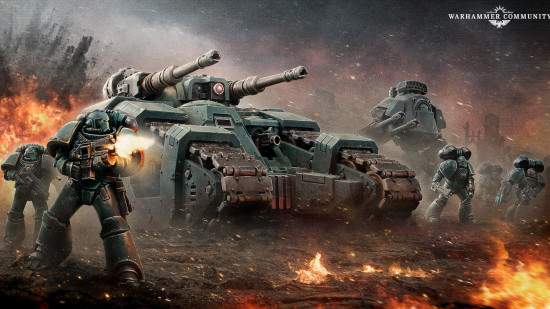
A new piece of Warhammer: the Horus Heresy product photography is causing suspicion in the online fandom, as fans point to a Space Marine with a mysterious sixth finger as evidence that Games Workshop is using generative AI in its marketing. Games Workshop published the image yesterday in the announcement post for a new model kit, and it sure looks like the Marine has an extra digit – but what does this actually mean?
We’ve reached out to Games Workshop to request clarification on how the errant pinky finger made its way into the image. At 5.30pm BST on Tuesday, GW published a statement to the Horus Heresy facebook group stating that the image was “not AI”, and was an error during photo editing. It adds “please, go easy on our artists. They are only (and completely) human”.
Games Workshop does have a history of minor photoshop errors in its marketing photographs, with fans quick to spot duplicate arms or squished-up torsos and share pictures of them online. This key art is a heavily edited photo montage, and the bonus finger might just be the result of an editor duplicating a layer rather than moving one.
It’s also possible that the bonus finger was the result of an AI-empowered editing tool. Photoshop contains lots of different tools that could all be called “AI”, but which run several different technologies. As examples, both Content Aware Fill and the Remove tool can be used to remove items from an image and smooth over the gap with a generated background; of the two, only the Remove tool runs on something similar to generative AI like ChatGPT or Claude.

I consider it borderline impossible that the entire image was generated using an LLM, mostly per Occam’s razor: I already know that GW can make images like this via photo montage in Photoshop, and I have yet to see generative AI reproduce models this accurately or with this clarity of composition. That’s without considering GW’s stated stance on AI, which is cool.
Writing in GW’s most recent half-year report, CEO Kevin Rountree stated that “we do not allow AI generated content or AI to be used in our design processes”. The company does not have a complete moratorium on generative AI, but that only a few senior managers were permitted to use it, and then only to evaluate if it had actual use cases: at the time, they were apparently quite unenthusiastic about the tech.
Generative AI remains a deeply unpopular technology in the tabletop fandom, one reason that fans are so jumpy whenever we get a hint of it. For a look at how board game developers are handling it, check out my colleague Mollie Russell’s interview with designers that are pushing back against AI.
 Source: Wargamer

