Our Verdict

Kingdom Come Deliverance: The Board Game is worth your time, whether you’ve played the videogames or not. It’s an interesting, efficient deck-building puzzle that, at the same time, gives you space to stop and smell the flowers (or enjoy its storylines). Learning to play this huge, token-laden behemoth is an uphill battle, and four-player games take 5+ hours to tackle. But, if you can forgive its few minor hiccups, you’re in for a fantastic time.
- Endless variety
- Beautiful components
- Wonderful blend of strategy and story
- Clever, efficient deck-building
- Authentic homage to the game
- A slog to learn
- Runs extremely long with more than two players
- One or two clunky mechanics
I can’t stop comparing Kingdom Come Deliverance: The Board Game to Gloomhaven (or, perhaps more fittingly, Mage Knight). It’s less about shared mechanics, though, and more about feeling.
Here is a sprawling, component-heavy board game that takes longer to set up than many take to play. Here is a game that marries euro-style strategy gameplay with adventure stories, with little compromise on either side. Here is a board game where sessions last for hours, and you might never run out of new things to discover. Here is a board game that’ll soar to the top of many players’ Game of the Year lists.
Kingdom Come Deliverance: The Board Game is a triumph, if only because it’s a videogame board game I actually want to play. It’s a rare treasure that celebrates its source material with authenticity, but never forgets that board games are a fundamentally different medium. Videogame board games often think the truest representation of their original IP is clunky, grindy gameplay. Kingdom Come, in contrast, is as smooth as freshly churned butter.
It might not seem that way on your first playthrough. The rulebook is 50+ pages, and designers Vlaada Chvátil (Galaxy Trucker, Mage Knight) and Tomáš Holek (SETI) have a lot of interlocking mechanics to explain. Here’s a little summary.
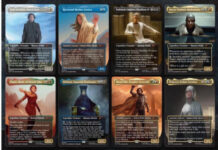
KCDTBG (as I’m calling it now, because that title is a mouthful) is a competitive adventure game that’s primarily powered by deck-building. You spend five days – each with four turns – exploring the kingdom of Bohemia, with the aim of having more victory points than your mates by the end.

There’s a small serving of point salad here, with many paths to a high score. Your main methods can be boiled down to three activities: upgrading your deck, completing quests, and acquiring pricey items.
We’ll dive into your deck first. Everyone starts with a basic deck of cards, and each card has three uses. You can discard a card to reap the rewards of its bottom text, which usually increases the movement track on your player board. You’ll need this to wander the fields and towns of Bohemia.
Moving is one of many minor actions you can perform on your turn, provided you can pay for it. Other ‘free’ actions include visiting shops, washing in troughs, rearranging your inventory, and consuming food (there are penalties for getting too hungry).
You only get one main action per turn, and only three per day (your fourth must be spent ‘resting’, which replenishes your resources). Main actions come in six categories: hunting, stealing, fighting, ‘befriending’, herb gathering, and training. Those first four have specific colors and icons to them.
To perform an action, you must play a card from your hand. If the center text of the card shows that action’s related symbol, you play the card face up, gaining the benefits of said middle text. You can still play a card if it lacks the right symbol, but it’s played face-down, with no additional reward.

Then, you must complete a test to see whether your action succeeds. You’ll draw and discard cards from your deck (usually three, but sometimes more or less), and this time, you pay attention to the text at the top of the card. Draw cards with enough symbols matching the test type (or universal gold success symbols), and you succeed!
Obviously, success becomes more likely if you have better cards in your deck. Advanced cards offer more success symbols, as well as unique powers to influence tests. Plus, you score points for adding advanced cards to your deck, plus for any you retire.
You usually retire cards through a training action or as a reward for other activities (such as placing beds after a successful befriending action). As for acquiring cards, your best bet is to climb the skill tracks on the left of your player board. You’ll pick up skills on your adventures, and once you’ve got enough, you can spend them on a card of your choice from the tableau.
But wait, how do you increase your skills?! It’s time to talk about point-scorer number two: quests.
Quests garnish your deck-building with a little narrative. Some are minor affairs picked up in taverns, while others are involved, multi-step parts of a greater story. The requests are myriad. One day, you might be brewing remedies for the sick; another sees you digging up corpses to pilfer their jewelry. Many of these story beats are loving nods to the videogame, but you don’t need any prior experience to enjoy them.

A quest’s rewards are as diverse as the quests themselves. Some, as I mentioned, offer skill tree increases. Others might place beds, netting you the points and one-time benefits associated. Others simply promise cold, hard cash.
Groschen is a wonderful thing in KCDTBG. Every 10 groschen is worth a point by itself, but its purchasing power is often more valuable. You can buy resources that would have otherwise been time-consuming to gather: food, flowers, and even beds. From merchants, you can buy horses, armor, clothing, weapons, and tchotchke (with a steep discount, if you’ve already befriended them).
Horses and gear often come with symbols that count as extra successes in specific tests. Some weapons even allow you to draw more cards when hunting and fighting – neat! Neatest of all are the padlock symbols on these cards and tokens. For every two of those you have equipped at game-end, you score one point.
There’s our gameplay loop in a (rather long) nutshell. You wander the map, completing quests to increase your wealth and abilities. The aim is to gather as many positive resources as you can (advanced cards, groschen, ‘good’ cards for moral acts, and material goods) while reducing the number of negative resources in your pool (dirt, wounds, hunger, and ‘evil’ cards acquired through morally bankrupt deeds).
With so many moving parts, learning to play is an uphill battle, even with tutorial videos and a well-designed starter scenario. At an estimated 80 minutes per player, KCDTBG already moves at a glacial page, and that’s before we factor in return trips to the rulebook.

Regardless, that first game leaves you hungry, and pacing improves with additional games. It’s not long before you can marvel at how cleverly efficient the deck-building is, and how endlessly replayable it seems.
Gloomhaven keeps players engaged for years on end with hundreds of different story scenarios. KCDTBG only has a handful of main story quests, but combine these with a chunky deck of side quests, plus four decks of advanced cards to build with, and you’ve got a game that never feels the same. CGE’s previous board game, Drillers, had fans immediately demanding expansions to keep gameplay fresh, but Kingdom Come scarcely needs support.
It’s not all roses, of course. The fighting action is bogged down by a clunky, unnecessarily complex combat mini-game. And even this otherwise seamless system doesn’t feel quite strong enough to justify games that last five, six, or more hours.
KCDTBG comes close to earning those all-day sessions, but its strategy isn’t quite rich enough to keep me enthralled that long. Three players is the most I’d want to play with, or perhaps less – because all low player counts miss is a breadth of stories.
Perhaps part of this struggle at high player counts is how solitary gameplay is. There’s a ‘meeting’ mechanic that gives players perks for sharing a space, and main storylines often present a race to earn the best rewards. Other than this, player interaction is ignored. A four-player game feels very much like a one- or two-player one, only with double the runtime.
Still, these are only small flecks of dirt on the game’s shiny armor. This is an excellent game from two of board gaming’s star designers. You don’t need to have played the videogame to love it, though you will need a high tolerance for long, hefty games with hordes of fiddly pieces.
Want to learn more about the year’s best board games? We update our guide with weekly reviews, or we can recommend you our favorites in the Wargamer Discord.
A review copy of this game was provided by the publisher.
 Source: Wargamer