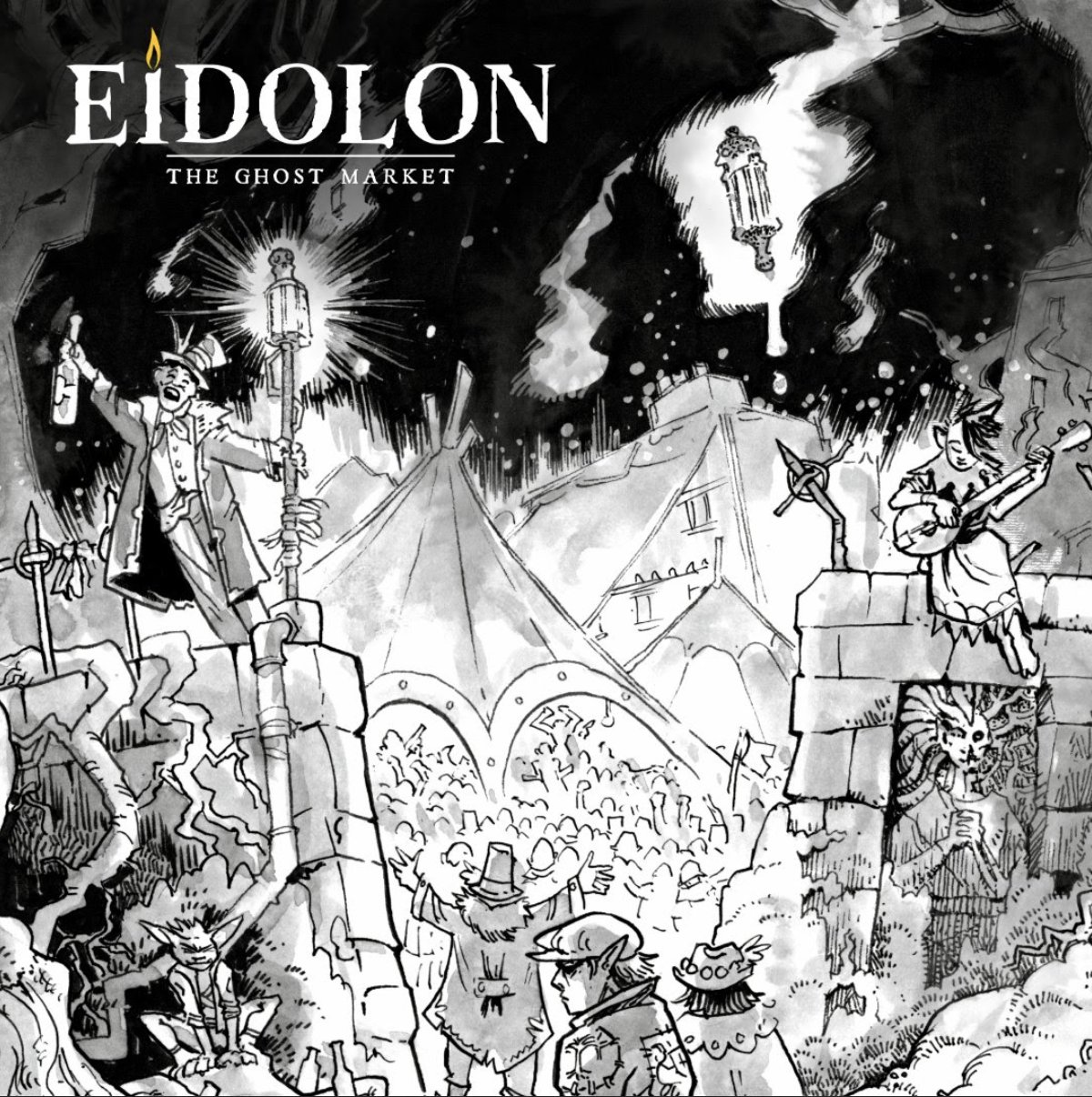
Keith Baker, best known for designing the beloved D&D setting Eberron just funded a new venture. His publishing house, Twogether Studios, just raised almost $122,000 for a new Daggerheart campaign book. Co-created by Baker and Jenn Ellis, Eidolon: The Ghost Market is a ghost-powered fantasy city that revels in the strange and unusual.
I for one think the world sounds intriguing, and it’s a strong fit for Daggerheart’s narrative-led heroic fantasy rules. I’m not here to sell it to you though; Baker does a more than adequate job in our recent interview. He also has some pretty insightful things to say about the design philosophies of both D&D and Daggerheart, as well as the continued legacy of Eberron. Check it out:
WG: Give me an elevator pitch for Eidolon as a setting
KB: One of the things I loved when creating Eberron was looking at the impact magic would have on a culture. Eidolon is a city where necromancy, specifically the binding of ghosts, is a cornerstone of their industry and technology. For weapons and armor, you’re sort of wearing a ghost who protects you or enhances your senses, or things like that.
I like to say it’s a bit of a blend between Sweeney Todd, Dracula, and Neuromancer. You’re playing people in a system that crushes those at the bottom. The city is ruled by five oligarch families that control the necromantic industry, and they’re all terrible in their own way. They run a system where your ghost is the most valuable thing you own.
Some people compare it to Blades in the Dark, and there are similarities. But I would say Blades is much darker, whereas a key point of Eidolon is trying to find hope. You’re trying to find justice or vengeance, or just make a difference.
With our sourcebook, you can do whatever you want with the setting. It describes the factions, the houses, and the districts, but it also contains two campaign frames.
The first, Boneriggers, is the Sweeney Todd path. Part of it involves deciding which of the five houses is an enemy your party seeks vengeance against. But, beyond that driving force, you also decide the community that binds your team together. As the campaign unfolds, you’re doing mercenary work and investigations as part of your vengeance quest, but they impact your community.
The other path is called Catering Crew, and it’s more of a wild heist. You’re essentially catering parties in the mansions of the oligarchs, some of the worst and most dangerous people in Eidolon, and you’re trying to accomplish goals under their noses. It’s a little more whimsical, and it’s a bit like crazy, evil Bridgerton – or like catering a party for Sauron or Darth Vader.

What interests me about Eidolon is its preoccupation with the past. We have magic items literally built by bonding a ghost to it – and you mentioned that happy ghosts don’t stick around.
This is a society that requires misery to function. Why was that a story you thought it was important to tell?
Eidolon was built at the site of a gate to the underworld, so you can talk to people on the other side, and it’s this intensely haunted area where ghosts linger easily. The idea was, rather than presenting your typical D&D necromancy with zombies and skeletons, we consider why ghosts linger.
Ghosts linger because of trauma, unfinished business, or intense emotion, and they’re not continuously conscious. This is mechanically baked into the system, and what you can do with a ghost is based on the emotion driving it. Poltergeists are driven by anger and move things, while Miseries are despair, and they affect emotion and perception. Specters observe, and muses remember.
Once that ghost is bound [to a magic item], there’s nothing cruel about using it. When your armor holds the spirit of a dead lover who protects you, most of the time they’re sort of asleep.
What is cruel is the system this exists in. The ruling houses are going to work you to death. They want you to be angry and miserable, because that’s what creates ghosts. That’s their crime, and that’s what really makes them monsters. Living well really is the best revenge here, and that’s how you break down a system that’s making everybody miserable.
It sounds like Eidolon lends itself well to Daggerheart. A lot of that RPG system revolves around this struggle between hope and fear, light and dark, levity and grit.
Exactly. Eidolon is an idea we’ve had kicking around for about 10 years – we actually made a Fiasco set using it. And now, we’re making a different setting with Daggerheart in future, so we wanted to warm up and get to know the system. Eidolon was sitting around, not doing anything, and we felt it fit with Daggerheart. This is a city shaped by fear, but you’re the people holding on to hope.
Plus, at its core, Daggerheart is not a wargame. You can later whatever story you want onto Dungeons and Dragons, but it is a wargame. That’s where it began, and it’s weird running D&D with no combat whatsoever. In Daggerheart, the combat is equally weighted with social interaction.
The Catering Crew campaign frame, in particular, has a good half to two thirds that’s just managing a party. You could tell that story in Dungeons and Dragons, but it’s not the story the mechanics want to tell.

I feel like this current era of D&D really pushes the idea that the system can do everything and anything – but I firmly believe the mechanics tell the stories they want to tell, regardless of your plans.
100%. You can tell any story with D&D, because you can tell any story with anything, but the system has things it wants to do. If you’re playing D&D, where two thirds of your character sheet is combat abilities, and there’s no combat or conflict, it feels wasted.
I would love to see a module for D&D – and I’ve thought about doing this occasionally – that’s designed for social conflict. What I mean is actually going through the classes and saying ‘oh, the Barbarian can throw a tantrum’, or the Rogue’s class abilities are more about being sneaky. Daggerheart’s social conflicts have as much weight as its combat, and that fits well with Eidolon, where action and conflict are very much part of it, but that’s not all there is to it.
What else attracted you to Daggerheart as a designer?
First off, I love Eberron and I’m going to keep supporting it. But Eberron is D&D. It has to be D&D legally, so I’ve already got a D&D setting to work on. With Daggerheart, we wanted to try a new setting, and why not make it in a new system? Why not explore something else?
Secondly, Daggerheart embraces the way I like to run any roleplaying game. I really like pulling out the collaborative storytelling aspect. One of the simple things I’ve always done in D&D is, if you run into a mob of zombies, I’ll make each player describe one of the zombies. That really draws players into a story and helps them visualize it in a concrete way. Daggerheart leans into that and makes it part of the core philosophy.
It is fair to say, in a small way, Eidolon grew from the fact you can’t work on Eberron in the ways you might like?
Absolutely. It’s the whole reason I have a game company. We make card games and board games as well as roleplaying games, and I’ve even written novels, but I can’t do that in Eberron now for legal reasons. I can’t write a new Eberron novel or make an Eberron card game. We wanted to make something we can explore down any avenue we like.
I’m very happy and grateful to Wizards that they made the DM’s Guild. Phoenix Dawn Command came out because, 10 years prior to that, there was no way to create Eberron content. I love the fact that I can now create in the setting through that specific channel – and so can other people. There’s 1,000 Eberron products on the DM’s Guild, and I love that.
I wanted a setting where I had the freedom to do more, but I’m at least glad Wizards have opened Eberron up in that way. They could have just sat on it and kept the vault closed.

You’re the originator of Eberron, but you’ve shared authorship of the world with so many people, from other designers and publishers to fans creating their own content. What are the ups and downs of that?
First of all, I want to give credit where credit is due. The core concept of Eberron started with me as part of Wizards’ fantasy setting search. But even from the very beginning, Wizards sat me in a room with James Wyatt, Chris Perkins, and Bill Slavicsek. We all worked together, adding and removing pieces from the idea.
A lot of people helped shape Eberron in key ways. I’ve stuck with it and continued to push elements that were important to me. But even the name Eberron is actually Bill Slavicsek’s name. I call myself the creator of Eberron because it did begin with me, but a lot of people put their spin on it.
Going back to the philosophy of Daggerheart, I’ve always said Eberron is a source of inspiration, not something that restricts the stories you want to tell. I grew up doing homebrew, reading the core rules and taking ideas from there. I want people to take what they like and change the things they don’t. Don’t let canon stop you because one part doesn’t fit the story you want to tell.
Not everybody has to make their own world, and some people like to share a common foundation with everyone, but I’ve always said ‘make it your own’. My books on the DM’s Guild aren’t canon, and I sometimes contradict the canon and do things my way. I don’t agree with all the writers who’ve ever written for Eberron, and you don’t have to either.
I have wanted to write D&D books since I was 14. I knew what I wanted to do, but I never expected to make something that so many people would get to experience and share. I love seeing people explore it and make it their own.
Want to chat more about Daggerheart or Dungeons and Dragons? We’re always keen to talk nerdy in the official Wargamer Discord.
 Source: Wargamer