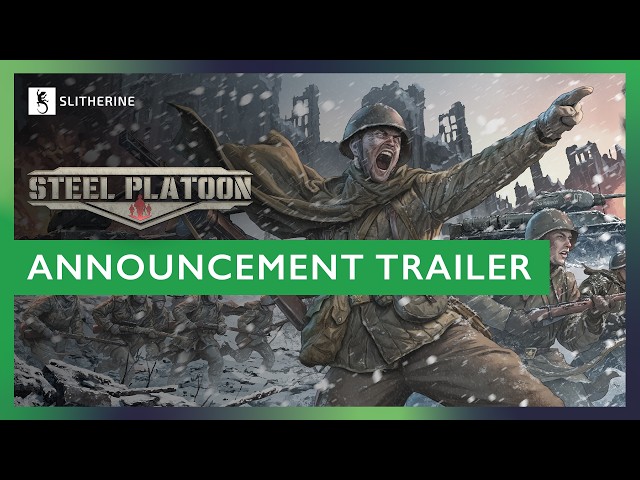
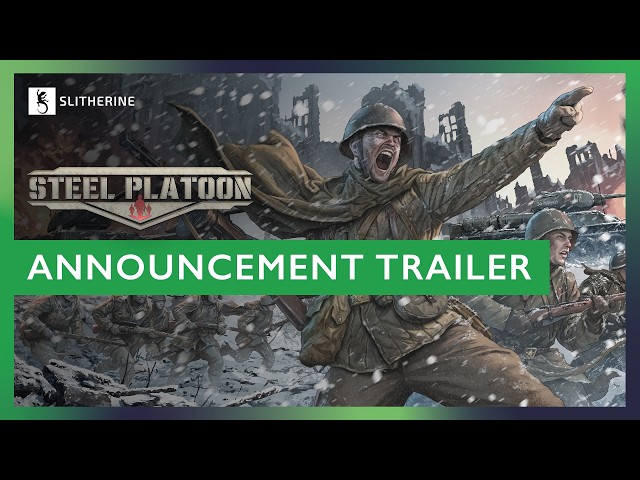
Steel Platoon was revealed on Saturday, a real time tactics game set in WW2 with a fifteen mission single-player campaign following the Russian defense in the battle of Moscow. Thanks to an invitation from publisher Slitherine Software I was able to get my hands on an early build of the game at Games Ground Convention in Berlin – here are my thoughts.
Developed by new studio Tactical Move, Steel Platoon seems to be built on the same engine as Slitherine’s Terminator: Dark Fate Defiance. Destructible terrain, modelled vehicle armor, ammunition and fuel tracking, squads of infantry you control as one, special abilities and gear tied to hot keys, it’s all there. TDFD is far from the most famous game, probably because it’s stuck with the Terminator franchise’s least popular sub-license, but it’s a deep real time tactics title. Shifting the setting to WW2 could be a crowd-pleasing move.
While multiplayer is promised, Saturday’s announcement (and the demo build) focused on the fifteen mission single-player campaign. This has RPG-like progression elements, with a persistent force that grows and shrinks between missions, and troops who gain experience and specialisms (or die permanently). The protagonists are all invented boots-on-the-ground soldiers, not famous generals, and it’s possible for them to die in the course of battles, which will apparently affect how the story unfolds.
How much the story will branch is yet unclear, and it will be vital. I love the fantasy of an army that persists between missions, but designers need to account for the possibility that you’ll win a mission so poorly that you go into the next one with a crippled army, or risk soft-locking players. It’s particularly pernicious when a late difficulty spike punishes you for the outcome of a battle much earlier in the campaign.
Missions follow the battle for Moscow from the perspective of the Russian. According to the presentation for the game during the Slitherine Next livestream, objectives in the early campaign will include defense in depth, preserving troops during a retreat, or holding at any cost in the face of a German breakthrough. As Operation Barbarossa stalls to a halt in the teeth of staunch opposition and the lethal Russian winter, I have to assume they’ll swing more towards offense.

The first campaign mission is a hectic multi-front defense set in a small city on the German army’s route into Moscow. As different German elements close from all side your platoon is sent racing around the city, repelling thrusts from all angles, before you’re eventually forced to retreat.
The characters are pure pulp. Your command squad includes a plucky youngster full of propaganda and courage, a grandfatherly veteran of the Finnish war, and a square-jawed lieutenant who is the de facto protagonist. The story is a straightforward tale of heroism, with your platoon fighting off German assaults and rescuing civilians, ending when your lieutenant bids farewell to his nurse sweetheart as your forces are recalled to Moscow.

The mission aims for cinema. It’s packed with NPC units, with men dying in droves, buildings collapsing, tanks bursting into flames, and sub-objectives failed without ending the mission. Mission objectives could have been communicated more clearly – once you’d completed the set-piece in a location you could run onto the next one with all your forces, even if the AI defenders who came to relieve you did a rubbish job. But by not breaking the action to inject new objectives, it felt like one breathless battle scene.
It was a little too much for my turn-based brain, and I rapidly found my force strung out throughout the city with no clear sense. The minimap was too small for the density of unit icons, at least for my skill level, and I wished the camera could pan and descend so I could see further ahead of my troops to get a more geographically oriented view of the battlefield.

Better familiarity with the control scheme and the icons on the squad list – annoyingly placed top right of the screen instead of bottom centre as nature intended – would have helped. Overall, that first mission feels like the start of an action game where you’re handed all of the end game abilities so you can feel really powerful, only to lose them once the story really starts. In a strategy game context, I found that every bit as bewildering as engaging.
The sheer quantity of units in the introductory mission, and the constant support of NPC units, also obfuscates just how important tactical positioning is to your success. Infantry need to take cover, or better yet garrison buildings, to survive sustained fire. Vehicles have individually modelled armor panels and breakable systems, and if a tank ever loses its crew because they die or they’re forced to bail out, another crew can hop in to capture it.

The second campaign mission explores this in depth. You start with just two tanks, and have to loot fuel and ammo from German-controlled depots, then break out captured tank crews from captivity and retrieve an abandoned heavy tank. Set in snow-blanketed Russian countryside on a road between light rural settlements, you’d think this would fix my problems with cognitive overload from the first mission. But two tanks proved more than enough for me to pilot – I didn’t manage to break through this mission during the time I had available.
That could be balancing or AI, but at least some of it was me not knowing what I was doing – if I want to make that a developer problem, lets call it a failure of tutorialization. The less built up environment at least gave me plenty of room to admire the destructible terrain, stray shells turning wooden buildings into kindling, suggesting all sorts of tactical possibilities for creating angles of attack with heavy ordnance that I am currently too dumb to achieve.

I’m calling this one “promising”, then: a solid singleplayer campaign set during WW2 is always welcome, destructible terrain and directional damage models are my kink, and as a miniature wargamer I’m a fiend for strategy games that skip out on real time base building. But I’m not yet convinced of the balancing or how accessible the control scheme is – I need more time to tell if the challenges I had with the demo were alpha jank, a skill gap on my part, or the intended experience.
It’s been a while since Wargamer updated our guide to the best RTS games, and we haven’t really grasped the nettle of what to do with real time tactics games – there’s more and more of them every year. If you’ve got an opinion on whether or not we can mix the two – and which RTT’s deserve to be on the list – let us know in the Wargamer Discord community.
 Source: Wargamer