


Warhammer 40k is an expensive hobby – but how does it stack up against other miniature wargames? I’ve compared 40k against three other 28mm scale science fiction wargames – Konflikt ’47, Starcraft, and Star Wars Legion – to work out which has the highest barrier to entry for new players.
Working out the ‘cost’ of a miniature wargame is a vexed question, because your choice of faction and how you build your army can greatly affect it, and whether or not you count the cost of paints, glue, tools, and scenery massively affect the cost. Games made in Europe cost more in the US, and visa versa, thanks to shipping fees and tariffs. Skirmish games often have expensive individual models, but only require you to own a handful to be able to play.
So I’ve set some arbitrary limits for this exercise. I’ve picked four sci-fi wargames with 28mm or 32mm figures in which you field (roughly) a platoon of soldiers, vehicles, and/or monsters. Prices are taken from each game’s official webstore, and I haven’t accounted for shipping costs, import duties, or any discounts you might be able to get from a local store. I’ve added in the cost of rules or custom dice and tokens that are mandatory for the game, although unofficial free alternatives are usually available.
What does a Warhammer 40k army cost?

I was inspired to write this article when I found the 40k Army Cost Calculator, an army list tool that also adds up the MSRP of your list. Each time I entered one of my own armies, it came out to roughly $50 / 100 points. There is some variance among different Warhammer 40k factions – horde army lists are more expensive, while the Custodes are so cheap they’re basically not comparable to anything else.
A Combat Patrol starter set costs $177 and has enough forces to play in a dedicated game mode – but it’s a game mode that uses variant unit rules to attempt to balance the wildly different points values between armies and doesn’t really succeed. Most of them leave you a long way short of a ‘minimum’ 1,000 points army for proper 40k: the average is around 500 points worth of models, and unlucky armies like the Drukhari and Astra Militarum have less than 300. The exception is the Custodes, whose Combat Patrol box contains over 1,000 points (and is actually two Combat Patrols).
The two player starter set is $255 and contains the Ork and Space Marine Combat Patrols, plus terrain, so it really is everything that two players need to get started in one box (minus paints and tools). They’re also fairly well balanced against one another.
I’ve only highlighted 1,000 point minimum size armies so far, but 40k is balanced around 2,000 point games. Assuming you get 500 points of models from a Combat Patrol, you’ve got to find another 1500 points, for around $750. And while Warhammer 40k makes its core rules free, army lists are locked in $40 Codexes, plus official mission cards cost a further $35.
Verdict: Expect to pay in the region $1,000-$1,100 for a full army, rules, and mission cards – unless you want to play as Adeptus Custodes, who can build a full (if not necessarily optimal) army for closer to $350.
What does a Star Wars Legion army cost?

If you’re sick of paying more for Warhammer 40k because you live in the US, you might find Star Wars Legion cathartic – publisher Atomic Mass Games is based in the US, so the normal pricing dynamics are reversed.
Legion is very cheap to get started in thanks to its absurdly priced Faction Starter sets. For $99 you get a 600 point Recon army, and all the custom dice, rulers, and tokens the game needs. Recon uses the full rules and unit stats as the main game, but with different mission objectives. And it’s just 400 points away from a full 1,000 point army.
AMG also releases limited-run $140 themed army sets, though these don’t come come with the tokens, rulers or dice. I’m not going to list the pricing of these necessary gubbins separately because it’s so close to better buying a Faction Starter set, I don’t see any Legion player not buying one.
Model kits hover around $60 / 100 points, so if you build out from a faction starter, you’ll spend a total of $339 on models. If you don’t want to field any of the units in the Faction Starter, you’ll spend around $600 and buy the starter anyway to get the dice and rulers. Unit and upgrade cards can be downloaded for free from the Legion website, but you may want to buy the physical Universal Upgrade cards pack for $30.
Verdict: expect to pay $369 for a full Star Wars Legion army and upgrade cards built out from a Faction Starter set, or $700 if you completely avoid the game’s Faction Starter sets.
What does a Starcraft Miniatures Game army cost?

Starcraft is the newest army-scale sci-fi game and it has the smallest range, with just two waves of units released so far (though wave three is now up for pre-order). A single-player starter set costs $119 (or $129 for the Protoss), and has all the troops you need to play a 1,000 point basic game, plus necessary tokens and dice. Given the narrow range of units, every player is realistically going to buy one of these.
Expanding out to a full 2,000 point army from there isn’t too bad. Kits run from $29 (Terran Medics) to $79 (Terran Siege Tank) but the majority are $49 – units cost around $20 / 100 points (plus or minus, depending on how many upgrades you give them). So you’re looking at another $200 to go from a starter set to a full army.
Rules are available free online, plus you get unit stat cards in the box. The official scenarios call for specific terrain, but the same is true for Warhammer 40k and I didn’t factor it in there, so I’m not going to include it in the price here.
Verdict: Expect to pay around $330 for a full Starcraft army.
What does a Konflikt ’47 army cost?

Konflikt ’47 has the most variability in army pricing, because there are so many ways to approach the game. It’s set in an alternate history continuation of WW2, and publisher Warlord Games’ range of Bolt Action WW2 minis can be fielded alongside unique sci-fi super weapons. An army could include Russian conscripts or super-heavy walker tanks, and kits could be made from plastic, resin, metal, or a mix.
18 plastic ‘Fireflies’ with jump packs cost $59, while 8 metal Schwertruppen cost $67 – the fireflies are worth three times as many points! Meanwhile a kit of 30 US infantry could contain three inexperienced squads (210 pts), or three Veteran Infantry squads loaded up with SMGs and other upgrades (474 points). In short – this is the sketchiest pricing estimate I have.
With that said, it’s not too hard to work out what it costs to start playing. The two player starter set contains 750 point armies for the Axis and the US, plus the rulebook, some basic terrain and the necessary ‘Order Dice’ and (debatably necessary) ‘Rift Dice’ for the two armies. That’ll set you back $152, and it’s everything you need to play a smaller battle. Warlord also has a range of single-player starter armies for $176 which contain anywhere from 800 to 1200 points, depending on faction.
A full army is 1,500 points, and if you want to play as either the Axis or United States, you can get there for $328 by buying the two player starter set and an army bundle. Army lists are free to download from the Warlord Website, but you will need to grab at least some more order dice, which’ll set you back $29.
Verdict: expect to pay around $350 for a full army and Order Dice that you build around an army starter set. Building an army a la carte could vary wildly from that benchmark.
Final thoughts
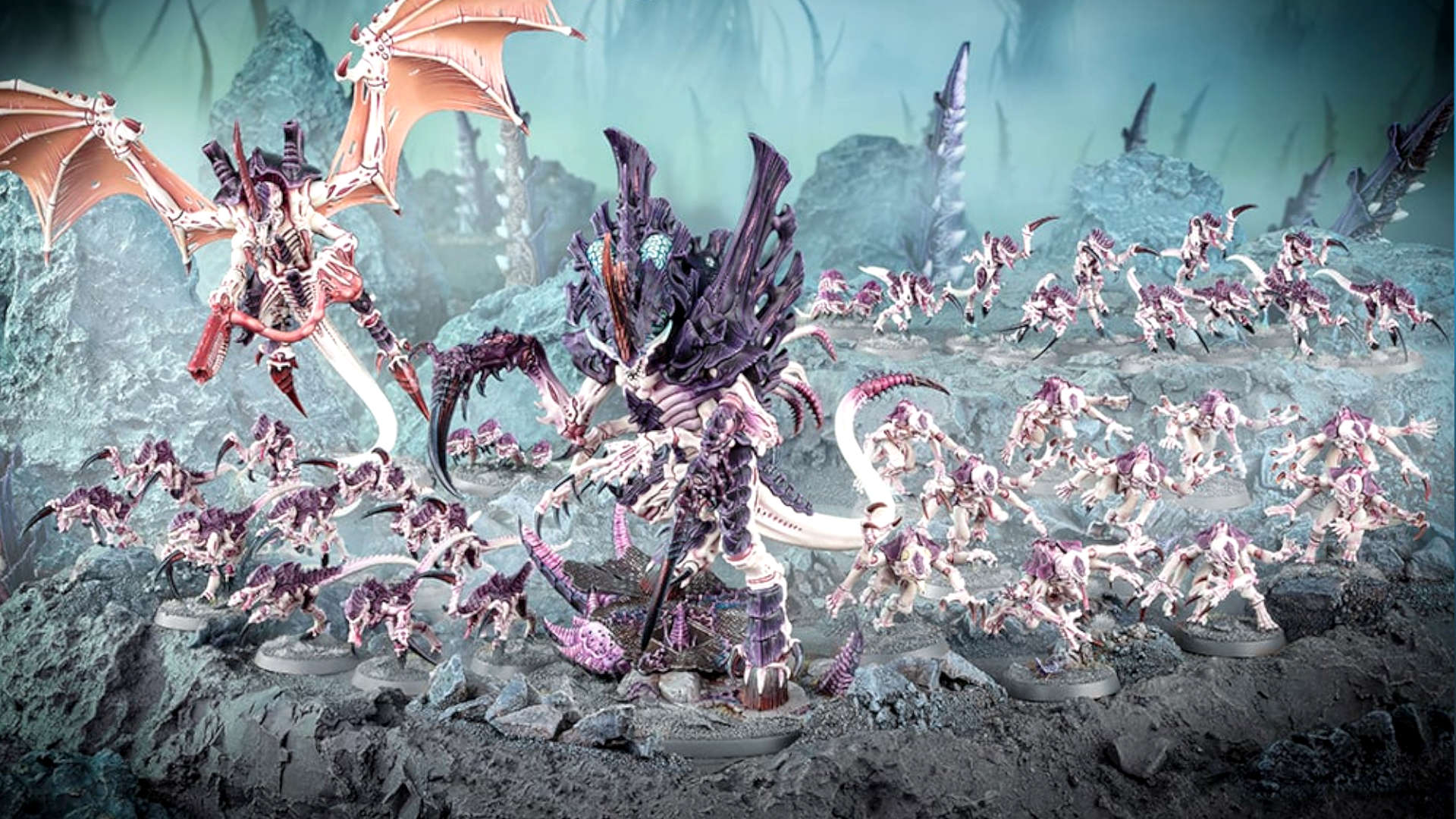
You should expect to pay two to three times as much to field a complete army in Warhammer 40,000 compared to Starcraft, Star Wars Legion, or Konflikt’ 47. There are exceptions – an army of Adeptus Custodes costs about the same as armies in the other games, while a Konflikt ’47 army that leans particularly hard on green infantry could be unusually expensive.
Sprue for sprue, Warhammer 40k kits appear to be a bit more expensive than the competition, particularly Konflikt ’47 and Starcraft, but that doesn’t mean they’re worse value – I can’t put a price on aesthetics. What I noticed most, when comparing armies between games, was that Warhammer 40k armies are just bigger – you have to put more units on the table to play Warhammer 40k properly.
I can’t say whether having more models and more units makes 40k a better or worse game. It does make it more of a commitment in both time and money. The sunk cost may explain why 40k fans can get so heated when game balance is (or seems to be) out of whack.
One last, amusing thing I’ve noticed from this exercise: if you really don’t like Warhammer 40k, but nobody local to you plays the game that you do like, you can build two complete armies in that game for less than the cost of a single 40k force. Let players who don’t have the cash to splash on 40k use it; donate your spare army to the club or store for demo games; become a pillar of the community.
Speaking of communities, you’re most welcome in the Wargamer Discord community! Join us for friendly discussions about all sorts of tabletop games.
 Source: Wargamer
