


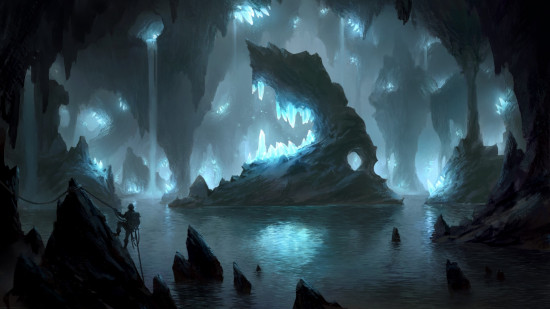
Down into the depths, under stone and over stone, the road wends away through cavern and cave, away from the light, into the Underdark. Adventures in the subterranean world of the Underdark are some of the most evocative in Dungeons and Dragons – and lessons from real life cave exploration can help make your party’s lightless adventures feel even more real and gripping.
The ideas here all come from a trip to Blue John Cavern, a tourist attraction in the UK’s Peak District which is still a site of low intensity gemstone mining. Descending the narrow steps into this awe inspiring cave system, it was impossible not to imagine how the different D&D classes might respond to such an environment.

Air and rock
Caves are created by magma forcing its way up from below, water drilling its way down from above, and other geological forces or fantastical magic – they’re the children of violent ruptures in solid stone. Nothing about them is uniform. If a cavern has a flat floor, the players should ask “who leveled this out, and why?”
Caves are as likely to run vertically as horizontally, with the adjoining tunnel mouths sometimes great distances above or below the nearest flat ground. The lower portion of a cave might be a single large bowl, but the rock above it could be carved into multiple narrow channels that branch apart like a star, making spider-climbing creatures almost as mobile as ones that can fly.
Water and stone
Caves might provide shelter from the worst of the rain, but this doesn’t mean they’re bone dry. Water that permeates rock will flow through caves and deep caverns on its way to the aquifer, falling in waterfalls, dripping from ceilings, sweating down rockfaces, and gathering in pools. Heavy rains on the surface can suddenly flood tunnels.
Water shapes the landscape of the underdark: flowstone, stalagmites, and stalactites are all formed by the gradual deposition of calcite as it’s leached from the rocks, and where these features show up, the stone is likely to be slippery underfoot.

Light and life
While caves are isolated from the surface world, they’re not hermetically sealed, and surface plants and creatures will find their ways inside. If they don’t find their way out, that usually spells their doom – but the presence of electric lights allows moss and algae to gradually colonize rock faces. In the magical Underdark, glowing fungi and perpetual light spells could have far more impact, creating pockets where the flora and fauna of the surface mingles with that of the underdark.
Indelible Marks
Flowstone has a surprising property – touching it with bare skin subtly discolors it, and rock that’s frequently touched eventually changes from a natural white to a sickly brown-yellow. In the Underdark, discolored flowstone is a sign that a route sees frequent use – and different D&D races may leave different marks. A band of discoloration high up on a stalagmite could be a sign that ettins and ogres regularly pass through, while deep purple stains might indicate a route frequented by the Drow.

History of Use
If sentient creatures occupy a cave system they invariably rework it to suit their needs, leaving traces of their presence after they mov on. That could include steps cut into stone that follow the route into a mine, or pulley systems left in vertical shafts that once brought supplies down and treasure back up. Natural springs are likely to be dammed and directed into convenient troughs to provide clean drinking water.
In the Underdark, sentient creatures are as likely to enter a cavern from below as from above, and they’re likely to make their own peculiar accommodations. Azers might unstopper magma plugs to provide light and heat; Aboleths will use magic to flood chambers that enable them to progress upwards; Beholders will widen out vertical faults to allow them to conveniently float up and down through their domain.
Has a natural wonder ever inspired you for your D&D home game? What surprising features of caves have we missed out that we should have mentioned? Let us know in the Wargamer Discord community!
 Source: Wargamer

