


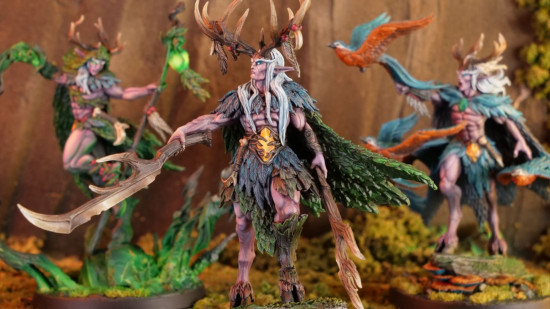
I first encountered Wyldwood, the game of stone-age tactical combat in a fantasy world developed, at Adepticon this year. Sitting right on the border between a miniature wargame and a grid-based strategy board game, the first thing anyone will notice about it is its mind-bogglingly massive models. But, as I’ve found while playing a demo game with Adrian Phillips – co-founder of the YouTube channel Tabletop Titans and the studio behind Wyldwood – beneath that obvious glamour is a game that is simultaneously elegant, simple, and deep.
As we’re on opposite sides of the Atlantic ocean, we played via a very high quality Tabletop Simulator mod. “This thing has been so incredibly helpful for testing”, says Phillips, “it’s meant we’ve been able to gather hundreds of games” played by members of the game’s Discord community, “so we get all the play test information”. “On the first pass through the faction that was too strong was the elves because, as always, [they had] too much movement, too many tricks – but we were able to see that and adjust it.”.

Wyldwood launches with five factions, with models been sculpted by the talented monster makers at Creature Caster. The playstyles of the different factions shine through in their aesthetics: the shambling, diseased wood spirits of the Witherwood Lwegions fight by crippling the enemy with debuffs and refusing to stay dead, while the lithe elves of the Leafsong Nomads are evasive and fast moving.
Battles take place over a square grid: models can move orthogonally, like chess rooks, and can attack both orthogonally and diagonally, like chess queens. Models and trees block movement and line of sight, while rocks only block movement. Players deploy five champions, one of them a colossal leader, at the start of the match, and then batter one another until one side has claimed victory by slaying enemy characters or through other means.
The stats for each character are summarized on a single card, and they’re very simple; their movement distance, starting health total, plus their abilities, only one of which is available at the start of the game. On top of this very bare foundation, Wyldwood does something that many games advertise and only the best board games actually achieve: it’s simple to learn, but genuinely deep.
Each champion can unlock two more abilities during games, by collecting magical Wisps from the wood. These spawn in random locations at the start of each round; when a model collects a Wisp it ends their turn, usually before they’ve attacked, so it’s a big commitment. The Wisp then gets socketed into a handy slot on the champion’s information card, unlocking a new ability. They also provide one of the ten victory points you need to win the game – provided the character holding them stays alive, painting a big target on your newly-upgraded hero’s head.
Whether, when, and which ability you unlock for a character can have a massive impact on how they function. During our game, Phillips took on the magically-inclined Nightwood Covenant Orcs, and early on he unlocked the Defense buff for his melee-centric Severed Butcher, turning him into a tank for the game.

I picked the dwarfs of the Urscar Kindred, and by the third turn of the game my own melee champion Painseeker was in a prime position to slay the Butcher, but certain to die to reprisal attacks. Instead I chose a tricksy play, and backed off to socket a Wisp to an ability that would deny Phillips most of the victory points when he inevitably finished off my champion.
There are no dice in Wyldwood, with all attacks simply dealing flat damage, but there is still uncertainty, thanks to the action card deck. You’ll draw a hand of these cards each turn, with decks unique to each faction. This is where the really powerful attacks and impactful abilities are, paid for with a budget of Fate points that increases turn on turn. I realized after my super-sneaky retreat that I had overlooked an attack card for the Painseeker that could deal damage equal to the amount of health he’d lost, which would have annihilated any one of my opponent’s champions except his massive leader Brakka, Grief-Summoner.

You can customize these decks too to tinker with how your force performs: Phillips could have brought two additional fighters onto the field by mixing summoning cards into his deck, for instance. And he promises that the studio is already looking at post-launch expansions that will add new champions to mix into your lineup, for even more variety.
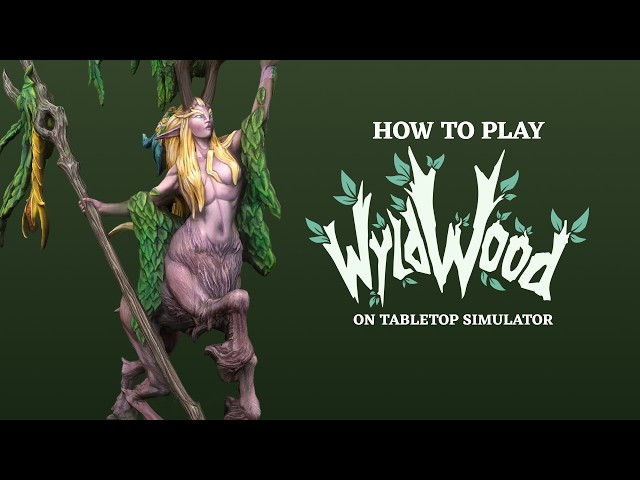
Phillips says that “the same thing that makes it a fourth game for [experienced Wargamers] makes it a good first game” for genre newcomers, and I’m inclined to agree. It feels elegant. If you’re intrigued, you can easily add the mod on TTS to test it for yourself – there’s a helpful how-to video below.
The Wyldwood Kickstarter
The Kickstarter crowdfunding campaign for the game opened on Tuesday, and the game’s massive centerpiece models come with an appropriately massive price. If you want a physical faction starter set, which comes with the cards and tokens for one faction as well as the minis, it runs to $220: you’ll need to find an opponent with a set as well. A digital starter set, which will ship you the physical game components and give you STLs of the models to print on a home 3D printer, is $90.
With the recent social media storm around MiniWargaming’s delayed crowdfunding campaign for Ravaged Star fresh in my mind, I ask Phillips why prospective backers should trust another YouTube channel to deliver a board game.
“I have all the models, physically produced from the factory already, and we’ve paid the sculptors, painters, manufacturers, stuff like that – we take the risk on us, but it means that by the time we go to Kickstarter, it’s really just a matter of [determining] the quantities we need to do”.
Obviously the minis are the headline, but I press Phillips on cardboard components and packaging. He says “at UKGE we had the first prototype runs, basically we did a quality check, everything looked good”. When we spoke, he expected to receive the final proofs for printed materials shortly before the Kickstarter launch.
The entire project is being produced and fulfilled by a single company, Unicool, rather than divided among multiple manufacturers. “We could save a little bit of money here or there, but the logistical issues that can come up between having them ship different parts to different people just didn’t feel worth it”.
As a miniature painter I respect the decision to build a game around such vast components – as someone with limited shelf space, I shudder to think how I’d ever store a full set. My impressions are that it’s a good game, and I hope it finds a market.
If you’ve tested Wyldwood, why not hop into the Wargamer Discord community and let us know what you think?
 Source: Wargamer

