


Of all the board games, wargames, card games, and RPGs I checked out at Gen Con 2026 (in between meetings, atrocious burritos, and cowering in fear of tornadoes) my preview of War for Roshar, with its designer John D Clair, was among the more surprising highlights. Why should I be surprised to be excited about Brotherwise’s third and latest Brandon Sanderson board game, you ask?
A fair question. After all, the last two (a Sanderson reskin of the O’Neal brothers’ hero-creating game Call to Adventure in 2020, then Clair’s own Mistborn Deck-building Game in 2024) were both well received. The Cosmere TTRPG raised over $15 million from backers in 2024, making it the most successful tabletop Kickstarter ever (until Avantris’ $16m Neon Odyssey unseated it this year). And, while reviewers – including our own Mollie Russell – found the Cosmere RPG somewhat hidebound by its own complexity, its deep, beefy systems, paired with Sanderson’s enormous lore base, have generally impressed.
Why, then, should I not already have been foaming at the mouth for another tabletop entry, especially one in a genre I’m particularly partial to: massive dudes-on-a-map strategy games with generous dollops of politics added? It’s time I admitted it: I am an almost total outsider to the works of Brandon Sanderson. My experience of his Cosmere fantasy universe amounts to reading literally the first couple chapters of Mistborn book one (the first of seven) and bouncing off, ungripped. If you’re the sort of fan for whom that instantly disqualifies me from having opinions on any related topic, you may go now in peace, with my blessing.
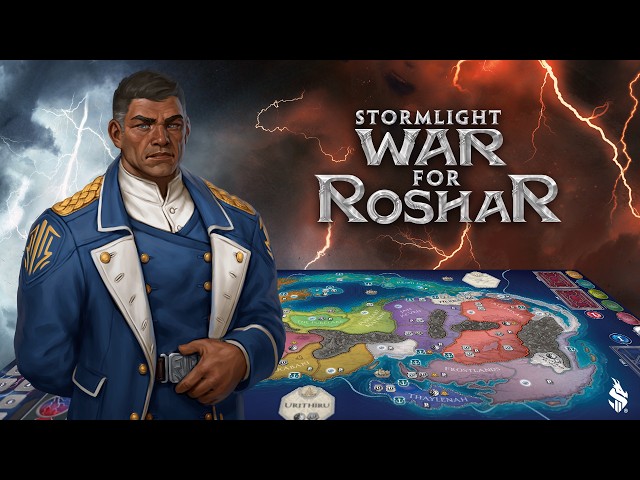
If you’re still here, though, let’s dig into what I learned from chatting to War of Roshar’s designer John D Clair that piqued my interest more than Sanderson managed to. First off, a bird’s eye view of the basics: this game is set on the planet Roshar, the setting of Bran-San’s other epic fantasy series The Stormlight Archive.
These stories take place on Roshar’s single, Pangaea-like supercontinent, which was devastated by an empire-shattering war of godlings 4,500 years ago and is now constantly fought over by two dozen rival nations, with varying levels of moral depravity. All are seeking out powerful magic macguffins that’ll give them the upper hand, but they’re kept in deadlock, largely because (and here’s the classic Bran-San twist card) gigantic, destructive magical storms ravage the entire continent once a week.
Even to my non-Sanderson-pilled mind, that is a potent recipe for a dudes-on-a-map strategy game, with plentiful opportunities for the lore-backed mechanical kickers such games need, to stop them descending into ‘basically just Risk’. Loads of competing successor kingdoms? Sounds like we could be bartering alliances and levying troops to our coalition! Legendary magical artefacts that could turn the tides of war? Oh mamma, I’ll fight pyrrhic battles to nab those! World spanning storms? I bet those could provide random environmental threats that’ll menace factions large and small!
Well, as Clair tells me, the game has all those elements. For one thing, those sentient ‘highstorms’ rack both sides in random areas of the board every round, stopping either player from resting on their laurels too long. For another, the titular war is the one against the rage-god Odium that ramps up across the second and third Stormlight books. Key plotlines from those novels – raising a military coalition against Odium, and securing the magical, army-teleporting Oathgates – do indeed form the bones of this board game. We’ll get to all that.

But the leading feature, the one Clair seems most enamored with, is even more narrative focused: it’s the people. All your favorite book characters are here, and they’re baked right into the heart of the game. “I call it a hero-driven game,” he says, “because all of the actions you take during the game are done by heroes, and then the troops that they command.
“So if I activate a particular hero, that hero can move, and then he or she can do a command action based on [what’s around them], and those are the troops that you can move. So you’re all driven by where your heroes are and able to influence the board.” For all the Stormlight Archive books’ big, board-gamey war-drama, many fans’ favorite bit is its massive, diverse cast of characters – each with different origins, attributes, and viewpoints on the world’s woes. So Clair, who introduces himself to me right up top as an enthusiastic Cosmere fan, has made a point of placing the novels’ beloved big names at the forefront of War for Roshar’s gameplay.
“Crucially,” he explains, “each player actually gets two heroes, and the pairing of your two heroes is where a lot of the strategy and implications come in”. Our demo setup at Gen Con showed a player set up with Kaladin and Jasnah. “But in a different game,” says Clair, “we might have Shallan and somebody else. And it’s the same for Odium factions – they’re gonna have different heroes playing them”.

Each hero, Clair says, is “quite asymmetric in two ways”. Through the game, you’ll be removing cubes from the player board housing your two hero cards, which “reveals either more strength to the hero or one-time powers that they can do” – but also unlocks Radiant Powers the heroes can activate for boons in and out of battle.
Beyond that RPG-esque ‘leveling up’, though, your choice of leaders also determines your strongest opening moves, Clair tells me. “Every hero has two starting cards they start with. Hero actions are, for the most part, driven by playing cards… and the two cards your heroes start with matter.”
In fact, card play drives every action in the game, because – unlike the archetypal map-control strategy games of yore – there are no dice here. “Battles in the game are deterministic,” Clair says (i.e. stronger army wins) except that “players may have cards in their hand that, once a battle has begun, they can play to influence the battle in secret”. Some of these cards, he promises, can have a huge impact even in battles where the outcome seems certain. “A lot of the unexpected moments in the game aren’t going to come from a random output”, he tells me. “They’re going to come from a player action that you didn’t expect your opponent to do – which is card-driven.”
Not even the drawing of cards is entirely random, either. “Some actions you can take in the game let you go through one of your faction’s decks and add a new card to your hand, and that card is not revealed to your opponents until you actually play it,” Clair reveals, “so a lot of the unexpected stuff is going to come from that”. That’s also the main way to shape your overall strategy once the game really gets going, it seems. “The choice of characters we got at the beginning matters a lot,” Clair explains, because “if I know you have that character, as an experienced player, I know what your strengths and weaknesses are”.
“But then, as we play, much of what our ultimate powers end up being are what we draft from the decks as we play. So, though I may start with Kaladin and Jasnah, as I play, I can draft into flexibility to try to counter what your strengths are – and buffer my weaknesses.” Carefully upgraded or not, though, the heroes do have some inherent skills and weak points, intended both to balance them in-game, and to anchor them to their counterparts in the novels.

“A character like Jasnah, she’s not especially great as a commander on the battlefield, but her diplomacy is amazing,” Clair says, whereas “Dalinar, he’s a very good commander on the board, and he’s a pretty good fighter himself in battles, and his diplomacy is okay, but gets progressively better – fitting his character arc”.
Which brings me to a particularly enticing point: battlefield prowess isn’t the only skillset you’ll need to optimize your hero leaders for; you also need them to make friends and influence people. Winning the war for Roshar depends as much on diplomacy as it does on taking heads – and, judging by Clair’s description, this half of the game appears more satisfyingly integrated than it normally is in this sort of fare. That’s mainly because you actually have to do some of it in order to expand.
The basic system isn’t complicated: all the board’s many nations are represented on an Allegiance Track showing whether Odium or the Coalition is their best friend, and sending one of your heroes to do a Diplomacy Action in a nation’s capital brings it closer to your side. What’s more impressive to me is how the implications of national allegiance are so neatly blended into the core wargame, as opposed to merely imposing boring, transactional buffs and debuffs around the edges.
“On the board,” Clair eagerly explains, “there are a bunch of neutral nation troops, and they basically just sit in that nation’s territory and defend it. If either side moves in, they’ll fight them, right?
“But if you pull that nation towards your allegiance, they won’t fight you anymore. They’ll only fight the other side. And if you pull them all the way – not just Friendly to you, but all the way to Aligned – all those troops actually flip and turn into your troops, and now you can help command them into battles.”

“That push and pull matters a lot,” he says – “especially when you need to get into nations and you want to be able to recruit new troops there”. This topic pricked my ears up, because it’s a real sticking point for wargames in general. A common complaint about lightweight war board games is that they can gloss over the vital challenge of maintaining your conquered territory, to maintain supply lines and protect against insurgencies. A common complaint about heavyweight war board games is that they can take up half your time faffing around with supply lines, economy, and other stuffy subsystems, when what you really want to be doing is having a damn good battle. Solving this fiendish tightrope act is a real puzzle for board game designers.
War for Roshar’s solution, at the very least, seems to have a basic elegance and verisimilitude. Essentially, diplomacy takes longer but pays off more in the end, while pure conquest moves faster and breaks more stuff, but quickly leaves you overextended and fending off constant insurrections, because conquered peoples don’t tend to like it very much. “If I go into a nation hoping I can recruit troops, I have two ways to do it,” Clair explains. “One, make them friendly, and now I can recruit troops for them. Or two, outright conquer them and then recruit troops.”

“But if I conquer them, they’re going to fight back,” he says. “Each round we flip a card that spawns new neutral troops in various nations. So if I’m trying to repress a nation so I can recruit there, throughout the game they’re gonna gradually be spawning new troops that keep fighting back a little bit.” There’s a touch of faction asymmetry here too, as Odium is most often better at aggressive conquest, and the Coalition “has a bit more ability to control and less ability to conquer” – though Clair assures me both can win either way.
One final design twist takes us even further away from bog standard Risk-alikes, and that’s the victory condition: the ten magical Oathgates arrayed across the board. Over two to four hours (“we didn’t constrain ourselves too much on trying to hit a lighter target and a short time play,” says Clair) you’re fighting to take and hold as many gates as you can and, crucially, more than your opponent.
Each round, the two sides count up their gates to reach the victory point threshold needed to win, and the side with more gets a VP bonus equal to their lead. It’s like the opposite of a catch-up mechanic; it’s there to put the loser out of their misery. It’s not quite as brutal as it sounds, though, because all Oathgates are not created equal: the factions take turns to assign a VP value of 0-3 to each gate, effectively betting on the ones they’re most confident they can take and hold.

By my lights, this all adds up to a very appealing, cohesive layer cake of strategy mechanics, with asymmetry peppered judiciously throughout, rather than concentrated in just the faction system, as is more usual. Armies operating as functions of your named heroes – and their battlefield success being a mixture of pure numbers and the sneaky actions of those heroes – is a neat way to keep Sanderson’s famous characters center stage. Baking the diplomatic challenge directly into the same strategic decision space used for your war plans makes it crunchy and relevant, without clogging up a midweight wargame with administrative jetsam.
Will those ingredients coalesce into a strategy board game I’ll actually want to keep playing for a 4 hour session (which is undoubtedly the minimum my first few games will take)? I’ll have to wait until it’s in my hands to find out. Brotherwise is launching War for Roshar on Kickstarter on October 13, at which point we’ll also find out how much they’re charging for this long-haul fantasy bunfight.
If you’re a Sanderson and/or Stormlight fan who didn’t click off when I said I hadn’t read the books, come join the free Wargamer Discord and let me know if you’re jazzed for this game – I’m genuinely interested in the perspective of folks whose interest, unlike mine, is as much for the lore as for the gameplay!
 Source: Wargamer
