


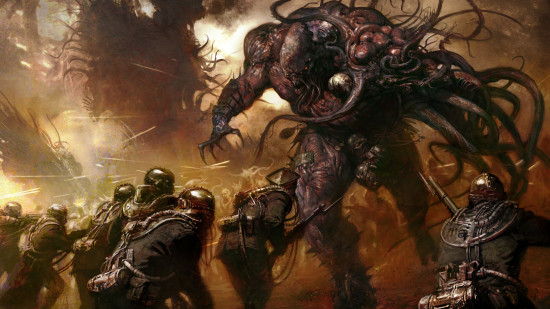
If all you knew about professional fantasy and sci-fi illustrator Thomas Elliott was his career history, you might assume he was getting close to retirement. A five year stint at Games Workshop making art for Warhammer 40k and Age of Sigmar; the cover art for Doom: the Dark Ages; now the art lead for Trench Crusade at Factory Fortress – it’s a packed resumé for someone in their early 30s. Somehow, he’s had the time to create an original sci-fi universe called Eskaton, a world of art and stories that will soon be available as a setting book published by Mindworks Studios – I spoke to Elliott to learn more.
“I first started working on Eskaton 10 years ago”, Elliott says, “I wanted to do big sci-fi battle scenes, but I didn’t want to just be making Warhammer 40k fan art”. “I realized quite early on that if I wanted to be making these battle scenes, it’d be a lot easier if I had pre-made characters” – and the world grew from there.
It’s set in a future where humanity has “proliferated to the point where [earth] can’t sustain life – we’re forced to colonize space”, but it’s a “low sci-fi setting, where we never broke light speed”. Vast distances, “divergent evolution, time relativity, all of these things are factors in this setting” – so it’s a setting with no aliens, but many descendants of humanity that seem extremely alien.

“There’s re-occurring themes throughout the book of surviving only through unsustainable growth, or how as a species we are much better at solving problems than preventing them”, Elliott says. “Eskaton is the setting where those ideas are blown up to their fullest degree… we’re very, very good at adapting, and we will adapt to survive, no matter what, but sometimes the end product of that will be horrific, or at least to us sitting here right now”.
Much of the book is given over to exploring a single world, Neo-plasia. “It’s a very mineral-rich planet with a toxic atmosphere, so everyone’s on these walking mining colonies called Mitick cities – it’s a powder keg”, and the central conflict of the book is a history of a war of rebellion within and around these cities.
Another faction came from examining the consequences of this world – what about the people who don’t fit into the Mitick cities and their systems? “The Karull have this artificial synthetic skin which they’re bonded with at birth, which allows them to oxygenate their blood directly, a bit like an amphibian”, Elliott explains.

When he spent time thinking about their condition, he realised that they wouldn’t “experience things in the same way that you and I do”. From this came the idea for “the Skin Dancers, where this kind of fascination with the missing sensations becomes a neurosis; they’re defined by their curiosity and obsession with flesh and skin and all these things that they’re not experiencing”.
If that sounds intriguing, you can sign up on Kickstarter to be notified when the Eskaton crowdfunding campaign launches on July 7. As well as the core hardback book, Elliott says there’ll be special pledges for custom frontispiece illustrations, and even for some of his original artworks for the particularly well-heeled reader.
Elliot’s interest in science-fiction and fantasy began at a young age. “My mum was super, super into sci-fi, and basically at the age of six she showed me the 1980s Flash Gordon film, which left a really deep impression on me – it starts on earth and then 20 minutes into the film, you’ve got this alien civilization with all these colorful different cultures”. Naturally he was inspired by Star Wars and Warhammer, but he wouldn’t connect his love of fantasy with his desire to become an artist until his final year at art school.

“I studied fine art, not illustration, which are two very different beasts”, Elliott says. “All through my time at art school I was painting these abstract paintings that were very technical, but not figurative at all… and then about six months before the end of the degree, I stumbled across Frank Frazetta, and I was like, ‘Oh, I have completely studied the wrong thing, I want to be painting muscular men and curvy women and barbarians'”.
He’s a serious student of Frazetta’s work and technique. “He paints like the old masters, he starts on a sepia ground and blocks in the colors, but he does it in a very efficient way”, he explains. “You zoom into his paintings and he’s got just the right level of information so when you see it as a whole picture, it looks detailed where the details need to be, but actually it’s very economically done”.

As for more contemporary artists, Elliott grew up with Warhammer and “the dream team of Paul Dainton and Karl Kopinski, Adrian Smith, Alex Boyd, super black and white, super aggressive, and I absolutely loved it”. By the time he made it to Games Workshop “the style and what the studio wanted had changed and evolved – or de-evolved, maybe”. He remembers “one of my very early pictures was a guy getting beheaded, and basically my manager sat me down, was like, ‘Thomas, I’m afraid you can’t show that'”.
Creatively, “there were a lot of things which I wanted from working at Workshop which I wasn’t able to do”. The Eskaton project “is basically making the art I always wanted to do from the get-go – hence a lot of black and white ink stuff, some of the more graphic elements in there”.
I can’t help but see parallels between Elliott and his new boss Mike Franchina, the visionary concept artist responsible for the Trench Crusade universe. Elliott concurs. “Before I officially joined [Factory Fortress] I had a few video calls with Mike, and it was kind of spooky how similar our arcs have been”, Elliott says, “He worked for Blizzard, didn’t like the corporate nature of working for them, despite the fact that they are kind of the holy grail of who you want to work for, which was very similar to my experience of Workshop”.

Now that he’s on the Trench Crusade team “I am curious to see how that develops; it started from a very strong singular vision with Mike, and as it transitions into a more of a group project, how have they found that balance between lots of voices, but also keeping a very specific flavor”.
It’s a direction that Eskaton is beginning to drift towards, albeit very slowly. The Eskaton world book will feature short stories by Elliot’s sister, aspiring author Lily Elliot, and by videogame writer Samuel Jones; publisher Mindworks Studios already makes a small range of display-scale Eskaton miniatures. At least one other artist has contributed to the book, Zen Chumphon Singhakawi.

Elliot doesn’t have word of a miniature wargame based on Eskaton yet, but I would be very surprised if that situation lasts. It’s a grimdark setting purpose-built to house unique factions with radical aesthetics, animated by the imagination of an extremely talented artist. We know from the colossal success of Trench Crusade just how hungry the nerds are for that kind of vision. As soon as anything is announced, I’ll be the first to rave about it.
I was surprised to discover, midway through my interview with Elliott, that he’d created the image I used for an article header on Monday. Do you have a favorite piece of Elliott artwork? Come and share it in the Wargamer Discord community!
If you’ve read this far, you might also enjoy our interview with Mike Franchina, the chillest man I’ve ever met.
 Source: Wargamer

