


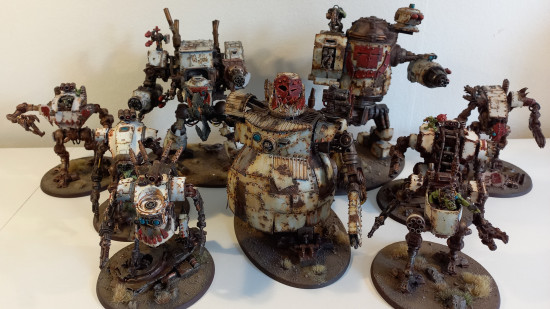
To delve into the dark secrets of Warhammer 40k’s Chaos Knights, I reached out to Björn Eriksson, one of the faction’s best players and a member of the Swedish WTC team. In the 2025 World Team Championships Eriksson had the unenviable job of playing first defender – the most likely player on the team to get stuck with doomed match-ups – and emerged from the tournament undefeated. So how does this dark baron command his forces to victory?
This is the latest in Wargamer’s masters interview series, in which we talk to world class 40k players about the Warhammer 40k factions they’ve built their names with, asking what new players need to know about the army, and what opportunities and challenges they expect to face in 11th edition.
Eriksson has been playing with Chaos Knights since early in eighth edition; initially they were “a hobby side project for my Orks, a load of looted Knights”, but “then in 10th edition I started playing the army more competitively when the Codex released”, and he ran them intensively in the run-up to the WTC, taking down several major Swedish tournaments.

The heart of darkness
Eriksson describes the Chaos Knights as “an army of a few tough pieces that can dish out massive damage, both in shooting and melee, an army that can put on pressure from early on and sometimes just break the opponent before they get a chance to even retaliate”. This is something they have in common with their loyalist counterparts – but there are differences between the two factions that go well beyond the masters they’ve sworn to serve.
“The CK can also play a slower game compared to the Imperial Knights””, Eriksson says, “with help from allies you can control the pace of the game, setting up situations that force the opponent to commit to bad trades that you then can capitalize on, and do your push later on”. This strategy is contingent on Chaos Daemon allies. “The Beasts of Nurgle are amazing for that kind of job”, Eriksson enthuses, “they are tough, [and shifting them requires] a commit that is much larger than their own points cost “. Nurglings are also useful as screening troops.
Eriksson sees this controlling game plan as the biggest strength of the Chaos Knights; a relatively small screen of Nurgle daemons can provide a very effective tarpit, and Chaos Knights punch back hard. “There are other armies that do that, but with Chaos Knights, if you do your clap back properly you will pick up so many resources from your opponent that they don’t have enough resources to kill your Despoilers”.
Knights don’t have many units to play with, and while that makes it even more important to do precisely the right thing with each unit, “if you play with a clock you will never have a problem with your time, you can make your decisions calmly and you don’t have to rush anything”.
And despite the low model count the list retains a degree of flexibility thanks to the Harbingers of Dread army rule, a menu of buffs that unlock throughout the battle and which “you can pick and choose from depending on what you play against”. For another menu of flexible buffs, Eriksson favors the Infernal Lance detachment and its Malefic Surge ability.

When giants fall
However you build your Chaos Knights list, you’re going to have the same vulnerabilities – losing a single model means losing a huge proportion of your board presence and damage output. “If you start losing resources, it will hit hard and it’s going to snowball out of control”. When you get to the late game, “if you’ve lost a lot of resources then it’s going to be hard to play Warhammer, you’ll have two big knights left and they can’t really do much”.
Managing your resources is one of the key skills for a new Chaos Knights player to learn. “It’s easy to lose units too fast if you position incorrectly or you push up too much too soon, and that snowballs out of control”, says Eriksson. “Learning when to commit a unit and how to do it as safely as possible, like finding those angles where you can retaliate but not get hit back too hard, that is difficult”, he adds.
“Even though they are tough, they can’t just stand in the open and stat check your opponent”, Eriksson emphasizes – at least, not in the early game. “Late game you can stat check the opponent, when they’ve lost enough resources”, but before that “you have to play it more clever than that”.
Eriksson’s control build relies on specific allied units, and while it’s valid at the start of 11th edition, that could change as we get 11th edition 40k codex releases. The army is also quite constrained in its unit selection. “The Despoiler has been the core of most competitive Chaos Knight armies”, he explains, “it’s such a good Knight compared to most of the others it’s hard to not take three Despoilers – and that’s a shame because some of the other Knights are very cool!”

Challenges and changes in 11th
Eriksson has worries that the slow paced play style he prefers for the Knights will suffer in Warhammer 40k 11th edition. “That’s due mainly to the hidden rule” protecting enemy infantry, making it harder to “bully people from across the board as you can in 10th”. Knights have also lost a unique advantage. In 10th edition the Towering rule allowed them to toe into terrain and shoot out the other side; that’s now a core Warhammer 40k terrain rule.
“In 10th edition you could set up angles that other armies really couldn’t” – but now all units have access to the same angles of attack, and the Knights are far more exposed. And with objectives now inside buildings, “you can’t stand on an objective behind obscuring terrain, the Knights will be seen if they are holding objectives”.
But there are opportunities. “Some of the 11th edition missions require a lot of actions, and Knights do that well, as being Titanic lets them do actions as well as shooting”. Together with the new Force Disposition rules – which tie the missions you will play to your choice of Warhammer 40k detachments for your army – this creates an interesting dilemma. Eriksson has been performing well with the Infernal Lance, but it’s a Purge the Foe detachment, which doesn’t currently have any actions in its mission set, and as it costs three Detachment Points it can’t be combined with another detachment.
“I think the more aggressive play style of pushing knights forward and just being a menace early on might work”, he muses. There’s of course the Plunging Fire bonus that gives Towering units a bonus to hit nearby units, and enemies on objectives will be just as exposed to being shot as Knights are.

Then “the fact that battle-shocks will now stay until you pass a battle-shock test can be really nice for Chaos Knights”, he muses. He often picks the ‘Dismay’ Harbingers of Dread ability early in the game – which forces enemy units close to Knights to test for battle-shock in their Command Phase if they’ve suffered even a single casualty. “All of the sudden those battle-shocks might just stick for another turn, might just snowball the game a bit more”.
Are you ready to strike your colors and pledge your allegiance to the dark powers – or, like Eriksson has done, convert an army so extensively you have to use it with the rules for a completely different faction? We’d love to hear about your progress in the Wargamer Discord community.
 Source: Wargamer

