


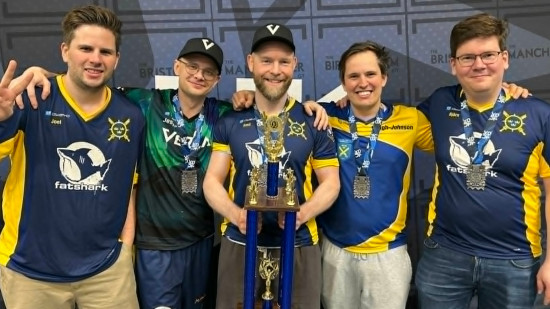
A talented member of Sweden’s Warhammer 40k WTC team, Emil Söderholm rose to notoriety after his frankly terrifying performance with the Deathwatch in the UKTC’s huge Winter International Team Tournament at the end of January. Söderholm finished with 119 out of 120 Battle Points, a feat that required him to crush every opponent with a huge points difference. The meta simply wasn’t ready for his take on the Deathwatch (and not just because he paints them yellow) – who better to tell us about the most elite of all Space Marines?
This is the latest entry in Wargamer’s masters interview series, in which we talk to world-class 40k players about the Warhammer 40k factions they’ve built their reputations with to get their vision of how the army functions and how it’s going to fare in Warhammer 40k 11th edition. As the Deathwatch have a very small range of unique units, and just one detachment, Söderholm’s explanations are tied to the specific list he developed and popularised as much as they are to the faction as a whole.

“The Deathwatch is basically these Kill Teams, these big bricks of 10 marines with different armaments”, Söderholm explains. “You have, say, a heavy bolter, a meltagun, different weapons that are effective into different targets”. On paper, that’s a recipe for sub-par units: normally “you want to have a tool that you are certain will deal with this thing, and you have a tool that you’re certain deal with that thing”, while in the Deathwatch “you’re making these big point investments into big bricks that are good into several things but not super good into specific things”.
“The thing that makes it work is the fact that they are able to teleport across the battlefield”, Söderholm says, thanks to the Site to Site Teleportation stratagem in the Black Spear Task Force detachment. This whips two units off the battlefield at the end of the opponent’s fight phase and lets them Deep Strike during the following turn. It’s an inherently powerful tool for any army, but for the Deathwatch it’s the key to unlocking the full potential of their seemingly unwieldy toolkit.
Take the Indomitor Kill Team, a mix of Space Marines in Gravis armor with flamers and power fists, melta rifles, and heavy bolt rifles. When shooting the closest target they get a massive +2 strength buff, but with just a five inch move it’s challenging to get every weapon in their mixed arsenal into position to get the bonus against a target it actually wants to shoot. Give that unit the ability to Deep Strike, though, and Söderholm says “it’s not that hard to actually put yourself in a situation where the closest target [the bolters have] is for infantry over here, and for the meltaguns, the closest target they have is the tank over there“.

To enjoy this freedom, Söderholm points out that “deep striking and teleporting requires you to get through the opponent’s screen” of expendable infantry. A key tool he uses for this is the Fortis Kill Team, which can be upgraded to carry a Vengor Launcher, an indirect-fire blast weapon. The range on the launcher is so huge that, almost no matter which screening unit you want to delete, every Fortis team will be able to contribute to finish the job.
The army relies on teleportation for its maneuverability, and Söderholm points out that “if you’re facing an opponent that is not giving you the options to teleport in a good way, you are a foot slugging army with units that move five or six inches, it’s very difficult to actually get anything done”. Sometimes the only way to make progress will be to commit units to a suicide mission, exposing themselves to retribution and only destroying a cheap enemy unit but opening up the space needed for your teleportation-heavy game plan.

“In some cases it will look like you’re not getting anything out of it”, he says, particularly in terms of piece trading, but it can be vital to “change the positioning of your opponent so that you can go for that killing blow”. Learning how much to sacrifice and when is one of the key skills for new players.
Söderholm runs around 80 infantry in his lists, which – given they’re all two to three wound Space Marines – “is a hell of a lot of marine bodies that are very difficult to shoot through”, presenting a stat check that not every opponent can pass. Offensively, “one of the main things about this army is if you layer all of these buffs together, the output is crazy, you probably pick up two to three knights in a turn if things go your way”.
The Deathwatch enjoy the accuracy bonus of vanilla marines’ Oath of Moment (though not its buff to wound), flexible Mission Tactics that grant extra weapon abilities, a variety of Stratagems that grant bonuses to shooting, and the specific rules found on each Kill Team’s data sheet, as well as bonuses from attached leaders.

Söderholm’s take on the Deathwatch leans into their strong shooting and maneuverability, but he does acknowledge that there are other options in the list. “The Terminators for example have a lot of heavy weapons, and when they charge from deep strike they re-roll charges, you could lean into that”. “There is some design space there to make an army that is sitting in Rhinos with a bunch of melee dudes that want to go forward and charge”, he adds, “but I wouldn’t say that that’s the most optimal way to play it”.
His army is a ranged infantry force, and it runs into trouble from enemies that can rush into melee and tag his units. With rules changes in 11th edition, Söderholm’s current solution to this problem has lost a lot of its effectiveness. In 10th edition “one of the few defenses you had against melee push armies was the ‘Fight’s First’ Deathwatch Veterans Kill Team, that you usually kept up in the sky to teleport down and do a Heroic Intervention”.

The tech for this package is still intact in 11th edition: the unit is lead by a Judiciar who grants Fights First, while the Beacon Angelis enhancement allows the unit to deploy from Deep Strike and use the Rapid Ingress stratagem for 0CP. But it’s not longer effective. Core rules changes in 11th edition mean that a unit with Fights First will almost never get to attack before an enemy unit that charged this turn, so the heroically intervening unit will take casualties before it hits the chargers and likely won’t be able to clear them.
“I think there will be a forced change in how the army works and how it’s built”, Söderholm says. “I’m not sure if you will go more aggressive with them – give them advance and charge with the Watchmaster, maybe”.
I spoke to Söderholm before the full rules for 11th edition had been fully revealed, and his biggest concern – that the Deathwatch index might be completely rewritten – hasn’t come to pass. He’s optimistic about the teleporting strategy surviving into 11th edition. “If we can solve that problem with being pushed by melee armies there’s good times ahead”, he muses.

Nerfs to the rules for indirect fire make it harder for Fortis Kill Teams to clear enemy screens, but making up for this are changes to unit coherency rules, which substantially shrink how much of the board a large unit will cover. And as deep striking units can now land within nine inches of their target, “meltas will be within half range, so they’ll be even more efficient”, he gloats.
Excited to start a force of the Emperor’s finest? Or have you been on the receiving end of a teleport-strike beating? Join the Wargamer Discord community and you’ll meet a gang of fellow players excited to share their insights.
 Source: Wargamer

