


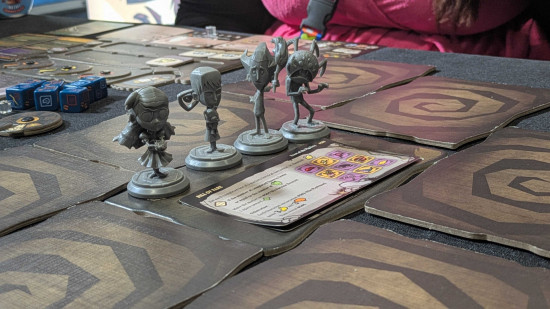
I’m a goth who plays games. Of course I sunk hundreds of hours into Don’t Starve in the 2010s. I was 16 when the spooky survival game released, and it was one of the defining games of my awkward teens.
Another defining moment of my teens was getting into board games. I hit college age, and I finally graduated from Yahtzee and Clue, entering the world of Carcassonne and Catan.
Now, those two cornerstones of my youth have collided in the form of Don’t Starve: The Board Game. Glass Cannon Unplugged (of Frostpunk: The Board Game and Dying Light: The Board Game fame) raised over $5 million on Kickstarter to get the game made. Clearly, I’m not the only one with warm, fuzzy memories of hunting Beefalo and fleeing killer bees.
The publisher displayed a very early demo of the game at this year’s UKGE, and I got the chance to take it for a test spin. I want to stress three of those words again: very early demo. The rules aren’t finalized; my demo began with our teacher retconning some rules on our player aids, because they’d been changed since the prototype was made.
I’m adding extra emphasis here so it’s clear what I’m offering – a first impression of a board game so new, it isn’t finished yet. It’s important context, considering I didn’t enjoy the game.

The board game is a brutal, scenario-based co-op for one to four players. Each scenario offers a different win condition – ours, for example, required us to collect a smorgasbord of rare resources, everything from gold to seeds to monster meat.
A round represents a single day, in which each player will take six turns. You have six rounds to complete the scenario’s objective. Turns can happen simultaneously, which quickly gets confusing when you’re trying to track how many turns everyone has left in the round.
Each turn, you can move one space and perform a single action. Around you is a randomly-generated tableau of face-down location cards. Move to one, and you’ll reveal it. Or, at least, part of it, because every biome has multiple location cards that can be revealed the more time you spend there exploring.
Exploring is one of your action options. You discard the current location card, reveal a new one, and gain its exploration bonus. Any hostile monsters that appear immediately get to smack you for intruding on their business.
Action-wise, you can also sprint to travel longer distances, fight hostiles, trade with friends, or interact with the location. That last one covers a broad range of activities, from fishing to chopping trees. Usually, your reward is resources. You can also pick up resources from murdering the inhabitants of the biome – how else will you get that monster meat, after all?
There’s a lot of randomness at play here. The world relies on card draw, and combat is resolved with dice rolls, which are often incredibly punishing. The health marker on your player board ticks down quickly, and it’s possible to die in your very first fight.

Difficulty, it seems, is top priority for Glass Cannon Unplugged. Your turns are short and strict, with many Interact opportunities locked away until you’ve crafted the right equipment. Crafting and cooking are free actions, but each of the many tool recipes requires multiple resources – so you better hope you stumble into the right biomes quickly.
Combat is extremely deadly, with running away often a preferable option. And that’s before we get to the nighttime phase, where Shadow Creatures show up to sup on your Sanity.
During this phase, your health takes another hit if you haven’t adequately prepared for cold weather. Plus, if you don’t gather enough food (or you let your existing stash spoil), you’ll get hungrier and hungrier. Hunger makes it harder to refresh resources like re-rolls. The lower your Sanity, the more shadow monsters turn up at dusk.
Oh, and did I mention that all those monsters you killed return during the night? Everything in your biomes replenishes – resources and hostiles alike.
Crafting can protect you from the elements, and you’ll have the chance to upgrade your camp in between scenarios. You also get a free revival each scenario that brings a dead player back from the brink.

But that might not be enough to save you. In our demo, I died as soon as the Shadow Creatures showed up. And, as our teacher gleefully informed us, we were playing on easy mode. You can adjust the difficulty to make the game even more unforgiving.
There’s nothing wrong with difficult board games. I’m famous among my friends for loving, as I put it, “board games that fucking hate me”. I relish those games of Eldritch Horror where Cthulhu wrecks me before I get a single shot in. I enjoy the rollercoaster of a thematic board game, even when I fail.
But Don’t Starve is less of a rollercoaster and more of an uphill struggle. It’s a busy, bitty exercise in frustration – one that’s not helped by an overwhelming iconography.
A significant portion of our playthrough was spent getting our teacher to explain and reexplain what symbols on the dice meant. This would come with time and expertise, but the visual language of the game, at first glance, is far from intuitive.
Visual design hiccups aside, the game’s challenge is meant to be its big selling point. Therein lies its biggest problem. The board game misunderstands what made Don’t Starve so compelling.
Yes, it was difficult to finish a run in Don’t Starve. With each passing day, the odds were stacked against you. Dying meant losing hours of progress.

But I never cared, because every in-game day was rewarding. The real joy of the game was discovery. Each day, I’d meet a new monster, one whose visual design was brimming with odd personality, the sort that makes you go ‘What the hell is that thing?!’
Survival meant solving puzzles, like seeing how far the Tallbird would chase you, or zig-zagging to dodge baby tentacles. Your reward? A hearty meal, or a new bit of kit.
You grew stronger gradually, but at a pace rapid enough that it wouldn’t sap your attention span. You could easily have a full survival toolkit by the end of the first day, and you’d be ready to start your farm tomorrow.
In the board game, those joyous peaks of progress are lost in a lengthy grind. And those monsters, so beloved for their distinct designs and personalities, are indistinguishable from each other.
You flip a card, go ‘I recognize the monster in this picture’, and roll dice to see how much damage they deal. They might get to roll different numbers of dice, but there’s nothing in the combat mechanics that make them feel like their digital counterparts.

Don’t Starve: The Board game is stunning. The art style of the videogame is faithfully recreated with spectacular minis. But authenticity is about so much more than what you can see. I believe the best videogame board games succeed because they capture the feeling of their inspiration.
My first test was brief and incomplete, but based on the demo alone, I’d say Don’t Starve: The Board Game has failed to capture its source material. Worse, it’s failed to compel me as a game in its own right.
Want to hear more about the games I tested at UK Games Expo? Join the conversation in the Wargamer Discord, where we share new tabletop stories every day.
 Source: Wargamer

