


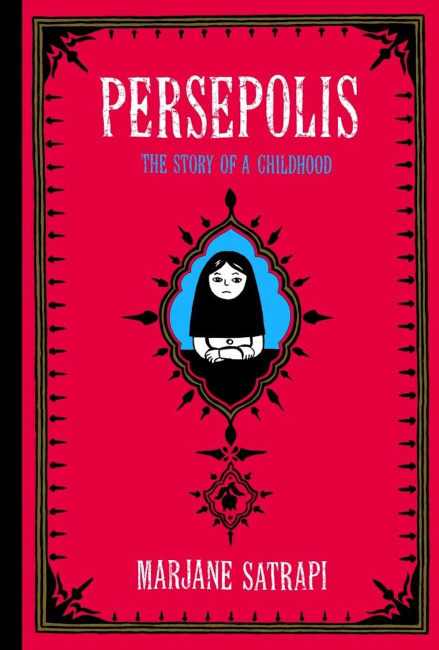

Marjane Satrapi, creator of the acclaimed graphic novel Persepolis as well as Embroideries and Chicken with Plums, died on June 4, 2026, at the age of 56. “Marjane Satrapi died of sadness a little over a year after the death of Mattias Ripa, her husband and the love of her life,” her family said in a statement to the French press. Ripa died in April 2025.
Satrapi was born in Iran in 1969 and raised in Teheran in a family of politically active leftists who opposed the regime of Shah Reza Pahlavi. However, after the Iranian Revolution of 1979, many members of her family were persecuted. She was particularly close to her uncle Anoosh, who was imprisoned and subsequently executed because of his political activities; he is a key character in Persepolis. When Satrapi was 14, as she became increasingly impatient with the strictures the fundamentalist government placed on women, her family moved her to a French school in Vienna, Austria. She later returned to Iran and attended college there, then moved to France, eventually settling in Paris.

Persepolis begins in 1980 and depicts her life in a sophisticated, upper middle class family as they adjust to the strictures of the new regime and the hardships of the Iran-Iraq war, and later, her return to Iran and the difficulties she encountered as an adult. The graphic novel was published in four parts in France in 2000-2003 and as two volumes in the U.S. by Pantheon in 2003-2004. It was a best-seller and was reviewed in the New York Times at a time when graphic novels were still a new category (see “Persepolis, the Stealth Hit”). Her adaptation of the book into an animated film (see “‘Persepolis’ Animated Feature”) won a Special Jury Prize at the Cannes Film Festival and was nominated for the Best Animated Feature Oscar in 2008 (see “‘Persepolis’ Gets Animation Nod”).

Satrapi followed Persepolis with Embroideries in 2005 and Chicken with Plums in 2006, both published by Pantheon (see “‘Chicken with Plums’”); Monsters Are Afraid of the Moon, a picture book, published by Bloomsbury in 2006; and The Sigh, an illustrated fable, published by Archaia in 2011 (see “Archaia Gets Satrapi”). Although she told Publishers Weekly in 2023 that she was done with comics and had shifted her focus to filmmaking, she edited and contributed to a graphic anthology, Woman, Life, Freedom, that collected accounts of the protests that followed the murder of Mahsa Amini, who was arrested for not wearing a headscarf (see “New Marjane Satrapi Book”). It was published by Seven Stories Press in 2024.

While it was not the first graphic novel to attain best-seller status and widespread acclaim in the U.S., Persepolis was nonetheless a milestone, drawing new attention to the medium, and providing a point of comparison for the literary graphic novels that followed. It won several awards at Angouleme, and The Guardian named it one of the top 100 books of the 21st century. The book, the film, and Satrapi’s outspoken opposition to the human rights abuses of the Iranian regime also attracted some controversy. The Iranian government denounced the film and successfully pressed the Bangkok Film Festival to drop it, and the book was removed from public school classrooms in Chicago and then restored after student protests (see “Chicago Public Schools Told Not to Remove ‘Persepolis’”). This in turn became the subject of a recent graphic novel by librarian Jarrett Dapier (see “Story of Student Advocacy”). In 2025, she turned down the French government’s highest honor, the Legion d’Honneur as a gesture of solidarity with the people of Iran, particularly the young women there, and a critique of the French government’s hypocrisy toward the country.Source: ICV2

