


Like many people, I played way too much Plants Vs Zombies in the 2010s. Back then, I had none of my current world-weariness – probably because I didn’t have a smartphone yet. I was shooting peas and chucking nuts at the undead on an iPod Touch for hours on end. Those were simpler times.
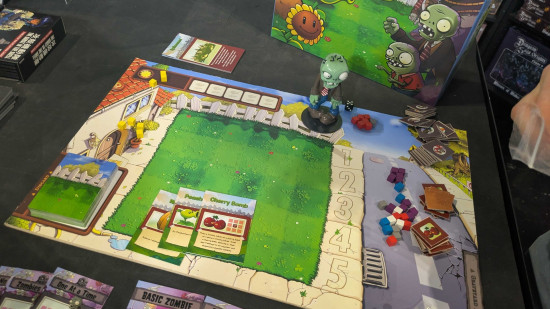
Plants Vs Zombies: The Board Game preys upon this nostalgia like a hungry zombie on a brain. The prototype shown off at UK Games Expo is instantly recognizable. For a board, we have the familiar gridded garden. The titular plants and zombies will also be lovingly rendered as minis (though there’s only the one upsized mini to judge from at this stage).
The board game itself is a co-op experience, where your garden army fights to fend off the approaching horde. If a single zombie reaches the house, you lose. Surviving the onslaught means you win – so far, so videogame.

The demo I saw was largely about hand management. You’ll start and end each turn with three cards. If one of these is Crazy Dave, you must play it, reducing the time tokens that track game progress. Other than that kook, your hand might be filled with plants, tools or zombies.
The zombie mechanic is the one that really won me over. It’s a simple, elegant way to represent the videogame’s constant hordes. Publisher Mantic Games tells me these rules are still in development, but I hope this one makes the final cut.
When Crazy Dave wipes out all your time tokens, a final wave of zombies begins. Until then, the undead will rise at random based on cards you draw.
Zombies act as chaff that clogs up your hand. Unlike plant or tool cards, they can’t be discarded. The only way to clear them is to use your action to play all zombie cards in your hand. And, if you only have zombie cards in your hand, they must be played.

Zombie cards show which lane of your garden they’ll appear in, as well as any unusual abilities they have. This means you can do a bit of strategizing about what zombies to deploy when. If lane three is particularly well-defended, it might be worth dropping Football Zombie before your hand completely fills up.
Speaking of defenses, it’s not a Plants Vs Zombies game without plants. Setting up your garden is a three-step process.
First, you’ll need to spend three Sun to buy a plant from the Seed Store. Its token gets buried face-down in your garden.

It takes another action to grow your plant. Flip your intended token face-up, and pay the relevant sun cost. This will depend on how many plants of that type are already in your garden: the first costs one sun, the second two, and so on.
If it turns out you can’t afford the flipped plant, you flip it face-down again, wasting your action. This adds some light memory mechanics to the overall experience.
When your plant is fully grown, you can use its corresponding cards to activate it. Many of these abilities will look familiar to a garden warfare veteran. Peashooters fire off together, while Cherry Bombs dole out area-of-effect damage.
Generally, I’m quite skeptical when a videogame becomes a board game. As with videogame movies, there are many parts that fail to translate when crossing mediums. The best adaptations are ones that manage to authentically capture what makes the original entertaining.

For the Worms Board Game (another Mantic title), that’s the chaos. For Slay the Spire, it’s the deck-building. For Dorfromantik, that’s the gentle exploration and expansion.
My time with Plants vs Zombies was limited, and the version I saw was unfinished. But, at first glance, I think it succeeds in capturing the authentic feel of the original. Fingers crossed that means the final version is a stellar board game.
The Kickstarter for Plants vs Zombies is expected to launch in Fall 2026. Want to learn more about what I played at UK Games Expo? Keep up with our latest posts in the Wargamer Discord.
 Source: Wargamer

