


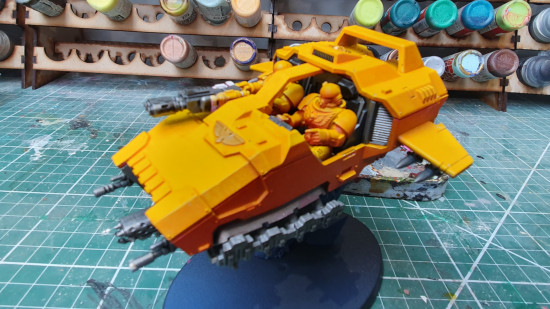
Warhammer 40k Armageddon is a packed launch box set and a bombastic start to the game’s 11th edition. Ignore anyone who’s been muttering about the Space Marine minis looking dull – they’re spoiled by over-familiarity, because these miniatures are crisp. Containing starter armies of Orks and Space Marines, the full game rules, a deck of intriguingly asymmetrical mission cards, and a lush lore guide to the latest stage of the war for Armageddon, this is the best jumping on point to Warhammer 40k you’ll see for the next three years.
Thanks to the team at Games Workshop, I’ve had my hands on a review copy of the Armageddon launch box set for Warhammer 40k 11th edition for a little under a week now. That’s been long enough to devour the lore in the Operation Imperator book, squint at the new core rule book and Chapter Approved mission cards, and hurriedly build and slap some paint onto the Space Marine half of the miniatures.
Without knowing the price point yet I can’t say definitively that the contents are “good value”. GW is fairly predictable in its pricing – it released a similar set for its fantasy game Age of Sigmar in 2024 for $275 / £160, and with inflation I’m banking on Armageddon costing around $320 / £185. That is, in absolute terms, an expensive luxury product – but launch sets are also always the best value for money that GW offers on its products.
The miniatures and lore are immaculate, while the rules – which I haven’t had time to test – show promise, though they’re basically an extension of the 10th edition rather than a revolution.
The miniatures

Armageddon comes packed with two armies, one of Space Marines, another of Orks. So far I’ve built the Space Marine half of the set and started painting them as Imperial Fists, to add to my permanently unfinished collection of banana boys. It took a supreme act of will to start with the Marines, because the Ork half of the set is absolutely packed with character, and I am hungry to get to them.
These are all push-fit miniatures; they don’t strictly need glue to put together. The Marines, at least, are among the best of that kind that GW has produced to date – which is rather faint praise, because I haven’t rated past GW push-fits very highly. There were a few tricky socket joints for attaching legs, so you should keep plastic glue on hand in case of breakages, but overall they’re better than older GW push-fit kits.

The Space Marine kits are proving to be a pleasure to paint. The little details like purity seals, armor iconography, and reliquary chains, add visual interest on top of their plain armor, but there’s not so much of the stuff that the surfaces are needlessly cluttered.
I find it noteworthy that while these are all new models, only two have new datasheets – the Eradicators with heavy bolters represent an existing unit with a new loadout, while the Landspeeder anti-grav skimmer is a modern redesign of a classic OOP kit. Maybe, finally, perhaps, we’ve hit the high water mark for how many units GW stuffs in the Space Marine army book? A man can dream.
The two forces seem roughly balanced for games against one another. They’re solid starting points for collections: buying just the four Marine characters alone would cost over $160 , and whichever direction you develop your army, you’ll want to use at least some of the models from this set.

One irritant is that the units don’t have maxed out gear options – the Ork Boyz don’t have any Rokkit Launchers or Big Shootas, which GW has stated are still weapon options for them – so you’ll have to convert stand-ins if you want to maximise the utility from these units in regular games.
I love these miniatures. I’ve seen some people call the Marine kits boring, and in a sense they are merely extremely competent renditions of designs we’ve seen before, something we know GW can do very well.
But actually pulling them out of the box set – and particularly seeing the sprues side by side with the ramshackle Orks – took me right back to the over-excited nine year old I was when I got my hands on the second edition Warhammer 40k starter set, with its life-altering John Blanche cover art and mountain of monopose Space Marines and Goff Orks. This is a box set that will start lifelong obsessions.
The rules

The 11th edition rules are a variant of 10th edition 40k, and if you love or hate that version of the game, the changes are not going to be enough to shift your opinion. They’re now free to download from the Warhammer Community website.
The competitive metagame will undoubtedly shift, and perhaps the subtle changes between editions will impart a substantially new feeling of play – but I’ve yet to test the rules. For the purpose of this review I’m just considering how they are presented and provided to the player.
The new small format rulebook is great. It’s well laid out, well illustrated with diagrams, and has a one-page index. It’s slightly longer than the 10th edition core rules, so perhaps the game will require fewer errata this time – and as it’s not attached to a 256 page hardback book, it’s also going to be far more practical to take with you to games.
The rules are written in a concise and precise style, with frequent breakout tables to articulate specific rules. These remind me of function definitions in computer programming – they’re unambiguous, which isn’t the same as easy to interpret. In the recent British heatwave, some sections of the rules slid off my melting brain several times. I suspect that 11th edition is going to be a slightly cleaner gameplay experience than 10th, but actually interpreting the rules from the rulebook hasn’t proven that simple.

There are datasheet cards for every unit in the box set. I don’t believe that these are the actual datasheets for the edition – the wargear options for the Boyz and Intercessors don’t match up with the existing box sets GW sells – but they do mean that this box set has everything needed for two new players to face off against each other. With that said, there’s no “learn to play” booklet, so those new players may need some assistance from their local store, hobby club, or online guides to get started.
Chapter Approved
The Chapter Approved mission cards included here provide a substantial shift in the way competitive 40k is plaid. Each player determines their primary objective by comparing their ‘Force Disposition’ with that of their opponent, with each pairing generating a unique mission with asymmetrical objectives (notwithstanding mirror matches, where both players have the same goals).
With five Force Dispositions there are 15 distinctive missions and 25 different sets of objectives. For competitive players, this is either going to create a bold new dimension for theory-crafting and list-building, or an ungodly balancing mess the designers will need several balance dataslates to fix. For other players, the asymmetry of these missions injects a credible sense of narrative into proceedings – some of the time.

When a Reconnaissance force encounters a Disruption force, the Disruption force can earn a steady trickle of points by setting up Decoys on objectives, while the Reconnaissance force gets points if it can Surveil the Foe. These two unit interactions affect one another – a unit standing near a Decoy can’t be surveilled, but a Recon force can move troops close to the Decoy to uncover it. There’s a story here – picture T’au pathfinders scouting out Astra Militarum artillery positions, only to discover they’re dummies set up by a light infantry force.
But we also get stuff like Sabotage, the mirror match for two Priority Assets forces. Both players are trying to sabotage objectives, and other than a small bonus for sabotaging the enemy’s home objective, both players are typically trying to sabotage the same objectives. That’s just not how sabotaging stuff works. Changing the narrative to ‘pillaging resources’ would have made more narrative sense of exactly the same in-game activities.
The mission deck contains secondary mission objectives, plus Twist cards that give alternate play modes for casual game. Overall, if you’ve had problems with the points-salad scoring style of modern 40k, the latest Chapter Approved deck won’t change your opinion. But there’s more sense of story than in 10th edition, and I’m happy to see this direction of travel.
I’m keen to try out the new edition with my older, grognard friends who have been sniffy about the competitive shift that 40k has experienced since ninth edition. I suspect that the narrative grounding the new missions provide will make a meaningful difference for this kind of player, helping to get them onboard with Chapter Approved missions which – for better or worse – are now the default way to play the game.
Operation Imperator

At the end of the ‘Armageddon: the Return of Yarrick’ campaign supplement, the industrial world of Armageddon had been overrun by the largest Ork Waaaagh! yet to hit the beleaguered planet, and Imperial defenses were on the brink of collapse. Operation Imperator picks up right where it left off, as Marneus Calgar, Chapter Master of the Ultramarines, rallies a strike-force of Space Marines from multiple chapters to deliver an emergency counter-attack. Their goal is only to delay the collapse of the Armageddon front-lines, to give more time for Imperial reinforcements to arrive.
This book introduces the different warzones on the planet, the key areas of interest within them, and the actions of the many different Space Marine strike forces as they establish their beach-heads, but doesn’t push any further beyond that. A lot of Space Marine chapters get in on the action, including some little known chapters like the Skull Bearers and Black Guard, and the temptation to abandon my Imperial Fists collection and paint the Marines as one of the chapters detailed in the book was real.

The art throughout has a fantastic sense of scale. Ork warmachines feature heavily; hundreds of trukks and buggies careening through smoke-choked wastes; insane driller contraptions ranked up ready to assault a fortress’ walls; the leering head of a Gargant blazing fire as it’s assaulted by Space Marine jump troops. If you’re a fan of tactical maps or orders of battle lists, there’s a lot to pick over here.
This isn’t a pure campaign book – the last 16 pages are given over to brief summaries of all the Warhammer 40k factions for the benefit of anyone who makes Armageddon their first ever purchase. While it’s far from as comprehensive as the Forge World campaign books of yore, it is well written, punchy, and evocative, and it is going to fire the imagination of any first time 40k collector.
Armageddon also includes the Dominatus campaign cards set, which allows a group of players to battle for the fate of the world and pick up some campaign-specific unit upgrades as they go. This feels like a pleasant inclusion that not every player will have a use for – for first time players, it should add longevity to this extremely expensive purchase, but it will be skippable for tournament players.
Final thoughts

Launch box sets for new editions of Warhammer 40k are a familiar proposition at this point: a premium bundle packed with models, and the first place to get the new rules in a printed format. In terms of the sheer weight of plastic and cardboard, they are always the best value for money product in the game’s three year edition cycle.
Existing players can make their decision based on the hard calculus of plastic – do you want to start or expand an Ork or Marine army? Do you plan to pick up the new rulebook and Chapter Approved deck? Find a friend to split the set with, and unless GW does something utterly groxdung with the price, you’ll be golden.
Armageddon is much, much more compelling for new players. It does not quite have everything they need to get started – they’ll need some clippers to get the minis off the sprues, a battlefield and scenery to fight over, tutorials or knowledgeable friends to help them learn the game, and a lot of six-sided dice. But it will launch them into the game with big chunks of their first armies, and a tantalizing taste of the grimdark Warhammer 40k universe.
If you want to see my progress as I paint up the Armageddon box set, come and hop into the Wargamer Discord community – and share your own progress if you pick the box set up when it releases on June 20!
 Source: Wargamer

