


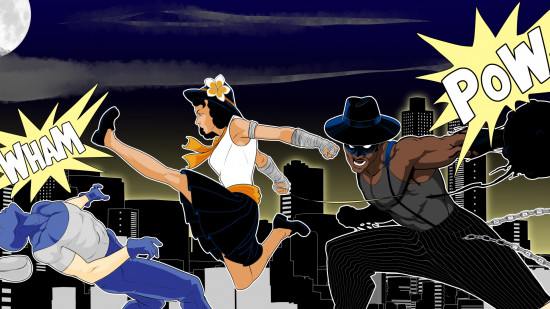
Noir 1933 isn’t like other superhero stories. In the age of Marvel fatigue and edgy, postmodern hits like The Boys, that might sound a little trite. Superpowers have been done to death – how are we possibly going to keep the genre interesting? For new TTRPG publisher Noir Incorporated, the plan is to go back to the beginning with a fresh pair of eyes.
The year is 1933. Prohibition is coming to an end, the Great Depression is in full swing, and facism is quietly on the rise in Europe.
Superman has just made his debut, and we’re six years away from the first Batman comic. Pulp is the height of genre fiction, with Doc Savage and The Shadow are the peak of heroism. Project director Teras Cassidy tells me all these heroes inspired the Noir 1933, but it’s who they don’t protect that really drives the project.
“We want to tell the stories of speakeasies and tenement buildings”, he says, “the heroes you’ve never seen before.” “As we looked into the history of pulp, there was clear bias and racism there, and the heroes of pulp that we know are all part of the white 1%.”
Using The Shadow as an example, Cassidy explains how the hero gains many of his skills from South American cultures. “He comes back to America and uses those powers to enforce the laws that his social strata and class believe are correct”, Teras tells me. “He might go to a speakeasy to shut it down because alcohol is illegal, but the speakeasy owners are just trying to make money to survive.”
“We were wondering ‘where are all the people of color’?”, he adds. “Whoever taught The Shadow must have taught their own communities these mystical abilities too – where are those guys?”

Noir 1933 aims to expand the pulp hero genre by exploring the “lost histories” of the real-world 1930s. As the Kickstarter page says: “We give voice to how these unsung guardians organized to shield their neighborhoods from systemic injustice and economic ruin”. “By inviting a diverse collective of authors and illustrators to populate this universe, we will create a space where characters must overcome the heavy cost of racism, social barriers and complex community-based realities to ignite a flicker of hope in a world on the brink.”
It’s a profound concept for a tabletop RPG, that’s for sure. It probes at the definition of heroism and its overly white history in fiction. When bias brings the morality of written law into question, what separates the criminal from the vigilante? Who is the real villain when the system fails?
While it could make for rich, complex roleplay, Noir 1933 draws on painful lived experiences of oppression. Despite almost 100 years passing by, many of these are still felt by marginalized people today. Sensitivity and authenticity, then, were key to the project.
“My daughter actually said to me, ‘Dad, you can’t write those stories'”, Cassidy tells me. “And she’s absolutely correct. That’s why we created a team of diverse people to build the world.” “Those people will help create those histories.”
While game design and narrative are primarily handled by Graham Tugwell and Duane Burke, additional authors of various cultures contribute to Noir 1933. This includes Mary Fan, Deirdre Sullivan, Daniele Bolelli, David Rudden, Keith R.A. DeCandido, and Derek Attico.
Meanwhile, Terry Huddleston acts as art director, with Sovannahry Em, Dobroslaw Wierzbowski, Nahry Em, and Adriano Moraes contributing illustrations. This team means Noir 1933 has a vast range of global influences, from Cambodia to Ireland to Poland.
Have no fear! The rules are here!
That’s enough superhero origin story for now. Onto the meat and bones of the system.
Players’ heroes fall under three umbrellas: ‘weird’, ‘pulp’, or ‘tech’ heroes. Within each category, there’s three archetypes, giving you nine ‘classes’ (to use the D&D term).
There’s the Slugger, a blue-collar brawler, as well as the Professional, an archetype that covers everything from chatty socialites to supernatural sleuths. Street Sharps are streetsmart combatants, while Gadgeteers use out-there inventions to solve problems.
Weaponsmiths specialize in a specific bit of potent gear, and Augments incorporate the tech into their very bodies. The Initiate draws power from their long-departed ancestors, while the Volatile’s body is a transformed weapon of eldritch destruction. That leaves the Mystic, who makes pacts with otherworldly entities in exchange for reality-warping power.
Each character has a ‘suite’ of three dice they can roll to make skill tests. These range all the way from the pointy D4 to the chunky D12, and the player has some control over which die they use. As an example on Kickstarter says:
“You lash out with your electro-whip, attempting to shock the Pinkerton menacing you: do roll your d6, d8, or d10 to see if you strike true?” “The remaining dice will be used to see what effect your attack has – so rolling your better dice to see if you hit may reduce the impact of the attack.” And if you save your worst dice, you may leave yourself open to a counterattack!”

GMs use margins of success and failure to narrate cinematic results. And even when rolls fail, the story is pushed forward by Moxie, which can modify future rolls. “This helps generate pulp-style events where all seems to be falling apart, but the hero manages to do something spectacularly dramatic”, Cassidy tells me, “like catching a rope over a lava pool of certain death”.
Catastrophic failures, though, cause Trauma. This can reduce your Moxie and, Cassidy says, alter your dice suite for future rolls. “Trauma can be overcome, however”, he adds, “often with the help of friends”.
Community and solidarity are integral to Noir 1933. So much so, in fact, that they have distinct mechanics. The Solidarity System allows heroes to enhance each other’s powers, giving them greater chances of success.
Plus, character creation is more than about a single individual. Players also create the Neighborhood their hero comes from and strives to protect.
“In other RPGs, you meet in a tavern – it’s disposable”, Cassidy tells me. “The Neighborhood is not only a place a character has to protect and live in; it’s a place that grows with you, and it’s a fundamental part of your character.”
“As you level up, so does your Neighborhood.” “These are low-level superheroes, so the Neighborhood is actually part of their power”, he adds. “For example, healing potions are basically unheard of, but your Neighborhood has a healer that takes care of you as you go through a campaign.”
Players collect a meta-currency called Sway as they complete missions and contribute to their community. Sway, in turn, gives them further influence over the Neighborhood during periods of downtime.
Neighborhoods change for the better as you grow stronger, but that’s not all that happens at home. The GM can sow conflict on your turf to push the story forward. If your Morality (a dedicated system in Noir 1933) changes too much, you may find yourself ostracized from your community. Plus, there’s always the chance that rolling a critical failure puts a stray bullet in your childhood best friend…
Noir 1933 may tackle serious subjects, but it doesn’t forget about its pulp roots. This is a game that promises high-stakes shootouts with Lovecraftian monsters and gangsters alike. There’s cinematic combat, verbal sparring, and sleuthing to do. And among all the adrenaline-fuelled action, you’ll (hopefully) help make the world a better place. That’s a hopeful thought to end on.
Noir 1933 continues crowdfunding until June 17. If you want to talk more about the best tabletop RPGs, you can also join the conversation in the Wargamer Discord.
 Source: Wargamer

