


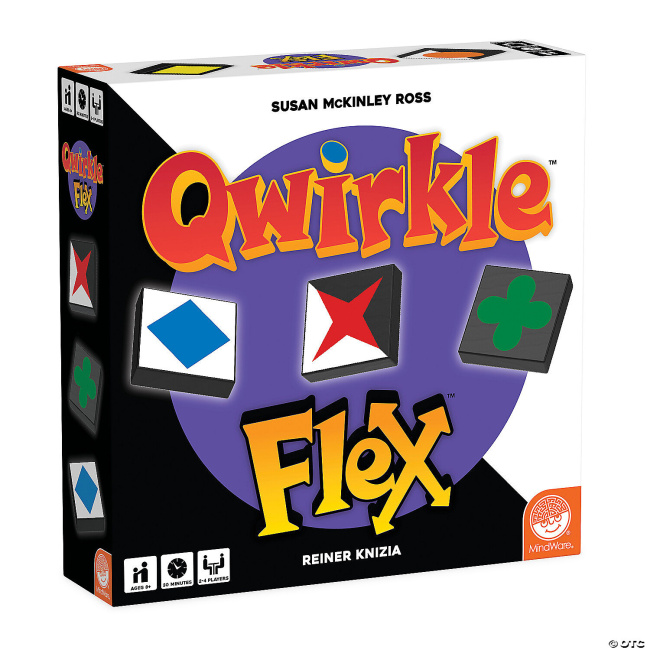

Quirkle Flex
Publisher: Mindware
Release Date: Fall 2025
Price: $29.95
Creators: Susan McKinley Ross and Reiner Knizia
Format: boxed game, low to medium complexity, 2-4 players,
Playing time: 30 minutes per publisher
Age Rating: age 8+ per publisher
ICv2 Rating: 4.5 Stars out of 5
The original Quirkle game came out just a few years ago, and already had both a smaller, more portable version and a dice-rolling version to add to the original tile placement game. The basic concept is that there are six colors and six shapes of images on the tiles, and players place tiles, like in a Scrabble game but with no board, to form columns or rows of tiles with the same color or the same symbol. No column or row can be longer than six tiles, or contain any duplicates of the same symbol and color. Any player who can complete the set of six tiles in a row scores a Quirkle, with bonus points.
Then, along came Reiner Knizia, who saw the opportunity to add more work for the poor scorekeeper and more chances for the players to score points. In this version, there are three distinct backgrounds for the tiles, and when tiles are placed, if they are arranged so that there is a diagonal adjacency between two or more tiles of the same background pattern, more points are scored.
For experienced players of the original game, this isn’t very difficult, but the actual number of bonus points scored can be tricky to spot, at first. As with the original game, the last few rounds of the game can be much slower than the earlier ones, as players run out of options for playing tiles without providing bigger scoring opportunities for other players.
One advantage to this edition is that it can be used to teach beginners the original game, by simply ignoring the background patterns for the teaching game. Then, just add the marginally more difficult version, as they get to know the basics. This may not be necessary, as players who are experienced at other games can pick up the Quirkle Flex rules quickly enough. One minor design flaw from the original game was preserved, as having the diamond and square shapes be the same size makes it easy for some players to confuse the two, as they look at the tiles on the table.
The game includes cardboard tile racks that may wear out, so raiding your old Scrabble set for more durable ones could become necessary for anyone who plays this a lot. The tiles themselves and the bag from which you draw new ones during the game are of nice quality, but a drawstring to hold the bag closed would have been nice. The tiles need to be stored in the box after the first game, and the bag seems safer than putting the tiles back into the cardboard in the box. No score pads were provided, but pencil and paper will be all players need to add.
For players who do not own the original version, this would be an excellent purchase as a short game. For experienced Quirkle owners who want a slightly more difficult version of the game, this will be tempting.
—Nick Smith
Source: ICV2

