



This is a guest post from Zach Langsley Norman.
 Like every good English lad, Stephen du Blois’s uncle, King Henry I, loved eating Lamprey so much that he died. Heirless*. And maybe hairless, too. Overconsumption of lampreys is known to have mysterious side effects**.
Stephen, enterprising young man that he was, rushed to his Uncle’s deathbed, only to arrive three weeks after he died. So, he was crowned king, despite Henry having a daughter, Matilda, who was very much alive and eligible for the throne. The crown was just lying there, after all.
Matilda was, understandably, plucked. Thus began an eighteen-year-long period in ancient England known as The Anarchy, here lovingly recreated in Tabletop format.
The Anarchy, from Bobby Hill and published by Garphill Games and Renegade Game Studios, is a 1-4 player game that takes about two hours to play. It is a multiplayer solitaire experience, and plays best at one.
Note: This review is based on plays of a purchased copy of The Anarchy, played with 1 and 2 players.
Gameplay Overview:
The Anarchy is played over five rounds. In each round, you will spend workers and resources to build up your defenses, improve your resource and worker production, hold tournaments and festivals, and train your citizens.
You’ll also need to prepare for an invasion of your castle by forces loyal to Matilda at the end of each round, based on Attack cards that you place atop your player board.
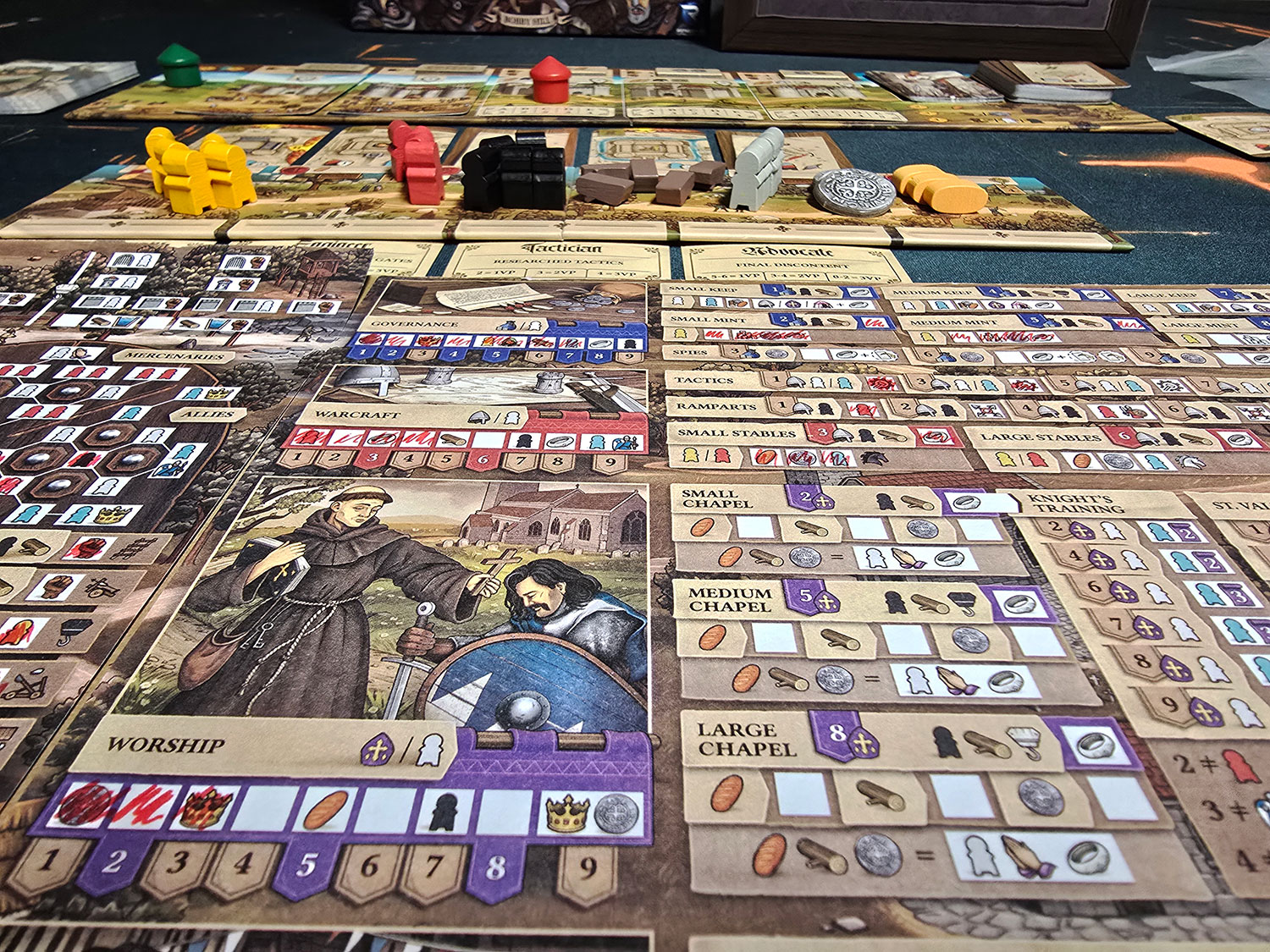
Like its predecessor, Hadrian’s Wall, The Anarchy is played on two very busy sheets of paper, your Left Sheet and Right Sheet. (My wife, upon seeing the play area, uttered a disbelieving “Oh wow”).
The Left Sheet is where you’ll build your defenses, log increased production numbers, and spend your silver for more workers or siege weaponry.
The Right Sheet houses your “personality” traits, determining your skill or investment at Governance, Warcraft, Worship, and Entertainment.
Each round, you will collect resources based on which Path card you choose. Path cards will give you an endgame scoring condition and a pool of available workers and resources for that round. There’s a nice decision space in whether you pick the better scoring condition or the better resource pool.
Game Experience:
The Anarchy is the Rube Goldberg device of flip-n-writes, with long action chains that can occasionally end unexpectedly. The game encourages the player to spend that extra Serf to dig the moat to it’s appropriate crocodile-holding depth, which will gain you a Materials and a Loyalty, which can give you an Influence, which can give you a Craftsman, which can be combined with the Material you got a second ago to build another Wall level (certified free of Amontillado casks), giving you a Might, which gains you a Patron, which can be used to train a Knight, and snag an extra soldier in the process. *whew*. At this point, your fingers will be cramping from the take-a-penny-leave-a-penny action of scribble, move meeple, scribble, move meeple, etc.
On the flip side of that, because the possibility to activate those long combos exists, it can feel somewhat anti-climactic when you initiate an action that results in two, one, or gasp, even zero additional actions.

Let’s talk leadership personalities. Do you aspire to be an efficient administrator? Spend your Patrons to increase your Measure of Governance to allow you to build mints (small, medium, and large available, as long as you have the cranes to lift all that material up high enough), or enhance your keep for bonuses.
What if you want to be the Cool Dad and just throw tournaments and festivals for your citizenry? Spend those patrons to increase your Measure of Entertainment instead.
Rarely will you find yourself with enough patrons to max out your tracks in all four of the Measures, and I found myself plotting game strategy based on what each of the Measures unlocks.

Many of the actions on this Right Sheet side will prompt you to flip two or more Domain cards, which have myriad symbols for each type of action. Say you’re hosting a tournament. You’d flip two Domain cards and look at the position of the Lance and Shield icons on each. One card represents your knight’s thrust, and the other is the challenger. The outcomes of these flips will determine whether you win the tournament and get the reward or not. This is the most random element of the game.
The biggest difference in The Anarchy as opposed to Hadrian’s Wall comes in the defense of your land. Unlike Hadrian’s Wall, The Anarchy telegraphs what you’ll need to successfully defend your keep.
Staving off the invasion is satisfying. At round start, you’ll have between two and six Attack cards that you need to defend against. Some of these are face up, and you can plan precisely for them. Others are face down, but you still have some information about them, like what tactics you can use to defend against these attack types, and a ballpark idea of how strong the attack will be.

Combined with the Path card, the Attack cards can dictate the focus of your play for a round. If you know that you’ll be assaulted with Archers, Catapults, and Ladders, and that you get points for finishing all your walls, you can pour resources into erecting walls and building covers.
You can also attack Castles and Forts occupied by Matilda’s supporters. To do this, you spend resources and Soldiers/Knights as required on each castle card. By conquering enemy castles, you gain some small resource rewards and Bravery and Might (in later attacks), which will help your final score.
These castle attacks are encouraged, and can sometimes feel like a resource drain (especially if you know there is a big Siege coming later). However, the points benefit is undeniable.
Final Thoughts:
The best part of The Anarchy is the flexibility that each game brings. Although the sheets are quite dense, you are constrained in how you use each resource you have. For example, craftsmen are limited to use only in Defense build-up on the Left Sheet, and building buildings on the Right Sheet.
As you get used to the decision space, your turns will begin to flow quickly. Learning the game, however, will take a game or two. This is a heavy flip-n-write, with a BGG weight of 4.00, which is right on the money. Paul Grogan has an excellent tutorial video, and the rulebook is well done. Even so, it took me a game and a half before I had internalized each bit, and I was still looking up small rules (how the heck do I run a Lammas festival?) in my fifth game.
For a flip-n-write, I found the game slightly too long. A full game takes me about two hours to complete, and I’d like to cut that down slightly. That said, there were no obvious bits of game that would make sense to lop off to shorten the play time. This is a well-baked pie, it just takes two meals to finish it off.
Final Score: 4 Stars – The Anarchy translates the joy of a color-by-numbers spreadsheet into a tabletop game format wonderfully.
 Hits:
Hits:
• Combotastic!
• Brain burner
• Small box, small footprint, LOTS of game
• The solo campaign is great fun
Misses:
• Randomness of card flips can be frustrating
• Just slightly too long

*Matilda is frowning from across the Eons
**No, it is not.
 About the Author: Zach Langsley Norman is an Enthusiast. Be it tabletop games, bicycling, cooking, tea, camping, golf, reading, watching baseball or hockey, or something else, he’s probably going to have a nice time. Zach’s favorite games are big, crunchy Euros. He mostly plays solo these days, unless his toddler decides to play punchies with a fresh game.
Source: Board Game Quest

