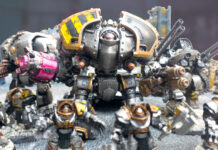
Veil of Ashes is in a very early, pre-alpha state, and it’s already one of the most visually stunning strategy games I’ve seen in years. First-time developer Greifenmaer revealed a playable demo at the Games Ground convention in Berlin, Germany this weekend, and thanks to an invitation from publisher Slitherine Software I was able to get my hands on it. This one could be special.
Veil of Ashes is set in an alternate timeline: in 1704 a great inferno burns away the familiar nations of earth but leaves behind a powerful new energy source, cinium. New empires and new technologies arise, principally massive steam tanks. Cue catastrophic world wars, and a fantastic premise for a videogame.
There’s a very grand sense of scale in Veil of Ashes. Units range from feeble infantry, through light and heavy tanks, up to monumental Behemoths, rolling fortresses with turning circles like oil tankers and the firepower to delete whole battalions. The build I played had no way to summon these things in organically, but I watched a pair of devs cut loose with the cheat menu and spawn them with abandon. Opposing gods of war obliterated one another in the centre of the map with apocalyptic firepower, and it was glorious.

Said map is already fairly deformable: trees crumple under tank treads, artillery shells leave impact creators, and the hulls of destroyed tanks create new obstacles and cover for other troops. I was informed that there are plans to allow infantry to garrison buildings, though this system, as well as embarking on transports, wasn’t implemented in the build. And of course there are plans to make buildings destructible.
Even without these features, Veil of Ashes is a fireworks show of destruction. Shells deflect from armor with red hot flashes of light, tank engines cook off in fireballs when shells hit home, and the artillery strikes are art. You can pull the camera back far enough to watch the parabola of each shell, leading a trail of smoke skywards before plummeting down towards its target. A direct hit lands like the judgment of god – zoom in close enough and the screen shakes while a column of fire and shrapnel launches into the air.

I played a couple of trial games, one against a human opponent and one with an AI ally against a pair of computer-controlled foes. Both missions were simple enough exercises in capturing and holding strategic points; a single player campaign is promised, but that’s a long way off.
This is a real time tactics game rather than real time strategy, so there’s no base building, just a recruitment menu that lets you order up units and deploy them via airship. You have a budget of a basic requisition resource to invest in your troops, which returns to your bank once they’re destroyed; heavier tanks require the investment of the rarer resource cinium.
The battlefields are big – not Broken Arrow big, but big – and maneuvering troops means committing them to a journey they can’t easily reposition from. When forces clash the engagements are often decisive, though if you manage to retreat a unit you can heal it in a friendly zone.

Infantry are maneuverable but fragile – the devs say they’re planning to let them hide in forest cover to reccy or ambush the enemy, but that wasn’t in the build yet – and tanks behave just like tanks, either light and fast or heavy and slow.
Artillery pieces are a blast (pun accidental, but I chose not to delete it), with truly massive attack distances. They don’t target individual units – instead you’ll pick a zone for them to strike. It takes time for a shell to land, during which time your opponent might have repositioned, but a direct hit from even a light artillery piece is devastating. Reconnaissance with faster moving troops is essential for actually locating the enemy, and firing on a hotly contested target zone risks friendly fire.

The build was fairly light on micro-management. Vehicles have stronger and weaker armor facings, so turning the enemy flank is worthwhile, and quite achievable on the huge battlefields; units have different stances and infantry squads can clump up or spread out, features I didn’t touch. You need to call in artillery strikes manually from each vehicle; the devs say they’re working on the ability to group activate artillery vehicles, and I’d welcome the option to set a fire zone your artillery to continually bombard.
Much remains to be implemented, but Veil of Ashes has already got the juice. It’s just incredibly cool. The challenge for Greifenmaer is to sustain its momentum and brings as much polish to bear on the gameplay and campaign as it has on the vibes. Optimizing the code so my middling PC has a chance of running it would also be nice.
The other new strategy title I went in-depth with at Games Ground was Steel Platoon – check out my first impressions here.
 Source: Wargamer