


When it comes to the world’s biggest board game, there are many pretenders to the throne. The infamous Campaign for North Africa boasts the longest playtime, while World in Flames won a Guiness World Record for its square footage. Hell, there are a dozen roll-and-writes that promise player counts in the hundreds. What makes Mega Empires special? Is it really, as its website claims, the biggest board game in the world?
Co-designer Flo de Haan admits to me that ‘biggest board game in the world’ is “a bit of a marketing term”. But there’s merit there, too, because Mega Empires has everything you’d expect from a game with ‘mega’ in its title. “The length of the game, the number of components, the number of players, the size of the board – with all these things combined”, de Haan says, “there’s no bigger game than that”.
Mega Empires first released in 2022 as a remaster of 2015’s Mega Civilization. It’s a civ-building strategy board game that emulates the real-world growth (and decline) of empires throughout history. Mega Empires is technically four board games, each standalone yet compatible.
The West and The East expansions cover the Mediterranean Sea, North Africa, and the Arabian Peninsula and Southwest Asia. Those two boxes alone accommodate three to 19 players. Then, there’s The Far East – North and The Far East – South. Mapping out East Asia, these two expansions arrive in 2027, and they bring the player count up to 30 people.
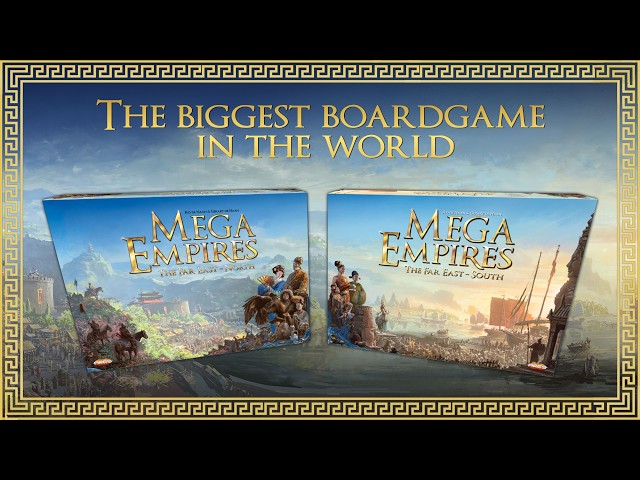
A full game of Mega Empires now involves a board that’s almost nine feet long. That doesn’t include the many player mats, tracking boards, and cards involved. I can’t verify whether Mega Empires breaks the world record set by World in Flames – but I can verify this game is freakin’ huge.
What makes Mega Empires stand out from other monster board games is its approachability. “We wanted it to play very simply”, de Haan tells me. “It’s really easy to learn, but the options are enormous.” “
As with almost any strategy game, your aim is to score the most victory points. You lead an asymmetric empire, and you mark your advancements by climbing the Archaeological Success Tracker (AST). You also score based on the value of your Civilization Advances, combined with the number of cities you maintain.
Cities produce commodities, which you can use to pay for powerful Civilization Advances, or to trade with other players. Trading also allows you to sneak Calamities into their hands – which can topple a civilization if not properly managed.
It’s a careful mix of area control, economic management, bluffing and diplomacy. The two Far East expansions are aimed at small player groups of three to five players, but even with the full 30, a game still plays over 15 rounds. That’s a mere 12 hours! A long time by the standards of a casual gamer, but a pittance compared to games like Campaign for North Africa.

“We always intended it to be a long game”, de Haan says, “but it was designed to fit in one day. You can start at nine in the morning, then play until nine in the evening, ready for people to catch trains home.”
In fact, Mega Empires might be the perfect game after you first get into the hobby. Seriously, hear me out.
“Mega Empires is actually Catan for advanced players”, de Haan says. “It’s the next step up. You build cities, and you connect them on a board, and you trade with people.” That’s quite the simplification of Mega Empires’ rules, but the core tenets are certainly Catan-esque.
The major difference, de Haan says, isn’t complexity – it’s ideology. “In Catan, you build up to a final point where you have X cities or points, and then you win the game”, he explains. “But there’s an expansion where you have to contend with Barbarians who destroy your cities and roads. Meg Empires shares this idea, because you have to understand you will lose the things you build.”

As the Kickstarter for the Far East expansions put it, Mega Empires is “a cycle of constant destruction and recovery”. “During a round you build up a little, but also your cities will be destroyed, and you have to build up again”, de Haan says. You have to be vigilant for Calamities, trading at the right time or finding spots to rebuild your cities.”
That non-linear progression might irk the hardcore eurogame fan, but it’s a more authentic mapping of real-world history. And history is very important to mechanics of Mega Empires.
Take, for example, the new expansions arriving in 2027. According to de Haan, the Far East expansions replace the floodplains of West and East with rivers, because historically “Chinese and Tibetan rivers are really impactful”.
“You can move your tokens two steps instead of one when using a river downstream”, he tells me. “But the Song Dynasty invented the pound lock, so this is also an Advance”. “If you have the pound lock, you can also move two steps upstream on the river.” Other Advances reflect the inventions of East Asian inventions from 200 AD to the year 1200: the magnetic compass, gunpowder, and more. The game’s new components consider the impact of paper, silk, and Mongolian Horsemanship.
As for other historically accurate mechanics, “we have fully integrated pirate ships, and these block sea movement unless you pay them a tribute card”. “If you do, you can also move them to your neighbor and place barbarian tokens to attack someone’s city.”

Plus, “We added Zodiac events to the AST”. “When the turn market hits a token, it triggers a random event – mostly a Calamity for all players, but sometimes they only hit players who are in the lead, or benefit those falling behind.” “It’s a real balancer”, de Haan adds.
There’s even a Great Wall card that adds physical barriers to the board, impassable unless you also have a Great Wall card – or gunpowder to bring the whole thing down.
The Far East expansions fine-tune the Mega Empires experience in many ways, at both ends of the player count spectrum. Cultural Heritage cards kickstart a smaller game (and there’s even some designed for the existing West and East modules). Meanwhile, trading has expanded via The Silk Road, not just to accommodate higher player counts, but to reflect the impact of trade on the region.
I asked de Haan if he could see Mega Empires getting any bigger. After all, there’s still a lot of world left to cover. He says he and the team can see them designing more modules, but the player count is likely to stick at 30. “We considered it during design, and we said ‘okay, this is the limit'”, he tells me. “Another player won’t add anything more.”
“In future, we’d really like to design other Mega Empires games”, he says. “Perhaps in other parts of the world, or other timespans, or focusing on specific regions – but we will not add more players to this world.”
You can check out demos of Far East: North and Far East: South at this year’s Essen Spiel, or when they see a full release in 2027. Until then, if you want to learn more about the year’s best board games, check out our dedicated guide – or hit us up in the Wargamer Discord.
 Source: Wargamer
