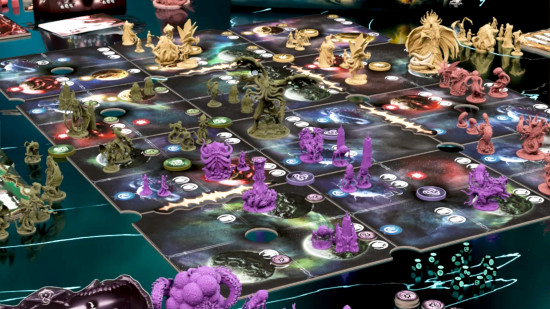
How do you transplant a strategy game from the grim darkness of the far future into the psychedelic chaos at the dawn of the universe? That’s the challenge for board game designer Samuel Bailey, whose new game Old Ones Origins takes his earlier design Warhammer 40,000 Forbidden Stars, and transports its galaxy conquering action out of the Imperium of Man and into the Cthulhu Mythos. I interviewed him to find out what was changing, and what elements of that classic design will stay the same.
Forbidden Stars was released in 2015, only a year before Fantasy Flight Games lost the license to make Warhammer 40,000 titles, giving it a very short but fondly remembered lifespan. Bailey co-designed it with James Kniffen, the duo adapting an earlier Starcraft Board Game that Corey Konieczka and Christian T. Petersen made for FFG in 2007.
All told, Call of Cthulhu: Old Ones Origins will be the third published iteration of the rules – and there have almost been other editions. “I’ve gone through three publishers with this, and I’ve done a different version for [each of] them – I had a whole version that I had made that was more hard sci-fi in a setting that I created myself”, Bailey says. When he signed up with Chaosium, moving the game to the Cthulhu Mythos was obvious.

But it’s not the Cthulhu Mythos as you might know it. “There’s so much sci-fi where it’s very human-centric – I want to do sci-fi that just has no humans in it, and can just be as imaginative and interesting as possible.” So the new game is set in the very earliest days of reality, when the Lovecraftian Great Old Ones aren’t ancient mysteries, they’re emperors and warlords grappling for control of the universe.
I’ve already written a separate article delving into the character and playstyle of the four Great Old Ones that will come in the core game set currently up on crowdfunding platform Gamefound. Forbidden Stars did an excellent job giving the four Warhammer 40k factions it featured distinct mechanical identities – when Bailey reminisces about it, we get a glimpse at what might have been if Fantasy Flight had kept the Warhammer 40k license, and a promising hint at what might be in store for Old Ones Origins if the game sells well.
“I had a lot of ideas that I was excited to get to, like Necrons, and Tyranids, and Dark Eldar, and T’au”, Bailey says. “My idea was to do another full box core set with new tiles, and you could mix and match everything, rather than just drip feed one faction at a time”. Another idea was “to do mini expansions through the print on demand factory, using the same minis, but [for example] a deck of all the Space Wolves cards” – that was kaiboshed by the terms of the licensing agreement, which would have required Space Wolf models to go with Space Wolf cards.

Surprisingly, working with the Lovecraft mythos isn’t without restrictions. “While all of Lovecraft’s stuff is in the public domain, not everything in the Lovecraft mythos is, and there’s quite a few prominent monsters that actually were not invented by Lovecraft and are still under the ownership of various authors”. “Chaosium has a lot of agreements with that for the role-playing game”, he adds, “but not with board game stuff”.
The distinctive makeup of the Mythos has also posed a challenge for making full factions. “You need a god who’s been written about a lot, to hang narrative and mechanical hooks on, and has a lot of units that you can put under their banner that makes sense”, Bailey says. “It was very easy to do for Warhammer 40K because everything is already in the game, there’s plenty of units and abilities to draw from”, he continues, “but it’s been surprisingly challenging to build out these factions”. Lovecraft was big on big guys, but the middle rungs of faction hierarchy have taken a little creative license to fill out.
Much of the mechanical identity of Forbidden Stars came from the asymmetrical factions and the way their mechanics matched their lore – an approach which, when followed through to the Lovecraft Mythos, inevitably results in very different factions. “My goal was to make it make a game that still feels like Forbidden Stars, but change as much as possible”, Bailey says.
And there have been more systematic changes. For one, units don’t have a Morale stat to represent their bravery and sanity any more. “That didn’t really make sense in a Cthulhu universe with the great Eldritch beings with alien minds”, Bailey says. It’s replaced by Power, a Call of Cthulhu RPG stat that reflects magical ability, and in Old Ones Origins fills a different mechanical role. Where Morale decided the victor in conflicts after three rounds of fighting, players can now exhaust their units to provide Power points, helping them to to cast spell cards from their hand.
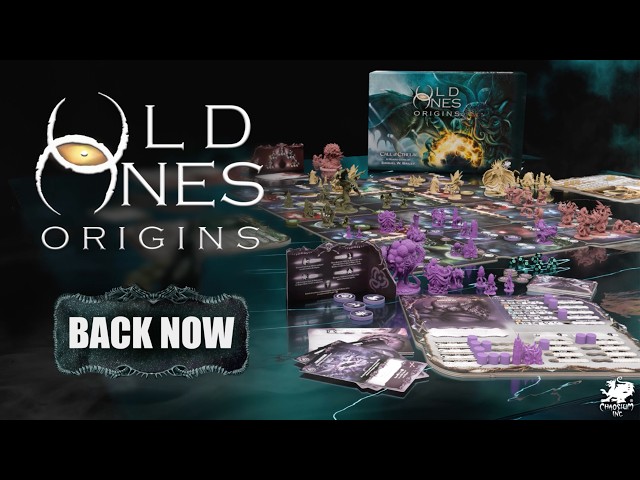
The combat system has have received quite a lot of tinkering, informed by feedback on the original game. “One criticism of Forbidden Stars is the length of the conflicts”, which only ever involve two players, “and sometimes you’re just sitting there for 10, 15 minutes until several people have had conflicts that you’re not involved in”. Conflicts in Old Ones Origins can be multiplayer brawls, and in certain “nexus zones” it’s possible for players to participate with their spells and conflict cards even if they have no units.
This is a design that Bailey has been developing in one form or another for over a decade now. One of the most enjoyable parts of the interview was how enthusiastic he still is for the game after all that time – he mentioned many more small tweaks that only veterans of the original title are likely to appreciat. I’m still hoping to arrange a virtual demo with him – the first place you’ll get to hear my thoughts is in the Wargamer Discord community!
 Source: Wargamer