


The Monolith is a unique board game in many ways. Phil Gross’ new design, currently crowdfunding under publisher Plaid Hat Games, tackles the topic of religious violence with immense empathy. That’s pretty surprising, given the war game’s ‘eavy metal, grimdark vibes.
Perhaps more surprising was the false start The Monolith first had. Plaid Hat voluntarily canned its fully-funded June Kickstarter after three days, only to re-launch with a vengeance on August 18. The campaign is doing well, with over $110,000 raised already, but for a while, The Monolith was more than just a board game. It was also a symbol of an uncertain Kickstarter ecosystem.
“There were too many things we did wrong”, Colby Dauch, Plaid Hat’s CEO, tells me. The board game itself, which remains identical between launch and relaunch, was seemingly not one of them.
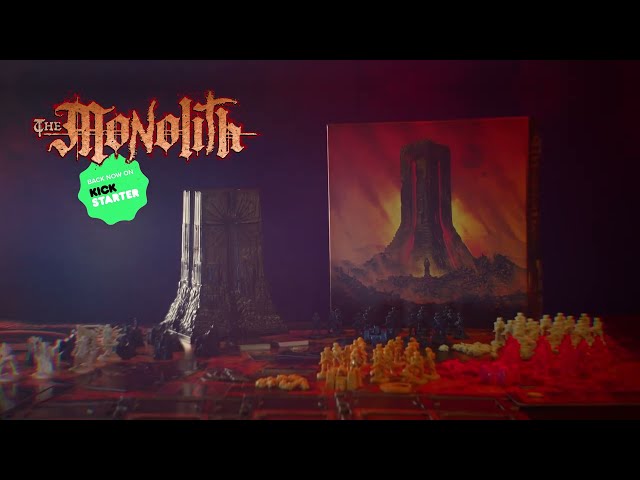
Describing itself as a ‘dudes on a map’ war game, The Monolith is a pitched battle in a setting that looks part-Warhammer, part-Mad Max. Players take on the role of shamans battling to be the true disciples of The Monolith, a vile psychic presence that has taken control of visiting human interstellar explorers and turned them all into violent obelisk-worshiping fanatics.
The central monolith’s psychic whisperings actually affect the gameplay, dictating what actions you can take. You’ll spend Hearts and Anger to manipulate the board in your favor, but once you’ve finished with the Order phase, all your remaining Hearts are tossed in the tower. The Action phase is where you’ll slay and sacrifice to your heart’s content, but you can only take the actions your Hearts landed on when tumbling through the tower.

“It’s the kind of thing that feels random at first, but then you realize how much it’s telegraphing and how much strategy comes into play”, Dauch says. “The whole death and renewal mechanism also gave me a lot of ideas for theming that I was excited about.”
Dauch teased out The Monolith’s themes with designer Phil Gross, who had already baked a charged narrative into his prototype. “The tower naturally flowed into a very confrontational design”, he tells me. “The violence was baked in from the beginning: killing troops, boasting, gaining Anger.”
Death – and the showmanship surrounding it – are key to The Monolith. “When you kill an enemy”, Gross explains, “you gain Favor (points) from the Monolith”. “Favor is the ultimate goal-to become the one true voice of the tower-and everyone thinks they’re the real prophet.”
“After you kill a warrior, that player’s shaman can cremate the casualty, which turns it into Anger”, he continues. “The shaman stores the Anger as a resource, and spends it on violent powers, like Chain Lightning. To me, this represents the self-righteous rage that drives religious violence.”
Violence begets death, but the cycle never ceases. In The Monolith, this cycle is fed by faith. Gross describes his game as “a brutal, endless battle for hearts and minds”. He also tells me the game is “a personal exploration” of “a historic and, sadly, contemporary problem”.
“Religions often pursue positions of governmental authority”, he says. “Their unification with power and attempts at control quickly result in violence, both by the state and by zealots.”
“I’m a Christian and nearly a pacifist”, he adds. “In the past, I struggled with anger toward religious authorities; I disagreed strongly with their political positions and got into fights online.”
“I became addicted to arguing with them and correcting their lies”, he tells me. “In The Monolith, I want to question the passions that bring people to violence, whether that’s through wars of nationalism or squabbles on Facebook. I like to think this theme can speak to both.”
It’s a heavy theme, but both Gross and Dauch promise satirical, accessible gameplay. “It can be cathartic to play these over-the-top characters in a self-mocking way”, Dauch tells me. “It’s kind of like thumbing your nose at all the things you hate.”
Gross adds that the “constant engagement” The Monolith offers is “pretty radical, and a welcome departure” for its genre. “For a game like this to not pause for head-to-head duels is fairly unique, and I hope that players enjoy it as much as we have.”

The success of Kickstarter mark two hints that the vision has reached welcome eyes. Dauch says, however, “I had a lot of fears that this game doesn’t appeal to anyone” after the first round of crowdfunding slowed. “It’s a huge relief that, this time around, it’s looking very different.”
The Monolith reached its original $20,000 funding goal, but Dauch admits “we were playing the Kickstarter game of ‘set your goal really low, so it funds really fast'”. After that, funding “immediately stalled”, he says.
Boardgamewire reported that Plaid Hat Games has already spent $30,000 on manufacturing, meaning this low goal wasn’t enough to cover costs. Dauch tells me now that The Monolith is “practically done being manufactured”.
He says this “mistake” was made with hopes of having The Monolith ready for a Gen Con or Essen Spiel release. “There’s no higher high than when we’ve managed to release something at a big show, and people are lined up going crazy for it”, he says. “I really had my mind set on that, and in doing so, really failed to take advantage of the core concept of crowdfunding, which is the telegraphing of demand.”
Dauch also says a lack of “bells and whistles” stifled the game’s initial success. “If we’re just offering the game, backers can wait for retail”, he tells me. “Why would they give us their money early unless something special is happening? That was a lesson we needed to learn.”

“In the past, we’ve tried to avoid FOMO”, he adds. “I’m just really against preying on customers.” “But, this time, we did it with the bells and whistles.” These, according to the Kickstarter page, include a discounted early bird pledge, upgraded components, campaign-exclusive artwork, and two small expansions. Backers can now also choose between a standard and deluxe version of the game.
The Monolith continues crowdfunding until September 17. Despite a bumpy start, the team behind the board game have kept the faith. “It was brilliant to begin with, and I think we tuned it really well”, Dauch says. “Once it’s out there and being played, I think it has a chance to be one of the greats.”
Want to talk more about the best board games coming out these days? We’re always keen to chat in the Wargamer Discord.
 Source: Wargamer
