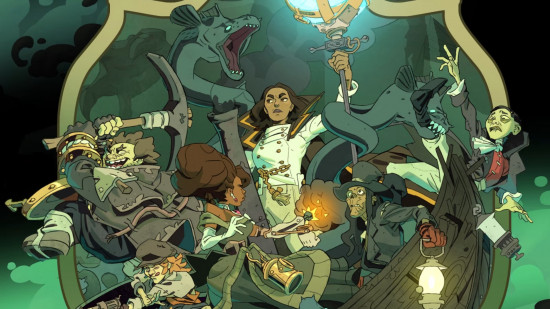
August is a momentous month in Chaosium history. The publisher has launched some of the most ambitious, influential tabletop RPGs in history, from Pendragon to Runequest to Call of Cthulhu. In August, though, it embarks on a new, fog-filled quest. Meet Time Without Tide, Chaosium’s first original IP in 30 years, which is about to begin crowdfunding on Backerkit.
When Chaosium takes a swing this big, we pay attention. That’s why we caught up with David Naylor and James Coquillat, authors and creative directors of Time Without Tide, to clear the mists and uncover the mysteries of this new TTRPG.

Both have worked with Chaosium for many years on digital content. “All the while, we were polishing up Time Without Tide to eventually show Chaosium”, Coquillat tells us. Time Without Tide, Naylor says, “has been our baby for quite a few years now”, with development stretching back as far as 2017. “Chaosium were enthusiastic”, Coquillat adds, “and it all went from there”.
Utter lunarcy
‘The Time Without Tide’ refers to a gloomy, gaslit era of humanity that followed ‘The Age of Decadence’. In this Victorian-style setting, humans pushed the boundaries of innovation, crafting technologies that allowed them to live in absurd opulence.
Then the moon fell from the sky.
“Through man’s endeavors, they have brought around their own ruin”, Naylor tells us. “The fallen moon is a visible, physical thing, a constant reminder of how things went wrong and why.”
Right now, the details of how humanity’s hubris brought the moon low are…foggy. What we do know is that lunar meteors undid centuries of human advancement. It also brought The Unknown, a malevolent fog that seems to have an intelligence of its own – and warps everything it touches.
Familiar objects grow sentient and aggressive. Living things with new appendages and eldritch bloodlust appear from the mists. And those aren’t the only threats beyond the walls of home. Remnants of the old world, from malfunctioning automatons to untriggered traps, could snuff your light out for good. And we haven’t even mentioned the fanatical factions that might turn against you…how are you supposed to survive?

Hire a contractor, that’s how. In Time Without Tide, you’ll play as a band of Delvers, mercenaries with unique ways of traversing The Unknown (relatively) safely.
“The Delver’s Guild sees you as a hammer and everything else as a nail”, Naylor explains. “When in doubt, throw a bunch of mercenary adventurers at a problem. You’re the heroes contracted to solve problems, and how you go about that is totally up to you.”
Delving is, as Naylor puts it, “kind of a suicidal career”, and your employers won’t waste any time passing on your gear to its next gig economy victims once you’re dead. But hold it close while you’re alive, because it’s the only thing standing between you and the Unknown.
A Delver is defined by their Relay and their lantern. The first is a relic of the Decadent Age that allows them to travel far from home, then teleport back whenever they like. “It means that you are pushing to your absolute limit before you’re hitting the bounce button back”, Coquillat says.
Next is your lantern. Whether it be a humble table lamp or a modified streetlight (something a pre-generated character in the game’s Quickstart is actually wielding), your lantern shines a light that beats back The Unknown.
“Monsters you’re fighting are harder to hit while they’re in the Unknown, and their tests are all easier”, Naylor tells us. “That nasty little goblin thing is pretty deadly if you encounter it with your light snuffed out.”

“It creates really fun, claustrophobic combats where you can have something quite dangerous catch the players unawares.” “But also, if the Delvers have a fortified wall absolutely bathed in lantern light, they could take on some pretty dangerous horrors.”
Mirth and Misery
By now, you should have a clear idea of what Time Without Tide is. As Coquillat puts it: “Time Without Tide is a balance between mirth and misery: the eldritch, the scary, and the dark, but also the humor.” Mirth, it seems, makes the misery hit home harder, and this idea is blended seamlessly into A Time Without Tide.
Take, for example, some of the monsters you might meet. “There’s a giant boar that’s too stupid to die”, Naylor tells us, “so you have to persuade it to be killed after it’s been taken down.”
“I’m partial to the skeletons”, Coquillat adds. “They’re very easy to kill, but their bodies are drawn to each other by gravity and amalgamate into giant colossi of bone, making them very powerful and dangerous.”
One great example of the game’s balance of mirth and misery is The Lumber Front. Coquillat describes the location as “this Great-War-style battle against trees who have been animated by the Unknown, and now mass conscripts are embedded in trench warfare against this never-ending tide”. “You can fully lean into the war movie gore of it, but it’s also great because of puns like ‘infan-tree’, ‘artiller-tree’, ‘tree-age tent’.”
The humor often leans towards the satirical, too. We can expect the classic Victorian-style “moustache-twirling” industrialists, as well as an utterly absurd upper class. “One of our pre-gen characters is someone whose house literally fell off a cliff, and they’re trying to gather enough money to raise it back up to high society.”, Coquillat says.

“Dandy characters within the world have this high society culture where they’re always one bad dinner party or bad outfit away from being completely destitute”, he adds. “They become trapped – ‘oh, I got the wrong kind of tropical fish and now I’ll be laughed out of my home and my family will starve’.”
Plus, Coquillat tells us, you can always trust the players to bring the silliness. That Relay might give them a free teleport home, but that doesn’t mean they won’t get into hijinks.
“If you give them a tool where you say ‘you can teleport out of danger at any point’, they’ll go ‘okay, so we’ll jump into the lava, and while you’re immolating, I’ll fire the one shot we need at the river, grab the treasure and hit the button – and it’s all going to be fine’.” “You give people a tool like that, and they use it to get into trouble far more than they do to get themselves out of it.”
Crunchy combos
Your Delvers’ tools can hold back the horrors and even create some moments of levity. They also offer another boon: some seriously interesting, strategic gameplay. “The game focuses on diving into the story in a detailed way, but it also has this strategic combat aspect”, Coquillat says.
The system isn’t a mega-crunchy monster with thousands of character options, however. “We focus on players making fewer but more impactful decisions”, Naylor tells us. “Our core system has a very limited set of traits and skills that combo together to resolve any number of challenges.”
This is most evident in your Delver’s traits and skills. You only get three traits – Body, Mind, and Will – which can be combined with one of six skills to perform an action.

“An example I like to give is taking the Skullduggery skill and pairing it with each of the traits”, Naylor explains. “Skullduggery is all things sneaky and investigate-y.” “If your character was trying to creep across the floor without being noticed, they might roll Body plus Skullduggery, because they’re doing something physical.”
“If they were looking for clues or trying to find a secret lever, they might roll Mind and Skullduggery”, he adds. “If they’re lying to someone, they would roll Will plus Skullduggery.” “We found that with those six combined traits, we could cover pretty much every area of play that regularly comes up.”
For Time Without Tide, less is certainly more. The system is simple, but the consequence of each choice is far reaching. “Players only assign 10 points at character creation”, Naylor says, “so each decision matters”. Coquillat adds that “as you as your character becomes more powerful, you are just spending a single point each time.”
Characters have hit points tied to their three traits, with each pool in low single digits. “A single instance of damage means quite a bit”, Naylor adds.
Coquillat compares this to the kind of math done in many other games. “When you deal 44 damage versus 47 damage, you can lose some of the drama and gravitas of that moment”, he says, “especially if you get twisted up in the dynamics of very, very precise optimization”. “I enjoy some of that element, but I think it’s at its most fun when you have really impactful decisions to make and you have to strategize a lot more.”
“It’s also something I think makes the game more approachable, particularly at a convention and for people who are more there for the story”, he adds. “It’s easy to pick up but tough to master, easy to love but hard to completely explore.”

There are many more choices to be made for your Delver’s build. Equipment can totally shift how you approach combat, for example. Lanterns create pockets of space where you’re better or worse at fighting, but wielding one requires a free hand that you might have otherwise used for a two-handed weapon or another crucial bit of gear.
These few elements combine to create a rich decision space. “Over the course of their adventure, they’ll need to decide when to take a rest or when they’ll want to ferry on”, Naylor tells us. “They also need to focus on managing their light sources, their ward, which is how they resist the changes of the Unknown.” “And in combat, they actually dedicate their light to points on the battlefield to push back the fog and give themselves strength.”
Awakened adaptations
Wait, changes from the Unknown?! That’s right. As your Delver develops, not every part of their person is under their control.
“Adaptations are how Delvers become mutated in this world when the fog gets to them”, Naylor says. “The adaptation they get is totally random.” “Players can choose if they want to spend experience to develop it, but they don’t get a say in what powers manifest.” “Whether they develop stretching long limbs or the ability to control fire, that’s up to the dice to decide.”
“A player might roll up their Delver with an idea of what they want to do, but after a few sessions of play, eyes begin to pop up all over their body”, he continues. “They can decide: is this something really cool for the character I want to pivot to? Or do I want to reject it and stick to the lane I was originally on?”
When an adaptation first appears, it’s malignant, offering only negative effects. There are chances to ‘purge’ it if it really doesn’t suit your build. But, if you can see the potential in suddenly being able to spontaneously combust, you can spend experience to ‘awaken’ the adaptation, turning it into something useful.

Naylor says an awakened adaptation usually turns the downside into an upside. ” If you get an adaptation that makes you really off-putting socially, when you actually awaken it and develop it, it will be good for social things”, he tells us.
“My favorite character I played was an ‘undertaker’ who was actually a corpse thief”, he adds as an example. “I had an adaptation that allowed me to speak to the corpses, so I collected heads from interesting people we found so I could ask them for advice (and get bonuses on skill checks).”
Naylor says these random elements enhance Time Without Tide’s character building rather than get in the way. “You can do a lot of white room planning for a build, but when the rubber hits the road, it’s actually more fun to have a couple of challenges thrown at you”, he says. “My general intent is this: Hey, hang on, here’s a spanner. Do I stay the path or do I embrace this opportunity and pivot? Because maybe I can get something really cool.”
Familiar, yet fresh
Time Without Tide has many influences, from videogames to comic books to Disney’s Atlantis. Its loving nods to apocalypses gone by, though, have crafted something unique and exciting. It’s like seeing a Delver turn an old lamppost into a life-saving lantern – unexpected, but invigorating.
If Time Without Tide is a homage to anything, though, its Chaosium itself. The new TTRPG is both a love letter to past titles and an attempt to carve a never-before-done niche for the team.
Coquillat says “it’s a little surreal” to have had so much support from Chaosium in developing the game. ” I’ve been a huge Chaosium fan since I was very, very young. I remember reading Chaosium books in an attic when I was nine years old.”

“We share a lot of touchstones between Cthulhu and Time Without Tide”, Naylor says. “Both have this eldritch space, the fear of the unknown, and investigators who are irrevocably changed through their adventures. That’s something James and I both love about Call of Cthulhu – you don’t play these heroes to see them get better, you play to see them get way worse.”
“Also, RuneQuest has such an epic setting and storied history”, he adds. “It’s a really well-developed setting, and Time Without Tide has elements of that as well. We have factions that have been warring against one another for ages. There’s all sorts of proper nouns for people to sink their teeth into.”
“But it’s also different. This doesn’t exist in the Chaosium suite currently, a kind of ‘make a build and stomp miniatures around a map’ game”, Naylor says. “We wanted to present something a bit different so fans of Chaosium’s existing materials can find something new they might enjoy.”
As veteran RPG nerds, there’s so much more about Time Without Tide that excites us. We don’t have time to tell you about it all, but if you’re still curious, you can check out the Quickstart for yourself. Simply sign up to the Backerkit page, and get ready to get lost in the fog.
 Source: Wargamer