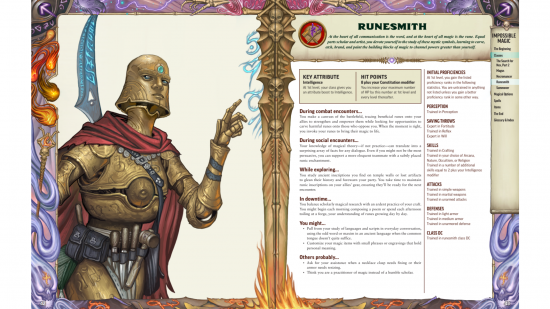
Impossible Magic is almost here! The next Pathfinder book drops on July 30, but we’ve got an extra-early peek at one of its most exciting features: the shiny new 2e Runesmith. I already loved the vibe of this class in playtesting, and after a readthrough, I’m even more keen to take it for a spin.
The Runesmith is still a fun, flavorful class that’s all about pulling off cool combat combos. To support this, the skeleton of the class is almost untouched since playtesting. Plus, many of the more interesting feats and runes have stayed as they were.
That being said, Paizo has done a lot of fine-tuning to features we saw in the initial playtest. And there’s an entire treasure trove of brand-new feats and runes to play around with.
On the whole, I’d say Paizo did a great job listening to fan feedback. This version of the Runesmith is a little more consistent, a little more supportive, a little more flexible, and a little less overpowered. The class reads more clearly, but it hasn’t sacrificed the creative combo power that got us so excited in the early drafts.

What’s been tweaked
I’ve gone through my part of Impossible Magic with a fine-toothed comb, and these are the major tweaks made to the Runesmith since playtesting:
Runic Repertoire
The number of runes in your repertoire increases less often in the final version, but the jumps are more dramatic. Basically, Paizo has shaved off those awkward levels where you gain one new rune at a time:
| Level | Runic Repertoire | Maximum Etched Runes |
| 1 | 4 | 2 |
| 2 | 4 | 2 |
| 3 | 4 | 2 |
| 4 | 4 | 2 |
| 5 | 6 | 3 |
| 6 | 6 | 3 |
| 7 | 6 | 3 |
| 8 | 6 | 3 |
| 9 | 8 | 4 |
| 10 | 8 | 4 |
| 11 | 8 | 4 |
| 12 | 8 | 4 |
| 13 | 10 | 5 |
| 14 | 10 | 5 |
| 15 | 10 | 5 |
| 16 | 10 | 5 |
| 17 | 12 | 6 |
| 18 | 12 | 6 |
| 19 | 12 | 6 |
| 20 | 12 | 6 |
As you can see, your max etched runes are unchanged. Your choices may seem a little more limited at certain levels, but actual power levels in play should feel familiar.
Runic Crafter
This third-level class feature functions as before, but it now improves at fourth level and every two levels after that. At these levels, you learn the formula for an armor or weapon property rune that’s of your level or lower. The rune can be common or another you can access.
Greater Runic Optimization
With this feature, a Greater Striking Rune deals 6 extra damage rather than five, and a Major Striking Rune deals 8 rather than 6.
Runesmith Feats
There are 53 Runesmith feats, with 21 of those being never-before-seen. That means almost everything survived playtesting (except Read the Bones and Smithing Weapons Familiarity). There’s plenty of changes, though:
Efficiency
The Runesmith is, in some ways, more action-efficient than before. For example:
- Invisible Ink is now a free action.
- Runic Tattoo can now be changed with one day of downtime rather than one week.
- Vital Compound Invocation (formerly Vital Composite Invocation) now costs one action rather than two, and it’s no longer limited to once every 10 minutes.
- Elemental Revision no longer limits how many times you can revise a rune per day, and you no longer need to reach 15th level to revise greater versions.
- Clashing Compound Invocation (formerly Clashing Composite Invocation) now costs one action instead of two.
- Astral Compound Invocation (formerly Astral Composite Invocation) now costs one action rather than two, and it’s no longer limited to once every 10 minutes.
However, several key features have become more taxing on your actions per turn. Many of the playtest feats that were limited to once per round now have the Flourish trait instead: Engraving Strike, Remote Detonation, and Fortifying Knock are all in this category.
Some more dramatic changes in efficiency include:
- Rune-Singer is now once per 10 minutes rather than once per one minute.
- Return Unto Runes no longer requires a free hand or an artisan’s toolkit, but it can now only be used once every 10 minutes.
- Annihilating Compound Invocation (formerly Annihilating Composite Invocation) now requires an action.
Tactical targeting
Several feats have had their targeting rules adjusted. The main benefits of this are two-fold. Firstly, it makes setting up combos a bit less fiddly. It also means you can use the increased number of buff/support runes to set up attacks on enemies – without needing to hurt your friends.
For example, Vital Compound Invocation allows you to invoke a rune on one target and heal a different creature within range (and healing now scales with your level instead of your Intelligence). Clashing Compound Invocation, Astral Compound Invocation, and offer the same flexibility.
Additionally, Chain of Words no longer requires the two runes involved to be on separate targets. Define the Canvas offers new positioning options in a slightly different way, as it now lets you center the effect on a corner of your space instead of “on your square”.
Consistency
The Runesmith’s feats have seen all manner of other small changes. If I had to sum up how they affect the class, it would be ‘consistency’:
- Dance of Bloody Ink now specifies you wield a melee weapon bearing a rune, but it now lets you Step and Strike whether your first Strike hits or not.
- By Your Name gives a -2 circumstance penalty to the target’s saving throw on a Critical Success and a regular success.
- Living Lexicon now lets you swap any one rune in your repertoire with one of the same level during daily preparations.
- Forge New Word now applies to variable-action spells (plus a lot more guidance about how invoking your new rune works).
- Astral Compound Invocation applies Stupefied 1, 2, or 3 (depending on your level of success) until the end of your next turn.
- Ghostly Resonance doesn’t count towards a weapon’s max runes, and it applies to unarmed strikes.

Runes
The Runesmith has 44 runes to work with. Those we’ve seen before have been updated in a few key ways. Here are the most interesting tweaks:
Damage reduction
There were several complaints that the Runesmith was overpowered during playtesting. Well, no more:
- Atryl reduces fire resistance by 5 rather than 6, and its damage is 1d8 instead of 2d6.
- Esvadir also deals 1d8 rather than 2d6 damage (and it now requires a Reflex rather than Fortitude save).
- Ranshu deals 3 electricity damage instead of 1d4, and its invocation deals 1d8 rather than 2d6 damage.
- Kojastri gives a rune-bearer resistance 4 rather than resistance 5, and it deals 2 damage when the rune-bearer is hit. Its invocation damage has also been swapped from 4d6 to 8d4.
Diacritic
Diacritic runes fuel some of the class’ most interesting combos, and that’s not going away. Paizo has acknowledged, however, that they’re a significant spike in complexity – and that can leave room for clunkiness.
All Diacritic Runes are now fifth-level, so you’ve got a few levels to acclimatize first. Beyond this, the changes are limited but effective. En- now also affects the rune-bearer as well as creating an area-of-effect cone. Additionally, Ur-‘s damage now equals 2 + half your level instead of your Intelligence modifier.
What’s new
Now, onto the really exciting stuff, the bits we’ve never seen before. The Runesmith has 21 brand-new feats and 25 all-new runes to play with. Here’s a preview of each:
Feats
Glyph Familiar
Feat 1
A living rune becomes your familiar! Choose one familiar or master ability per day instead of two. Your familiar always has the construct, flier, and tough abilities.
Rune Ward
Feat 1
This reaction triggers when you’re targeted by a spell. To use it, you need to be trained in the skill associated with the tradition of the triggering spell. You sketch a rune in the air, and it gives you a +1 circumstance bonus to your saving throw and AC against the spell.
Seek the Hidden Glyphs
Feat 1
You gain a +1 circumstance bonus to Perception checks to find magical traps, and you get a check to find these traps even when you aren’t Searching. If you’re holding or wearing an artisan’s toolkit, you can use Crafting instead of Thievery to disable the trap. Plus, if you trigger the trap by critically failing, you can Trace a Rune as a reaction.
Smithing Weapons
Feat 1
When wielding hammers, knives, and pick weapons, you can use your weapon to trace runes without an artisan’s toolkit. A Strike with one of these weapons also deals 1 extra fire damage to an enemy bearing your runes.
Enhanced Glyph Familiar
Feat 2
This is an upgrade to your Glyph Familiar that lets you choose two familiar or master abilities each day. Plus, when you use a single action to Trace a Rune, your target can be adjacent to your familiar instead of you (provided your familiar is within 30 feet).
Pattern Flight
Feat 2
Costing two actions and your use of Flourish for the round, this makes a ranged Strike against a target within your weapon’s first range. It ignores circumstance bonuses to AC granted by cover, and after the Strike, you can Trace a Rune on a target that’s in a line between you and the Strike’s target.

Song of Glorious Invocation
Feat 4
This single action requires the Rune-Singer feat, and it can only be used one per 10 minutes. You choose up to three rune-bearers within 30 feet and Invoke one rune on each. These rune-bearers also get a +1 status bonus to skill checks and saves against fear for one minute.
Writing on the Wall
Feat 4
You’ll need to be an expert in Arcana, Nature, Occultism, or Religion for this one. It allows you to cast Embed Message once per day as an innate spell, with a rank equal to half your level, and its tradition being the one of your related skill.
This version of Embed Spell can be written in a runic code known only to you and five creatures of your choosing. Anyone else must Decipher the Writing using the associated skill.
Diacritic Fluency
Feat 6
This is a free action that requires you to know at least one diacritic rune, and you can use it once per 10 minutes. When you next Trace a Rune on this turn, you can also Trace a diacritic rune onto that rune.
Engraving Maneuver
Feat 6
This action requires you to wield a melee weapon with the Disarm, Shove, or Trip trait. It lets you attempt to do one of these things to your target, and if you’re successful, you Trace a Rune onto your target – even if they get pushed out of range.
Edifying Trace
Feat 8
Here’s another single action with Flourish. You Trace a Rune onto an adjacent enemy and attempt to Recall Knowledge about them. A success gives your target a -1 status penalty to saving throws against your invocations for one minute (or until you use Edifying Trace on somebody else).
Swiping Trace
Feat 8
A three-action Flourish this time! You make a melee Strike and compare the attack roll with the AC of up to two enemies within melee. Roll your damage once and apply it to both – and you can Trace a Rune a single rune on each creature you damage.
This counts as two attacks for your Multiple Attack Penalty. Plus, if your weapon has Sweep, its bonus applies to the attack.
Prodigal Rune-Singer
Feat 10
If you’ve got the Rune-Singer feat and are an expert in Performance, you can Trace a Rune with song once per round instead of once every 10 minutes.
Runic Correspondence
Feat 10
This one requires you to be a master in Arcana, Nature, Occultism, or Religion. Once per day, you can spend a minute writing a message (25 words or less) anywhere that can hold writing. Picture one creature you know well, and if they’re on the same plane, they (and only they) can see and read the message. They can also spend a minute to write a reply of the same length.
If you spend 10 minutes writing your message, you can include a rune from your repertoire. A willing target can then Trace the Rune on themselves for up to 10 minutes. You can Invoke the Rune as a free action when they reply.

Orbiting Runestone
Feat 12
As a single action, you Trace a Rune with a damaging invocation onto a floating runestone. It has 10 HP, and when a creature Strikes you, you attempt a DC 11 check. On a success, the runestone takes the damage, with remaining damage still hitting you.
If the runestone reaches zero HP, it explores. If your attacker is within 15 feet, the damaging rune on your runestone is invokes automatically, affecting your attacker only. If the runestone still exists after one minute, it shatters and disappears.
Unerring Runic Attraction
Feat 14
As a single action, make a ranged Strike against a foe bearing a rune within your first range increment. You don’t need line of sight, ignore the concealed condition, and ignore circumstance bonuses to AC granted by cover and shields. Your ammo can even go around corners.
Maze of Runes
Feat 16
If you’re legendary in Arcana, Nature, Occultism, or Religion, you can cast Quandary once a day as an innate spell (rank equal to half your level, of the tradition related to your skill). The spell’s target can attempt a Perception, Society, Decipher Writing, or related tradition check to solve the spell’s puzzle. When you Sustain this spell, you can also Trace or Invoke a rune on the target creature as if it were adjacent.
Runesight
Feat 16
This reaction triggers when an enemy targets you with a spell or magical attack against your AC, and it can be used once every 10 minutes. It grants a +4 circumstance bonus to your AC against the attack. If the attack misses, that spell is sealed in a floating rune.
You can trace this rune onto a creature, and when it’s invoked, the rune-bearer is affected by the spell or magical attack that was captured in the rune. Make a check (class DC – 10 as the modifier) against the target’s AC to decide the effects.
Unbounded Invocations
Feat 18
When you Invoke Runes, you can invoke any number of runes within 30 feet (rather than just two).
Generational Rune-Singer
Feat 20
This one requires the Prodigal Rune-Singer feat and you to be legendary in Performance. It allows you to Trace a Rune with a song at will, with a range of 60 feet.
Stone Forge of the First
Feat 20
Once per day, you can spend two actions to create a 15-foot cube stone forge within 30 feet. It lasts for one minute, and it amplifies the power of runes in a 60-foot emanation. Runes within range don’t have their duration elapse while in the emanation, and those invoked in the emanation maintain their passive benefits but can’t be invoked again.
Runes
So many of the new runes are buffs to your team rather than offensive options, which should make for interesting new strategies:
Baruiel, Rune of Hold’s Bravery
Rune 1
As long as the rune-bearer this is drawn on is within 10 feet of an ally, it can reduce the frightened condition by 2 instead of 1. On invocation, each ally of the rune-bearer within a 10-foot emanation reduces their frightened condition by 2.

Camonica, Rune of Perplexity
Rune 1
The first time each round the rune-bearer takes an action with Concentrate, it takes 2 mental damage. Invoking the rune deals 1d4 mental damage to the bearer with a basic Will save. On a failure, they’re also stupified 1 (or 2 on a critical failure) for one round.
Level (+2): The passive damage value increases by 1, and the invocation damage increases by 1d4.
Ledria, Rune of Appeal
Rune 1
The rune-bearer gains a +1 status bonus to Deception, Diplomacy, and Performance checks. When invoked, each creature within 30 feet of the rune-bearer can Step closer to them as a free action.
Level (9th): The status bonus becomes +2.
Level (17th): Then it becomes +3.
Lyskel, Rune of Frost
Rune 1
The rune-bearer takes a -5-foot circumstance penalty to its Speed, and if it takes a move action, it becomes clumsy 1 until the start of its next turn. On invocation, this rune deals the bearer 1d4 cold damage, and if they fail a basic Fortitude save, all squares they’re on or adjacent to become difficult terrain for one round.
Level (+2): The invocation damage increases by 1d4.
Rehgog, Rune of Bestial Might
Rune 1
The rune-bearer gains an imprecise scent for 30 feet. On invocation, they can immediately Step as a free action, and if they attempt a Strike before the start of your next turn, it deals an extra die of damage.
Sertum, Rune of Preparedness
Rune 1
The rune-bearer gets a +1 status bonus to Survival checks and Lore checks related to your choice of terrain or natural location. They can also use Survival to roll initiative, with the status bonus still applying. Plus, on invocation, the bearer can Step up to three times as a free action.
Level (9th): The bonus increases to +2
Level (17th): And +3.
Thullax, Rune of Corrosion
Rune 1
The rune-bearer’s resistance to each physical damage type is reduced by 1. On invocation, they take 1d6 acid damage and, if they critically fail a basic Fortitude save, they take 1 persistent acid damage.
Level (+2): The reduction in physical resistance increases by one, the invocation damage increases by 1d6, and the persistent damage increases by 1.
Tilus, Rune of Vocabulary
Rune 1
The rune-bearer can speak and understand a language of your choice and gains a +1 status bonus to Society and Lore checks related to writing. The bonus is +2 from level 9 and +3 from level 17.
On invocation, the rune-bearer can automatically succeed any flat check to disrupt an auditory action for one round. They can also speak frankly even when confused, controlled, or unable to speak.
Av-, Diacritic Rune of Succession
Rune 5
When the base rune is invoked, you can Invoke a Rune on a different rune-bearer within 15 feet of the original bearer as a free action. Av- then can’t be etched or traced again for 10 minutes. You can also only have one of these runes etched or traced at a time.
Fob-, Diacritic Rune of Doubling
Rune 5
When the base rune is invoked, you can choose to also be affected by it, if possible.

Kit-, Diacritic Rune of Mercy
Rune 5
When the base rune is invoked, it is Nonlethal, and the rune-bearer has a -1 status penalty to any saving throw.
Per-, Diacritic Rune of Continuum
Rune 5
After the base rune is invoked, it automatically traces onto a different target of your choice within 15 feet of the original bearer. Once invoked, it can’t be etched or traced for another 10 minutes. You can also only have one of these runes etched or traced at a time.
Ti-, Diacritic Rune of Fundaments
Rune 5
When the base rune is invoked, you can change its damage to acid, cold, electricity, or fire.
Astillu, Rune of Submersion
Rune 9
The rune-bearer can breathe underwater and gains a Swim speed equal to its land speed (or 30 feet, if that’s the greater value). Its melee Strikes don’t take a circumstance penalty for passing through water. When involved, the rune-bearer can swim up to 60 feet as a free action without triggering reactions.
Cruonign, Rune of Leeching
This rune is drawn on a slashing or piercing weapon, and its Strikes deal 3 additional void damage. When a living creature is damaged in this way, the rune-bearer gains temporary HP equal to the void damage taken, which lasts for one round.
On invocation, the rune creates a 30-foot code originating from the wielder of the weapon, and it deals 4d10 void damage to each creature in the area, with a basic Fortitude save. If any creature takes damage, the wielder regains 12 HP.
Level (+2): The extra void damage increases by 1, the damage of the invocation increases by 1d10, and the healing increases by 3.
Germantria, Rune of Partnership
While you are within one mile of the rune-bearer, they take half damage from all effects that deal HP damage, and you take the remaining damage (without applying resistances, weakness, or other abilities). If you or the bearer reach zero HP, the runes fade without being invoked. On invocation, both you and the bearer gain 20 HP.
Level (+2): The HP gained increases by 5.
Oraloq, Rune of Inarticulateness
Rune 9
When the rune-bearer attempts a skill check, Linguistic ability, or to cast a spell without Subtle, they must succeed a DC 5 flat check or lose the action. When this rune is invoked, the bearer must attempt a Will save, taking 20 mental damage on a failure (or double on a critical failure) the first time they use a language, take a linguistic action, or cast a spell without Subtle.
The effects end once damage is taken or at the end of the bearer’s next turn.
Level (+2): The damage of invocation increases by 5.
Piteregrin, Rune of Transposition
Rune 9
The rune-bearer can use a single action to swap places with another willing rune-bearer within 15 feet. The action has the concentrate and teleportation traits. On invocation, the rune grows and swallows its bearer and any adjacent Large or smaller creatures. They’re then spat out in a square within a 15-foot emanation from the rune-bearer’s original position.
Ulgatus, Rune of Restraint
Rune 9
This rune is drawn onto armor, and when its wearer would gain or increase their drained, enfeebled, or sickened condition, they make a DC 15 flat check, preventing the gain/increase on a success. If they succeed, the rune is dormant for 10 minutes. On invocation, the wearer gains resistance 10 to critical hits for one minute.
Level (17th): The DC of the check decreases to 10, and the resistance increases to 20.
Yudici, Rune of Remonstrance
Rune 9
While a shield bearing this rune is raised, the bearer emits a 10-foot emanation that gives allies a +1 circumstance bonus to AC. When invoked, the shield regains 40 HP, and allies within the emanation gain a +1 status bonus to attack rolls and skill checks for one round.
Level (+3): The HP restored increases by 10.
Eck-, Diacritic Rune of Phantasma
Rune 13
The damage dealt on the base rune becomes spirit damage, and enemies adjacent to the rune-bearer take 1d8 persistent spirit damage.
Level (17th): The persistent damage increases by 1d8.
Nesh-, Diacritic Rune of Contingency
Rune 13
When you draw Nesh-, choose a trigger that invokes the base rune, using the same restrictions as for the trigger of a Ready action. When the trigger is met, you invoke your base rune as a reaction without invoking any additional runes. Once invoked, you can’t etch or trace this rune again for 10 minutes. You can also only have one of these runes etched or traced at a time.
Ochygoll, The Poisoned Star
Rune 17
The rune-bearer becomes doomed 1, and allies that begin their turn adjacent to them also become doomed 1 for one round. Each creature affected takes 10 mental damage the first time each round it attempts an attack roll or skill check.
On invocation, the rune summons a meteorite, and everyone in a 10-foot burst centered on a corner in the rune-bearer’s space takes 3d10 bludgeoning damage with a basic Reflex save. Then, everyone in a 40-foot burst of that same corner takes 8d6 fire damage with a basic Reflex save.
Xinsala, The Well of Virtues
Rune 17
When drawn, this rune creates a 30-foot emanation around itself that gives you and allies a +1 status bonus to AC against magic, a +1 status bonus to saving throws against magic, and resistance 10 to damage from magical effects. When invoked, any creatures in its area are healed for a total of 70 HP, divided as you choose. You and allies in the area also gain a +20-foot status bonus to your Speeds and are quickened for one round (your extra action is for Stride or Strike only).
Still here after all that reading? Wow, you must love tabletop RPGs. Why not join us to talk about them in the Wargamer Discord?
 Source: Wargamer