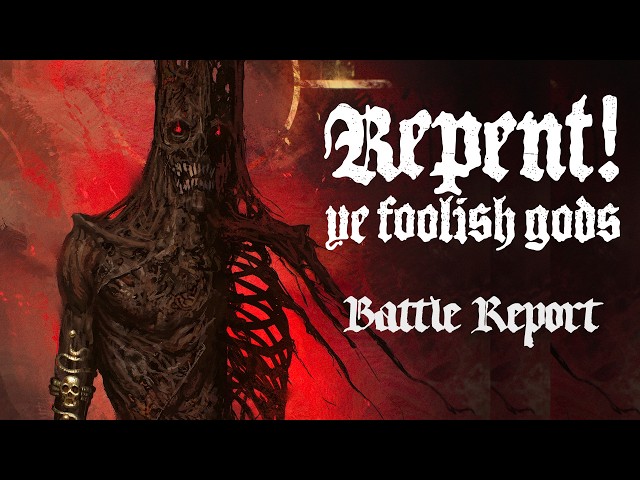
One thing that many different indie warband wargames have in common – the likes of Frostgrave, Inquisimunda, The Doomed, Turnip28, This Is Not a Test, and so on – is that they give players an excuse to buy, build or convert miniatures that have no use in any other game. Repent! Ye Foolish Gods takes this to a new extreme, because the goal of this solo or co-op adventure wargame is to make the dark gods sorry they were ever born – and you can hardly kill the incarnation of an evil god without a sick ass centerpiece model, can you?
Repent! Ye Foolish Gods is the latest miniature wargame from Snarling Badger studios, a joint venture between YouTubers Adam ‘Uncle Atom’ Loper of Tabletop Minions and Vince Venturella. It’s available as a PDF and via print-on-demand – I received a free review sample of both.
I’ve had a chance to read through the 132 page soft cover rulebook, and I think there’s a lot to like here for fans of solo wargame or grimdark fantasy in the vein of Dark Souls and Berserk. If you’re a gamer looking for an excuse to make more gnarly conversions or use random miniatures you’ve collected just because they were cool in an actual game, this could be the ticket.

The vibes
Here’s the setting: there was a war between the gods, and the evil gods won. The baddies have been in charge for a long time now, and the world sucks. You will control a sept of four warriors, each with a personal grudge against the gods and very little sense of self preservation. They’ll carve a bloody path through the dark gods’ followers, sacking their temples, ending their rites, slaying their lieutenants, champions, legendary monsters and chosen ones, before they finally face the incarnation of the god itself and – if they’re very lucky – end it forever.
According to Loper, “it all started with the title – it came from something a friend said during high school”. This was the catalyst for a design document by Venturella. “The first concept was too limiting (fighting against Greek gods) but the second swing – fighting against ‘dark gods’ – allows the players to get really interesting with their modeling choices.” Though it screams Dark Souls to me, Loper says that Diablo and Devil May Cry were bigger influences.
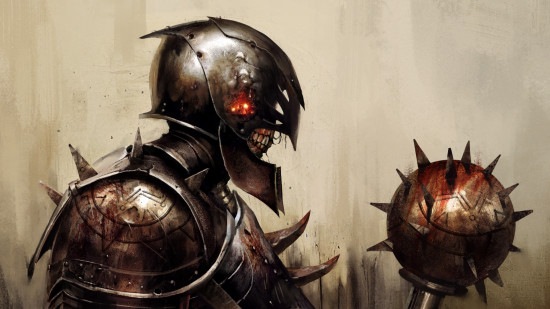
The setting is sketched in effectively in the first three pages of the book with evocative text and illustrations by the dark fantasy artist Dariusz Kieliszek. Flavor text for magic items, enemies, and the many gods of darkness sketch in just enough of the world to fire up the imagination, but it’s only an impression. This isn’t a game of maps or histories, it’s a framework for players to go absolutely ham making models that look like black metal album art.
Rules and content
Repent! Ye Foolish Gods is a rules-light game. The core of it is a D12 system, with heroes or monsters attempting to roll equal to or under a relevant stat to succeed in an action: Offense for weapon attacks, Fate for magic, and Tactics to detect hidden enemies or make other miscellaneous tests. Most models use a standard six inch move. The choice of weapon or spell determines the damage roll for an attack, which is reduced by the target’s Defense value – the remaining damage reduces the target’s Life total.
There are some extra wrinkles: critical hit rolls of one ignore the target’s Defense completely; there are some bonuses for stats above 10 which don’t make success more likely but provide circumstantial bonuses; and warriors and minions alike can be afflicted by persistent conditions like Bleeding or being Poisoned. But the great majority of the rulebook is given over to stuff – heroes, spells, monsters, scenarios, and more.
It’s a well-scoped design. Loper says “we always start with a very specific design document, so when new ideas pop up during design, it’s very quick to determine if they fit into the design document or not”. He and Venturella are “very wary of scope creep, because we work quickly putting out a new game every year”.

The player-controlled warriors are differentiated by their special abilities – some from their choice of starting class, others learned with experience gained during a campaign – and their equipment, be it mundane or magical. The many enemies, from pathetic Minions to the Gods themselves, have both innate stats and abilities and talents gifted by the god they serve and which your warband is attempting to murder. Each foe obeys one of a few different AI behaviour scripts, which mean Dross enemies will seek to gang up on the warriors while sneaky Hunters will prefer to move via the shadows, and so on.
The game is built in a modular, combinatorial way. Take the six classes of Warrior your sept could contain: divine Bastards, Cursed souls, descendents of the Fallen titans, and so on. Each one has a single special ability, unique to them, but they also have a small selection of Talents that any warrior could learn by meeting the requisites and spending the experience.
If that sounds like a narrow starting selection, you get more customization by choosing one of six septs. These tend to restrict how you assemble your force, but grant additional bonuses – the Sept of Decapitation favors gory melee combat and spurns elemental magic, while the Sept of the Shadow excels in infiltration, for instance. You’ll also pick a once per game Destiny ability, and a debilitating Curse, for a little extra flourish.

Scenarios are composed from several elements and plenty of randomness, resulting in a wide variety of possible encounters. Not counting special boss fight missions, your sept might embark on any of 12 raids, from assaulting a temple to stealing magical secrets. There are random tables to help you populate the board with terrain; random tables to determine the disposition of enemy minions in the mission; random secondary objectives; random ‘unusual occurrences’ that might trigger during the mission, from a Rain of Blood to Poison Mists.
Achieve a solid Victory or better in the mission and you might come away with a Magical Item, each one uniquely generated through four random rolls (two bonuses, one item type, and a negative burden). Loper points to it as an example of the Diablo inspiration shining through – it reminds me of the vast random generation tables in the old Warhammer: Realm of Chaos books, though it’s a lot easier to use.

To complete a campaign you’ll have to face down a Legendary Monster, then the Gods’ personal ‘Vanquisher’ champions, and finally the Gods themselves, in a series of increasingly difficult exhibition matches. Without playing the game, I have no idea how feasible it actually is to beat one of the end-game entities.
Take Cataclysm, god of chaotic destruction: whenever it makes a basic weapon attack, it throws three lightning bolts that each deal twice as much damage as a two-handed weapon; it also has a chance to discharge an AOE attack that electrocutes every nearby model and blasts them away from it; and like all gods, it has a chance to activate again each time a player controlled Warrior finishes their activation.
Working out how that final encounter could ever be bested is tickling my brain, though. Lightning Resistance for the whole party, of course. Using the Stealthy ability to hide models and manipulate the god’s AI, kiting it around the arena to cut down how often it attacks, perhaps? Buff stacking with Sorcery, consumables, and legendary items, to try and DPS race it into the grave?

Quibbles
From a read-through alone, Repent! Ye Foolish Gods seems really solid; the minor quibbles I have are all to do with layout. In a few places the last lines of paragraphs and stat blocks are cut off by page breaks, which makes for a worse reading experience and an irritation for anyone wanting to print pages of the PDF for reference. The rules are clearly written, sometimes to a fault – all 12 basic missions have their victory conditions printed in full, despite the conditions being identical each time.
Like I say – minor quibbles. This feels like an energetic and lovingly made solo wargame with a very clear vision – a grimdark campaign game that’s a perfect excuse to dust off your Realm of Chaos and Mordheim minis, grab your hacksaw and greenstuff, fire up the 3D printer, make some weird monsters and then kick their arses. When I get a chance to test it properly, I’ll let you know.
If you’re interested in more of Loper and Venturella’s designs, they’ve got a new edition of their annual zine SNARL coming out this November that will contain “a micro-game that’s just PvP and it’ll include some small expansions to some of our earlier games as well” – and the pair already have the idea for a brand new game in Spring 2027. I’m looking forwards to both.
If you’ve already given Repent! Ye Foolish Gods a go, or know of another great indie wargame I need to check out, come and share your thoughts in the Wargamer Discord Community!
 Source: Wargamer