


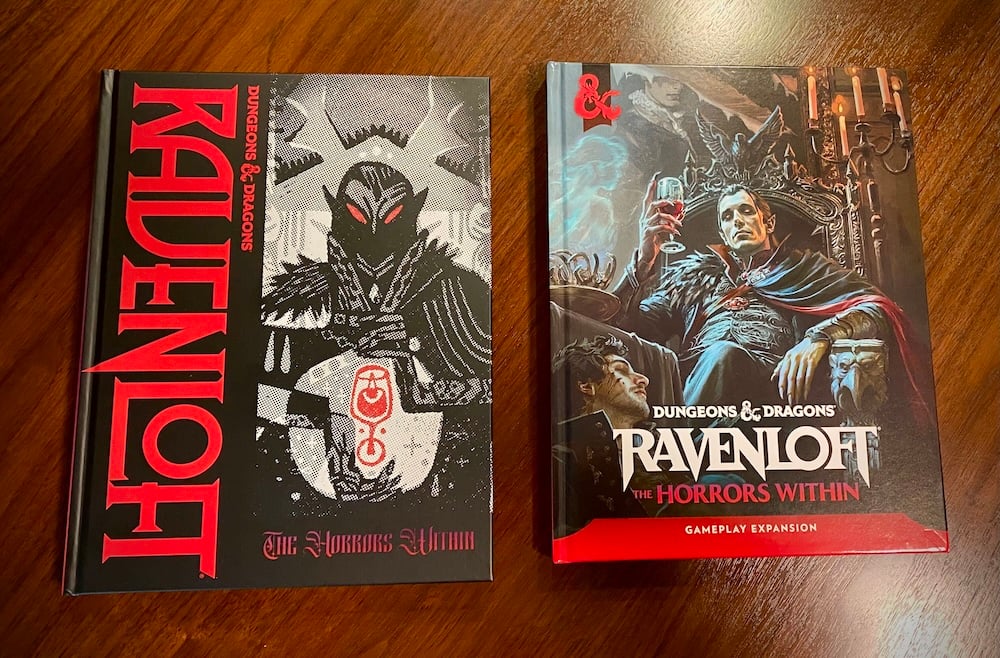
Ravenloft: The Horrors Within is out in the wild now. Here’s our review of WotC’s new big book of spookable scaries.
Ravenloft is responsible for at least two different big changes in the course of D&D history. In the original TSR days, Ravenloft was the setting envisioned by Dragonlance co-creator Tracy Hickman and his wife, Laura Hickman. They needed a setting for a villain that felt like something out of Gothic horror. As the story goes, they wanted a villain that could be more of a presence in the story, whose personality could drive the adventure.
Thus, the original Ravenloft was born, rising up around the vampire Strahd von Zarovich. In time, it became more than just a spooky place; it was a mist-shrouded realm of multiple realities all linked together by the evil beings at the heart of each realm.

Then again, in 5th Edition, Ravenloft helped spark a D&D renaissance with the Curse of Strahd. Originally released in 2016, it was the first campaign to really capture the D&D audience, right at the time that D&D was blowing up thanks to actual plays like Critical Role and a resurgence of D&D in pop culture, building off of the nostalgia-soaked Stranger Things.
Now, with 5.5E fully armed and operational, Ravenloft: the Horrors Within is a bold new campaign setting, the first steps outside of the Forgotten Realms for the new edition. It’s also where WotC takes a few big swings at what a D&D expansion could look like. Let’s dive in.
Ravenloft: The Horrors Within – What’s In The Book

Let’s start with the brass tacks. This is a 288 full-color, hardcover splatbook. It is packed to the brim with gorgeous art and dripping with flavor. The book is darker, in general, both in terms of the themes but also the color palette. You might have seen a video talking about how the WotC team was excited to find ways to make black pages with white text work without making the book too heavy.
And they pull it off. This book is lush. You can flip through it and see the full might of the WotC art pipeline in effect. Atmosphere abounds in the book. But it’s not just illustrations. There are 7 subclasses, 4 species, 4 new backgrounds, and 11 feats (including new origin feats).

DMs will find writeups of 16 different Domains of Dread with 17 total Darklords (one domain has two) as well as smaller blurbs about a few other Domains of Dread. But far more useful might be the rules for creating your own Domain of Dread and Darklord to haunt it. Even if you have no interest in homebrew, there’s still 51 new monster and NPC stat blocks (not counting the Darklords), and even 17 one page adventure write ups.
The book is packed to the brim with horror. But how does it all play out? Well, we’ll be diving into the specifics in the coming days. But for now, let’s review the book on the whole.
The Horrors Of A Campaign Setting

If there’s one thing that defines the new book, it’s that it very much wants to tell you how to play spooky D&D. It is full of advice for both players and DMs. There’s more advice for DMs than for players, which is to be expected, but also I think one of the places where the book undercuts itself a little.
The Player Advice sections include helpful nuggets like, “if your character laughs in the face of every danger, the undermine the adventure’s atmosphere.” Or “consider two or three things that unsettle your character and how those fears shape your character’s past and present.”

But each and every chapter beyond the player one, has different advice for the DM. There are so many genres of horror explored in Ravenloft – a fact emphasized in the previous Ravenloft book, Van Richten’s Guide to Ravenloft – and each gets its own little writeup of how the DM can make it feel like the players are in a Frankenstein situation, or how to play up the courtly intrigue of the Dementlieu masquerades.
Players don’t get the same specificity. They get told “hey maybe be scared sometimes.” I mention this because I think that’s emblematic of a weird dichotomy at the heart of the book. Players get a lot of new mechanics, but DMs get the deep insight into the world.

It illustrates an interesting problem of this campaign setting book. There are 27 or so pages of material for players to chew on out of the 288 in the total book. It’s not enough to be a player’s guide on its own. But it doesn’t have enough in the DM sections to really entice players to read it either.
Which is a missed opportunity, I think. In the more streamlined adventure-focused writeups that WotC is looking at now, I feel like there is still room for players to find hooks. The hallmark of a good campaign setting book/expansion is to find things for both players and DMs to get excited about in the campaign setting. Not just “oh here’s a new toy to play with” but “here’s something to hook your next character on.”
Ravenloft Is A DM’s Playground

That said, I do think that DMs are going to find a lot to love about this book. I mean, yes, players will love some of the new subclasses. I think four of them are really strong (and you can find out which are the winners and losers of the new book next week), but DMs have a veritable feast in the Ravenloft book.
Because, one thing that WotC seems to have gotten the hang of is give the DMs something to chomp into. And if you look at the rules for making your own Domain of Dread you’ll find a lot of atmospheric dials and interesting mechanical levers to play with.

Maybe you want inspiration from a number of different tables. Or need some guidance on finding the kind of story that makes a dark fantasy different from a folk horror story. There’s some good advice on style and substance here.
Even if, personally, I think that they could have benefitted from focusing on a smaller number of Domains of Dread. You get a very broad picture of Ravenloft, but it’s a bit diluted as a result. Each of the Domains of Dread feels a little flat, even if there is room (and guidelines for) filling out the missing shades of texture on your own.
Is It Worth It?

In the end, the ultimate question is: is the book worth it? I think this one especially depends entirely upon the kind of game you want to play. It’s not so essential to D&D that everyone has to go out and buy it. But few books are. I mean, probably only the Player’s Handbook can claim that title.
But it is a much narrower focus than even a typical campaign setting. This is for if you want to play in the realms of Ravenloft. If you want villains like Strahd von Zarovich or Cthulhu or Azalin Rex. If you want to play a horror campaign or a dark/gritty campaign, you will find the tools here for it. But they’re very tuned to a horror campaign in Ravenloft.

Which I mention because you’ll find some of the same (and slightly more broadly applicable) tools for horror in many of the other horror campaign settings that are out there. That’s the thing. Because when the original Van Richten’s Guide to Ravenloft came out, there wasn’t Dungeons of Drakkenheim or The Crooked Moon or Grim Hollow or any of the other countless dark fantasy/horror/eldritch/gritty settings that have been published in the intervening years.
You may well get more out of those than you do out of Ravenloft if you’re not looking for Ravenloft specifically. But if you want classic D&D, or are looking for more monsters or new subclasses, the ones in Ravenloft: the Horrors Within are sure to satisfy that itch. There’s a lot to love about this book. But is it the be all, end all of D&D horror guides? I don’t know that that’s true anymore. Not now that there are more 3rd-party publishers doing even more work. It’s a rising tide that will hopefully lift all boats.
Check out Ravenloft: The Horrors Within at the link below!
Please note that BoLS may earn a commission when you purchase through links on our site.
Don’t Miss:


Source: Bell of Lost Souls

