
Early and influential RPG designer Kenneth “Ken” St. Andre died on Sunday November 15, aged 79. St. Andre had a long career in the industry, including creating the second ever tabletop RPG, Tunnels and Trolls, and co-creating the pioneering CRPG Wasteland, widely credited as the inspiration for the Fallout videogames. He is survived by his wife Rocío Ulloa López and his children Jillian and James.
The news was shared on Tuesday by St. Andre’s friend and business partner Steven Crompton, writing in the Trollbridge forum. He says that St. Andre had been “fighting cancer for over ten years and then his heart began to give him troubles”. Compton says that López and St. Andre’s brother Brian “were there at his side, helping him and managing the situation heroically”.
St. Andre started gaming young, discovering Avalon Hill board wargames, WW2 miniature wargames with friend Mike Watters, and founding the chess club at Maryvale high school in 1965. He picked up notorious friendship-ruiner Diplomacy in grad school in 1974. With dreams of He had dreams of becoming a full time science fiction author, he developed several variants based on fantasy worlds including Robert E. Howard’s Hyborea, Michael Moorcock’s Young Kingdoms, and Edgar Rice Burroughs’ Barsoom.
In 1974, St. Andre discovered a revolutionary game called Dungeons and Dragons – but he didn’t click with it. Speaking to the blog Grognardia, St. Andre said “I wasn’t a minis gamer, and I’m still not, I didn’t know or understand the mini-traditions embodied in early D&D”. Rather than go along with the craze that was sweeping gaming societies across America, he “rebelled”, and in April 1975 he began to create his own TTRPG – Tunnels and Trolls.
Compared to the original Dungeons and Dragons – which while revolutionary was rambling, contradictory, and fundamentally incomplete without the separate Chainmail combat rules and the 1972 Avalon Hill boardgame ‘Outdoor Survival’ for overland adventures – Tunnels and Trolls was incredibly streamlined and user friendly. The shift to a D6 dice pool system from D&D’s mix of hard to obtain polyhedrons was a particularly user-friendly move.
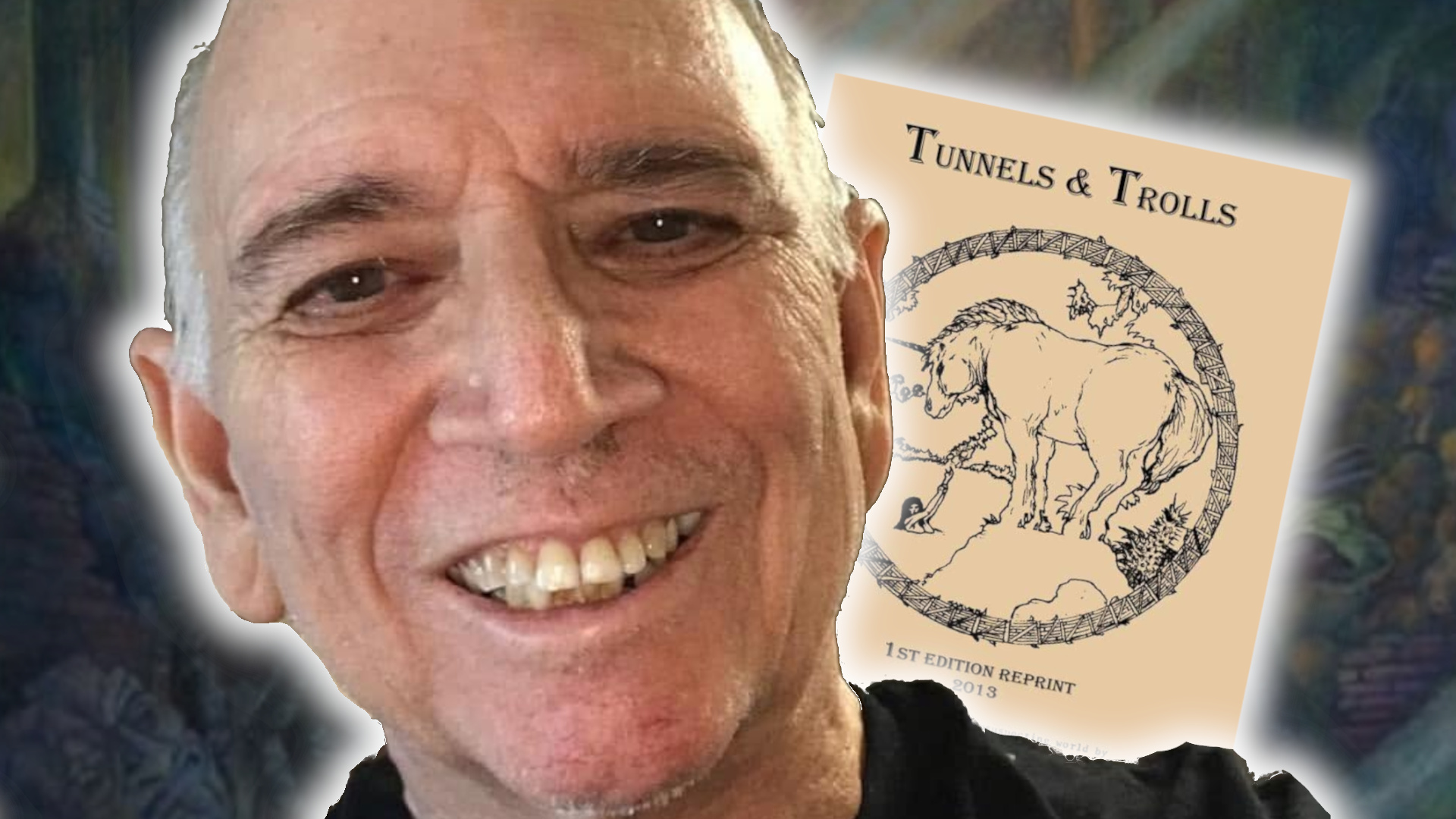
In the foreword to the 2013 reprint of the first edition Tunnels and Trolls rules, St. Andre says he wrote them on a “1917 left-handed Remington typewriter”. Interior illustrations came from his friend Robin Carver, created in one afternoon “with me and [James “Bear” Peters] sitting by and chortling madly”.
St. Andre printed 100 copies of the first edition of at the Arizona State University printshop, and gave Rick Loomis of Flying Buffalo Games to sell at the Origins convention. At the time, Flying Buffalo ran play-by-mail board games across America. When Tunnels and Trolls sold out at Origins, Loomis acquired the rights to publish the game. T&T second edition was published in December 1975, beginning Flying Buffalo’s pivot into a different form of RPG publisher.
Between 1975 and 2005 St. Andre wrote several updated editions of Tunnels and Trolls, taking the Flying Buffalo version of the game to version 5.5 in 2005. He later collaborated with other authors on the eighth edition in 2012, and a definitive edition in 2015. St. Andre also designed the first published sci-fi RPG, Starfaring, in 1976, the role-reversing RPG Monsters! Monsters! in 1976, and Chaosium’s licensed Elric of Melniboné RPG Stormbringer, in 1981.
St. Andre joined videogame developer Interplay in the 1980s, working on the ground-breaking CRPG Wasteland alongside designers Michael A. Stackpole and Liz Danforth, under director Brian Fargo. Perhaps best known today as the game that inspired Fallout, Wasteland was extremely innovative for its mature storytelling and open world setting, and sold a then mind-blowing 250,000 copies. St. Andre much later rejoined his companions to work on the sequel, Wasteland 2 – the game released in 2014.
In 2018, The Academy of Adventure Gaming Arts & Design – better known as the Origin Awards – inducted Ken St. Andre into its hall of fame.
Source: Wargamer