


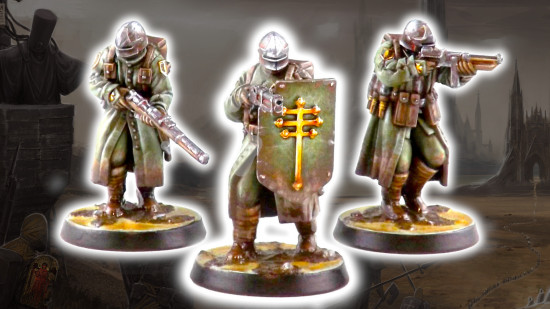
Trench Crusade is a divisive setting. From its origins as a personal project for concept artist Mike Franchina to draw wild ideas he’d never get away with in his dayjob, it’s a visceral, blasphemous setting that blends medieval history, mechanised warfare, and the kind of freaky imagery you only find in the album art for black metal bands. I’ve seen some people accuse the creatives making Trench Crusade of only caring about shock value: I interviewed Graham McNeill, veteran Warhammer 40k novelist and the lead author for Trench Crusade’s recent Carcass Front two player campaign set, to see what he had to say.
McNeill is a veteran author and world-builder. His career has included stints as a Warhammer 40k designer, as a 40k and Horus Heresy novelist, and as lore master for Riot Games and the League of Legends universe. His work on Carcass Front for Trench Crusade is superlative, so good that I dedicated an entire article to praising it a week before I published my 10/10 review for the set itself. If I wasn’t quite frothing when he agreed to an interview, I was at least peachy keen.
“Just writing grimdark for the sake of grimdark and being edgy, for want of a better term, it never feels that interesting to me”, McNeill says. “None of us are edgy 14 year olds trying for shock value: if there’s a [moment of] blood and guts or terror, it’s for something, it’s to have a proper emotional impact”.
He does allow that sometimes the emotion he’s trying to elicit is “Holy shit, that’s messed up!” But he says the team writing Trench Crusade “want to run that gamut of emotions of horror, of triumph, of excitement, of despair”. In large part that’s because as much as Trench Crusade is a horror story, it’s also a war story.

McNeill puts himself into the shoes of the characters stuck in the mud and mire of the setting. “There’s the little tiny bit of hope left at the end that everything we’re doing, maybe it can make a difference. Maybe not for us. Maybe not for generations to come. But the minute we stop fighting is when it’s all over”. He expands: “even if there is no chance of winning in this larger war, we still have to fight because that’s what people of honor do, what people of duty do, even in the face of insurmountable odds”.
I can see how that’s a useful anchor point for creating characters. What motivates people to fight on in the worst circumstances? What informs their decisions? Sometimes it’ll be negative emotions like spite and hatred; sometimes it’ll be madness; but nobility, duty, and self-sacrifice are all powerful motivators.
The world of Trench Crusade is one that its residents still want to fight for. “As wracked with war as it is, there are places that are not as horrible”, he says. “It’s a dark world, there’s privation everywhere because of the war and so on, but there is still life”. And if “people are still living, being born, loving, living their lives”, for McNeill, “even just a microscopic sliver of it in your stories allows them to be more than just grimdark misery porn”.
We discussed a lot of other topics, but those will have to wait for a future article. If you want to talk about the strengths and weaknesses of grimdark fiction, come and hang out with the crew in the Wargamer Discord community!
 Source: Wargamer

