


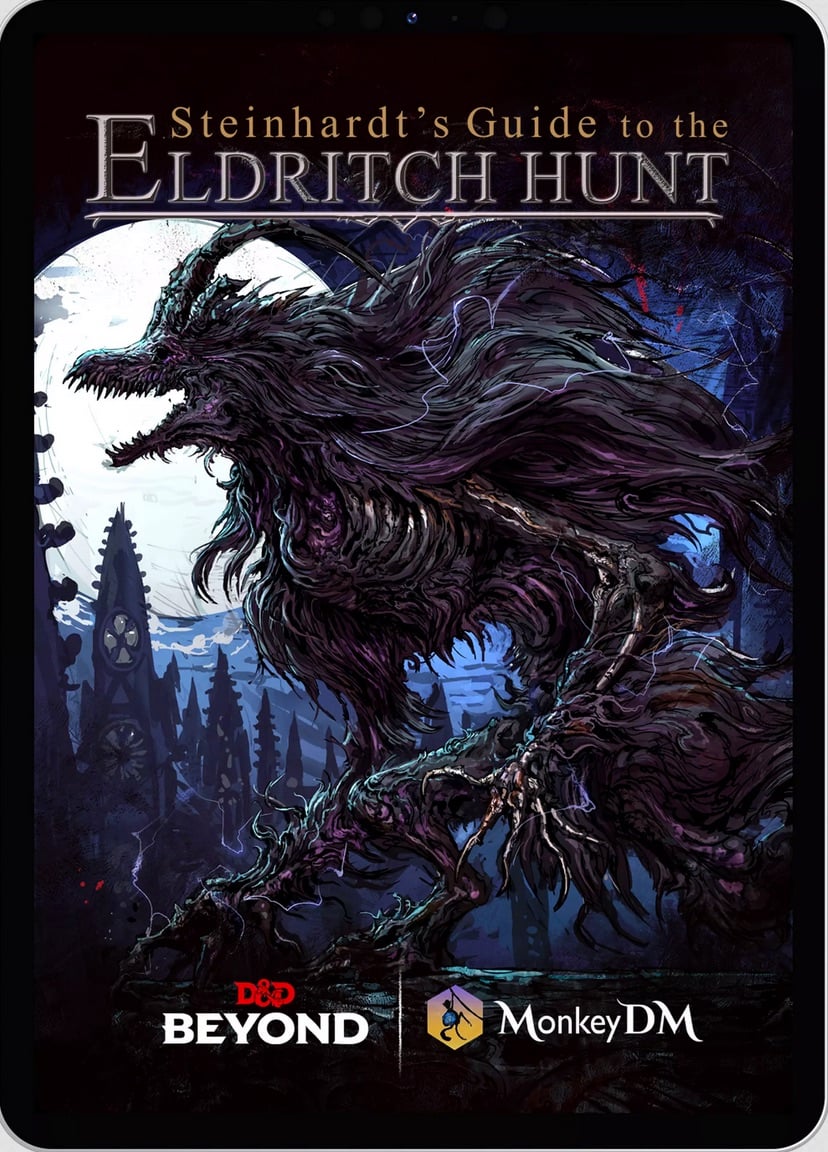
The Osteomancer, out of Steinhardt’s Guide, is the kind of Wizard that will both give you and cure your severe case of bone-itis.
Bones and especially skeletons are kind of inherently scary. On the one hand, it’s because they represent mortality; these are the remains of something that was once alive and now is not. But what if they moved again? Actually terrifying. But on the other hand, we all have a skeleton living inside of us just waiting to eat you so it can escape.
And Steinhardt’s Guide to the Eldritch Hunt, the eldritch horror player pack available on D&D Beyond right now, understands full well the horror potential of bones. To the point where it has a whole subclass dedicated to bone magic. As an Osteomancer Wizard, everywhere you go is the bone zone, and you will do a bit of body horror with every subclass feature you get. Though I will say, weirdly enough, for the Bone Magic subclass? These Wizards have no special ability with or affinity for the new Osteomancy spells included in the player pack.

Osteomancer Wizard – Bonely The Boneginning
I will say this. The subclass isn’t poorly designed, by any stretch of the imagination. As you’ll see from some of the higher-level features, it’s quite mechanically strong. But the weirdness of this class highlights that flavor isn’t this big interchangeable thing. Sure, you can reflavor mechanics, but sometimes the flavor matters.
Case in point, Illusionist Wizards, for example, have special skill when using Illusions. They also have features that let them do other, Illusion-related things. So do Abjurers who have the Arcane Ward, etc. But the Osteomancer has no such feature. Sure, they can add the new horrible bone spells right to their spellbook, which is cool and all. But so can any Wizard.

What do you get, as an Osteomancer Wizard, then? Well, starting at level 3, you gain Brittle Bone Armor, which is the ability to tell your party, “don’t worry, I can turn my endoskeleton into an exoskeleton.” And then you do that by forcing a frame of protective bones out of your body (told you, body horror at every subclass feature level), that you then shape into a protective barrier that grants you twice your Wizard level in temporary hit points.
While you have those temporary hit points, you also have some extra defenses, like resistance to two types of normal damage and a +2 bonus to AC. It’s nice. It stacks with stuff like Mage Armor because you can only extrude your bones when you’re not wearing armor or wielding a shield. And you can do it multiple times per day by spending a level 2 spell slot for each one after the first. But it’s nothing to write home about.

Your other level 3 feature, Anatomical Expert, is also just okay. You gain proficiency with Medicine and a bonus to Medicine and Survival checks. And whenever you’re doing one of those checks about a creature with a skeleton (most of them), you have expertise in the skill.
All of which speaks to your expertise with bones. But there’s no bonus for casting osteomancy spells. No special things you can do when casting one. It stood out as weird to me, in an otherwise solid subclass.
Higher Level Osteomancy Is Powerful, No Bones About It

At higher levels, the Osteomancer Wizard sort of obviates the need for some of the special bone magic spells. In fact, when you hit level 6, you get a huge jump in power, thanks to Bone Puppetry. This lets you use your Magic Action to target a creature with a skeleton to try and take control of its bones.
If it fails a Strength save against your spell DC, you take “total and precise control of its skeleton.” That means that until the end of its next turn, it does whatever you tell it to, and can’t do anything else. And sure, if you make it hit its friends, it has Disadvantage and its allies have Advantage on any saves the controlled creature might cause. But it has certain implications, like “taking control of a Wizard’s skeleton is all you need to make it cast a spell.” Plus, you can do this multiple times per day (up to your Int mod, so very quickly 4 and 5 times per Long Rest). It only lasts a round, but it’s basically a one-round Dominate Monster.

Then at 10th level, we get another weird array of features tied to a single ability that feels weirdly low-powered for getting it at 10th level. Skeletal Mastery is the feature, and despite what you might think it means, you have mastery over your own skeleton. Practically speaking, this means you can cast Alter Self at will and without concentration, but only to change your appearance or to gain natural (bone) weapons.
You can also tell your party “don’t worry, I can dissolve my own skeleton” and then dissolve your own skeleton to become an ooze so you can fit into narrow spaces. But never fear, you can regrow the bones in your hands if you need to do some fine manipulation while an ooze. This feels very much like something you should get at 3rd level. or 6th level, not 10th level.

Finally, the whole subclass caps off with Improved Bone Puppetry, which lets you extend the duration of your Bone Puppetry for a full minute and makes it unable to resist your commands. It does get to make a save at the end of each of its turns (and it takes your Concentration), but still. It’s plenty potent.
All in all, not a bad class, but lacking in mechanical/flavor integration in some weird ways. Still, weird is the name of the game when it comes to Steinhardt’s Guide to the Eldritch Hunt, available below on D&D Beyond.
Bone magic is going to be huge!
Don’t Miss:


Source: Bell of Lost Souls

