


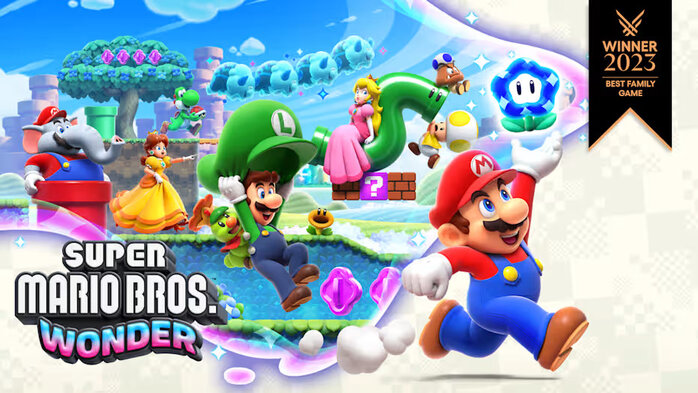
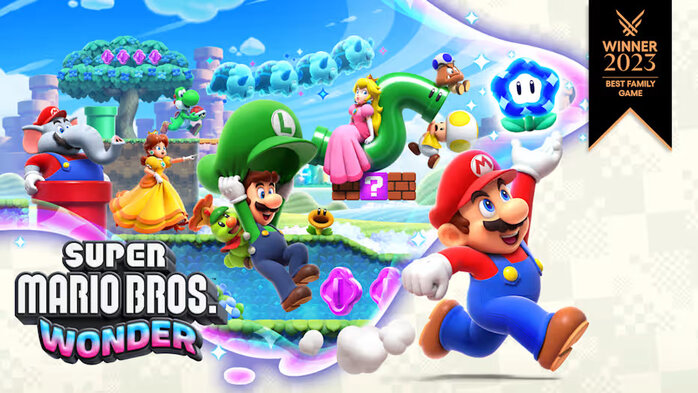
A talking flower should not be the thing that sticks in your head after a Mario game, yet here we are. One moment you are running through a clean, familiar 2D stage and the next the world bends, shifts or completely breaks into something unexpected. That is the core promise of Super Mario Bros. Wonder and it delivers that feeling almost constantly.
Super Mario Bros. Wonder is a side-scrolling platformer on Nintendo Switch that sends Mario and friends into the Flower Kingdom after Bowser fuses with its Wonder power. The story is minimal by design and exists mainly to frame the journey across themed worlds and introduce the Wonder Flower mechanic.
The narrative never aims for depth and that works in its favor. Prince Florian and the Flower Kingdom provide just enough context to move between stages without slowing the pace. The focus stays on gameplay rather than exposition and the game is better for it.
Gameplay is where Super Mario Bros. Wonder fully lands. The core movement is tight, responsive and consistently satisfying. Running, jumping and chaining momentum through stages is the main reason to keep playing and it rarely slips. Even when nothing dramatic is happening, the platforming itself feels good moment to moment.
The Wonder Flower mechanic is the defining feature. When activated, stages shift into altered states that can change physics, visuals, enemy behavior or the entire structure of a level. Some segments become rhythmic set pieces while others lean into chaos or surreal visual tricks. It is unpredictable in a way that keeps even simple stages fresh.
New power-ups include the Elephant Fruit, Drill Mushroom and Bubble Flower. The Bubble Flower stood out as the most useful and satisfying, offering strong control and utility. The Elephant form is more comedic than mechanically deep. The Drill adds vertical movement options but does not drastically change how most levels play.
Badges offer small modifiers that adjust movement or abilities. They add variety but do not meaningfully change the way experienced players approach the game. They feel more like optional tools than systems built for deep experimentation.
Multiplayer works well both locally and online. The online system, which shows other players as ghost-like figures in your world, adds a subtle sense of presence without disrupting solo play. It can also offer small moments of indirect guidance during tougher sections.
Visually the game is arguably the strongest looking 2D Mario to date. The art style is bright, expressive and consistently readable across all worlds. Music supports this well with distinct themes that match each environment and reinforce the tone of each stage.
The strongest element is still the core platforming. Movement carries the entire experience and makes even simple levels enjoyable. Wonder Flower segments add creativity and variety that keep the formula from feeling stale. Character choice also adds personality with Mario, Luigi, Peach, Daisy, Toad, Toadette, Yoshi and Nabbit all available even if they mostly play the same.
Where the game falls short is difficulty. Super Mario Bros. Wonder is very easy, especially for long-time players. Boss fights are also underwhelming and rarely create tension. Levels often end quickly before they fully develop, which can make some worlds feel a bit light in structure.
Completion is straightforward. Reaching full progress does not take long and while that makes the game accessible it also limits long-term challenge. Optional collectibles like standees do not add much value and feel unnecessary for most players. The Special World does introduce sharper difficulty spikes but overall the game still leans toward accessibility over mastery.
Final verdict
Super Mario Bros. Wonder is a polished and inventive take on modern 2D Mario that succeeds through movement, presentation and constant variation. It prioritizes accessibility and creativity over challenge and that defines the entire experience. For newer players or anyone wanting a relaxed platformer with strong ideas it delivers easily. For veterans looking for sustained difficulty it may feel light.
Final score: 8.5 out of 10
A creative and highly enjoyable 2D Mario experience built on excellent platforming and constant surprise, held back by low difficulty, simple bosses and limited depth in its optional systems.
Pokémon Lens
Super Mario Bros. Wonder connects to Pokémon through its approach to structured discovery and controlled experimentation. The Wonder Flower system functions similarly to Pokémon mechanics that temporarily reshape familiar rules such as battle gimmicks or form changes. It introduces variation while keeping the underlying structure consistent.
However, unlike Pokémon, which often builds long-term strategic depth through team composition and layered systems, Wonder focuses on short-form novelty and immediate mechanical payoff. Badges resemble Pokémon held items in concept but lack the same strategic impact. The result is an experience that mirrors Pokémon’s sense of discovery but not its long-term competitive or systems-driven depth.
Source:Pokémon

