


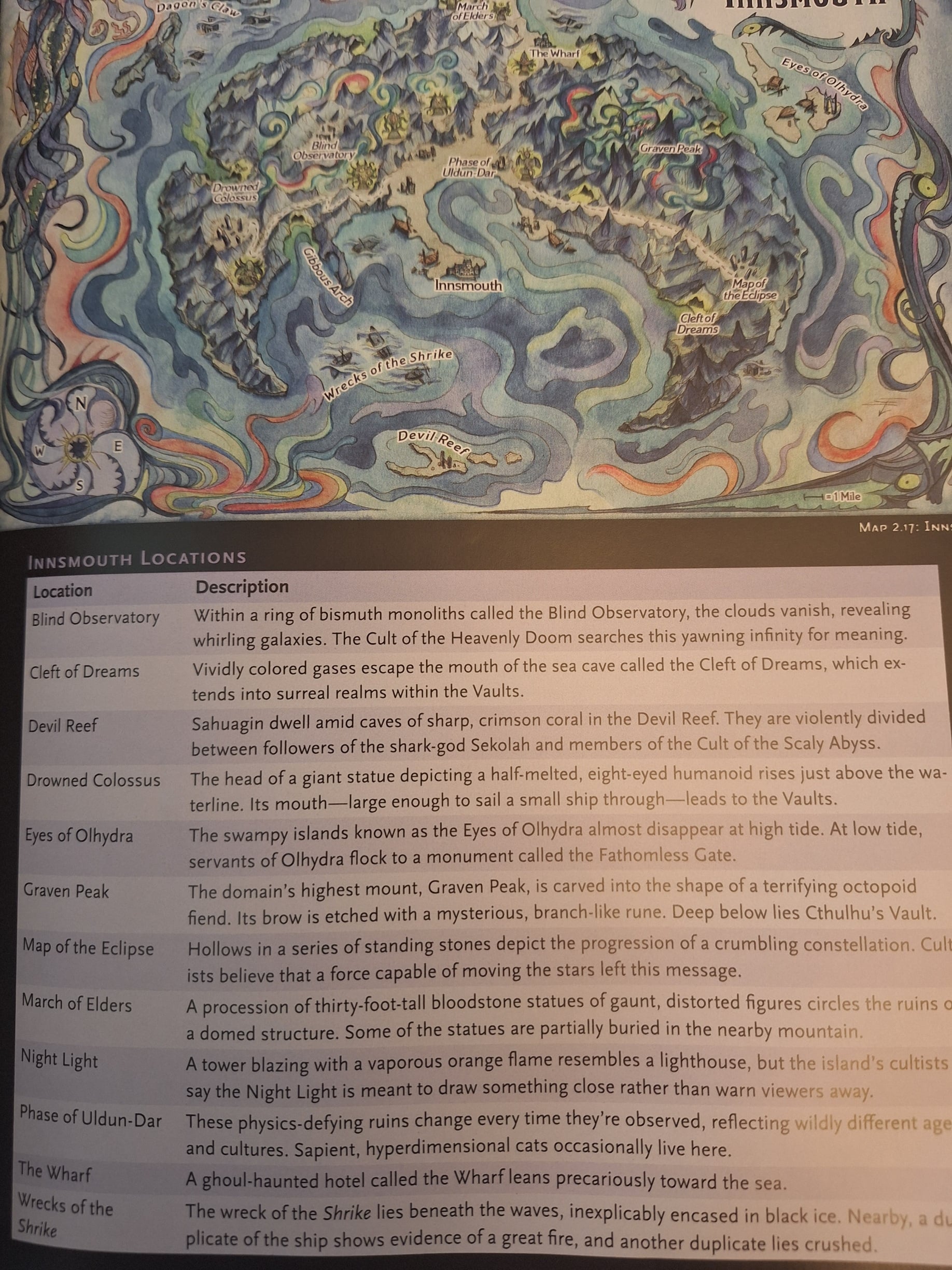
In Ravenloft: The Horrors Within, the sleepy town of Innsmouth and its most infamous eldritch horror take root in D&D.
Ravenloft: The Horrors Within, out now for D&D either online or on the shelves of your FLGS, revisits Ravenloft, sure. But it also adds a new dimension to the demiplane of dread. In some cases, literally, because the book adds actual new dimensions/demiplanes to Ravenloft, which previously hadn’t been in the book.
It’s not just a retread of Van Richten’s Guide to Ravenloft, though the book also does update the mechanics from that book to the latest ruleset. And that’s worth mentioning, because I think one of the strongest things in the book is the new horrors that the D&D team explores, and the approach they take in designing it.

Horror in D&D is a challenge. Partially because of how the game is designed: you play as heroes who become increasingly powerful as you level up and find more magic items, and there’s no foe in the Monster Manual that can’t be killed if you try hard enough. It calls to mind an adage that goes back to the earliest days of D&D, “if it has stats, we can kill it.”
Which came about during the days of Deities & Demigods. Ironically enough, that’s where Cthulhu first makes his appearance in D&D. And now, in Ravenloft: The Horros Within, Cthulhu is back. Along with the sleepy, cult-haunted town of Innsmouth, where Cthulhu lies deathless, awaiting strange aeons.

Cthulhu And Innsmouth In Ravenloft
One of the biggest challenges for horror in D&D is the fact that characters are often powerful enough that they have ways to escape whatever horrors are being visited upon them. So much so that in Ravenloft one of the first things you’ll find is advice for the players that says basically, “yeah we get it, but also it isn’t horror if you don’t play along.” I’m paraphrasing, here but, this is the quote from page 13:
“While playing a horror adventure, you participate in building a sense of dread. If your character laughs in the face of every danger, they undermine the adventure’s atmosphere. Consider how past events might haunt your character and contribute to the mood of horror adventures.”

It all comes down to buying into the tone and the horror of the game. Which is why each writeup of the various Domains of Dread is all about setting out the tone and the style and the eeriness of each domain. And Innsmouth, haunted by Cthulhu at the heart of it, is one of the standout examples of how the D&D team approaches establishing horror.
It starts with a listing of the horror features (spooky things that have a mechanical or narrative effect) of Innsmouth. For instance, Cthulhu’s eldritch presence changes the landscape. People in Innsmouth have haunting dreams influenced by Cthulhu to manipulate people into trying to release it from its imprisonment. Aberrations of all shape and size are drawn to it.

And of course, there are various cults dedicated to trying to get the approval of Cthulhu for a dark blessing. Because the people in Innsmouth are trapped, unable to escape. But unlike most other of the dread domains of Ravenloft, it’s at Cthulhu’s whim, not the Dark Powers of Ravenloft. Cthulhu can open or close the mist-shrouded borders of Innsmouth at will, so long as Cthulhu is alive.
And given Cthulhu’s stat block weighs in at CR 25, it’s more than likely that Cthulhu will continue to be alive.
If It Has Stats…

Let’s take a look at what Cthulhu can do. We’ve seen a glimpse of this before. Cthulhu only has an AC of 19, which seems strange for something so potent. But where the real horror of Cthulhu lies is in how you interpret the mechanics of its stat block.
One of its effects is “Impossible Geometry” which makes the ground, air, and water in a 10 foot aura of it Difficult Terrain. Also creatures inside it take damage, no save. But it’s in reality warping and shifting at Cthulhu’s whim that you find the “oh things aren’t right” kind of moments.

Because mechanically, Cthulhu is actually pretty straightforward. It has two claw attacks that deal an average of 27 damage each. If a claw hits, a Large or smaller creature is Grappled. Grappled creatures are subject to a Tentacle attack that deals an average of 34 damage instead (and reduces a creature’s hit point maximum while also healing Cthulhu).
At the end of the day, Cthulhu grapples someone and then tentacle drains/claws them to death while casting Befuddlement or Mind Spike at distant targets. And it can teleport around the battlefield at will, knocking creatures prone wherever it arrives.

But that’s how it is in 5.5E. Monsters are a little simpler to run – but it’s in what they do, in what accompanies them that you find the horror. And what accompanies Cthulhu in Ravenloft is a whole domain haunted by cults. A sample campaign suggests players might try to befriend/manipulate these cults to gain access to Cthulhu where it is imprisoned.

Even More Horrors
A collection of monsters from Lovecraft’s Mythos are in the book as well. You’ll find Ythians and Mi-Gos and Shoggoths and Elder Things (to name a few). Each one a presence in Innsmouth, each with an alien goal. And honestly, this is the stuff that’s the most valuable. Because I could easily see taking Cthulhu (or any of the Darklords) out of their dread domain and using them as a campaign-level villain in a setting you broaden beyond the borders of the Mists.
And then of course, watch as the party gets three lucky crits in a row and takes down the ultimate eldritch evil after it only gets a single turn!
Please note that BoLS may earn a commission when you purchase through links on our site.
Don’t Miss:


Source: Bell of Lost Souls

