


Verdict

With great miniatures and a short campaign of tutorial missions, Mazebreaker is a solid starter set for anyone who wants to learn Infinity, introducing the slick core rules while leaving the intimidating complexities for later. Editing problems mean this still isn’t the smoothest on-ramp, and you should identify a community – online or IRL – who can help you if the rules trip you up.
- Incredible minis
- Tutorial campaign introduces a complex wargame in manageable chunks
- Delivers on its promise of cinematic cyberpunk action
- A few rules typos add unnecessary confusion
- Stops well short of teaching you the full rules
- Terrain is high quality but extremely mission-specific
Operation Mazebreaker is the latest two player starter set for long-running sci-fi skirmish game Infinity – with miniatures, dice, rules, terrain, a paper playing mat, cardboard tokens and templates, even some short cardboard range rulers, the box really has all the gear and components you need to start playing the game. But does all of that make it a good starting point to this famously complicated wargame for a brand new player? Thanks to a review sample sent by publisher Corvus Belli I’ve been testing that – here’s what I think.
This review is based on building and starting to paint the minis, giving the rulebook a thorough readthrough, and playing through the mini campaign of teaching missions with my eager buddy Justin who is new to wargaming and has never said no to trying a new wargame (and who kindly painted up one of the Aleph minis to help illustrate this article). I’ve also considered the supporting material provided online by Corvus Belli, and how Mazebreaker complements that onboarding experience.
Operation Mazebreaker – the miniatures

The seven minis for each of the two teams in the box – and their accompanying lore – show just how good Corvus Belli is at coming up with cyberpunk ideas and expressing them as models.
Lets start with the Nomads, a space-fairing anarchist collective: the minis in this set are all from the Corregidor subfaction, which has a heavy Latin American and sub-Saharan African population. More specifically, these troops are part of a strategic program to defend Corregidor’s corporate interests in frontier territories, particularly mining operations, and they’re rare ground-pounders in the Nomad’s mostly space-faring military.

Those ideas are layered onto the models. Ruggedized body suits with oxygen masks suggest both space suits, heavy duty industrial gear, and self-sufficient spec ops; the Bandit, with his short dreadlocks, machete, and tribally-inspired flat-fronted operator mask, is a paramilitary take on Afro-futurism.

The other team is the Operations Subsection of Aleph’s Special Situations Section. Aleph is humanity’s only legal self-improving AI, and OperationS is a dedicated task force to hunt down unlicensed AI. If Apple ever had a paramilitary wing, they’d look like this – dripping in corporate style.
The Shukra – a paramilitary consultant usually loaned out to other intelligence services to assist in anti-AI operations – isn’t so much serving cunt, as launching cunt from an orbital weapons platform. 
The Dikpala Tacbots look like Steve Jobs’ take on Chappie, and the posthuman Asura – a forked aspect of Aleph’s consciousness embodied in a cutting edge artificial body – is destined to be shared on social media with the hashtags #fitnessgoals, #transitiongoals, and #steponmemommy. Delete as appropriate according to your gender identity and how publicly you let your freak flag fly.
These models are – and this should be no surprise if you’ve even looked at an Infinity mini – both gorgeous and fiddly. They’re all cast in metal and require careful preparation; it can be hard to tell the difference between a sprue gate, a small antenna, or a peg designed to attach a model to its base. You’ll need to use superglue to stick them together, and a pin-vice drill to put holes into bases for those aforementioned pegs.

Still, they’re less fiddly than I remember Infinity minis being a decade ago. Maybe I’m a better builder than I was then, but I think there are fewer oh-so-snappable wrist and ankle joints, and fewer miniscule points of connection between weapons and hands – the ankles on the teensy feet of the Dikpalas, above, look nightmarish, but they have sockets to attach the ankles to and they’re merely tricky.
The only real mechanical issue with the kits is the top-heavy BearCat jump infantry model, which needs a counterweight glued in its base to stop the weight of its jump pack toppling it over.
Despite the high detail on the minis, they’re easy to paint to a tabletop standard, especially with the magic of of speed paints. Speed paints and contrast excel when applied to textured surfaces where they can pool in recesses and creep away from edges that get the most from their ability to shade and highlight in minimal coats, and Infinity minis are so small and finely detailed that you can do this all over. The most challenging part of painting them is getting a good strong base coat of primer.
The other stuff in the box

The terrain in the pack is very tightly connected to the set’s narrative: the forces are fighting over an underground xeno-archaeological site trying to get their hands on a glowy tank of technogoo, and the terrain set features stalacmites, non-specific techno boxes, and a giger-esque control platform. It’s made from sturdy cardboard that goes together easily, and I inked the edges of much of the terrain using a black sharpie, a simple cheat that makes them look a lot better.
I wasn’t expecting to love the terrain – the stalacmites in particular look quite janky in photographs – but while playing the intro scenarios I enjoyed myself enough that I started ideating a dedicated underground cavern terrain set. But I’m a terrain obsessive with a 3D printer and bad impulse control: most new players are going to find the terrain in this set doesn’t mesh with most commercially available Infinity terrain.
The box also comes with two sets of faction dice, and a big set of cardboard tokens and templates. The tokens and templates are essential, but you’ll only use a few in the starter missions in this pak. The rest are tantalizing suggestions of what a full game of Infinity will entail.
Learning to play

The Operation Mazebreaker rulebook is uneven. The lore is great, a mixture of detailed unit backgrounds and story snippets that set the scene for the battle between Aleph and the Nomads. It’s well illustrated with drawings of every unit type, which is essential because it’s the only way you’ll be able to tell which model is which – five of the seven Nomad models in the set are human infantry equipped with submachine guns.
That’s at least a fair introduction of what players should expect: outside product packaging, Corvus Belli does a bad job indicating which models correspond to which blocks of stats. The free Infinity Army app is a powerful tool for reference and list-building, but it only provides unit names and their in-universe military badges. It’s thematic to a literal fault.

The Mazebreaker rules text has some problems, and they seem to come from editing oversights. To pick a few examples: the second of two unit stat blocks uses Spanish instead of English headings; an example of play mentions that a critical hit forces a model to take two saves instead of one, but it’s not mentioned in the rules explanation; that same example of play gets some sums wrong and attributes stats to the wrong models…
Infinity is a complicated game, and I don’t envy designing it in one language and translating it to another – I can understand how these errors got there. But for some new players they’ll create unnecessary confusion, and new players will probably face a lot of necessary confusion.
Barring these complications, the explanation of rules is serviceable: it favours natural language over legalese, and there are QR codes throughout which link to downloadable resources and explainer videos, if that’s how you prefer to learn. As you can hear in the video below, they use a rather memetic text-to-speech voice.
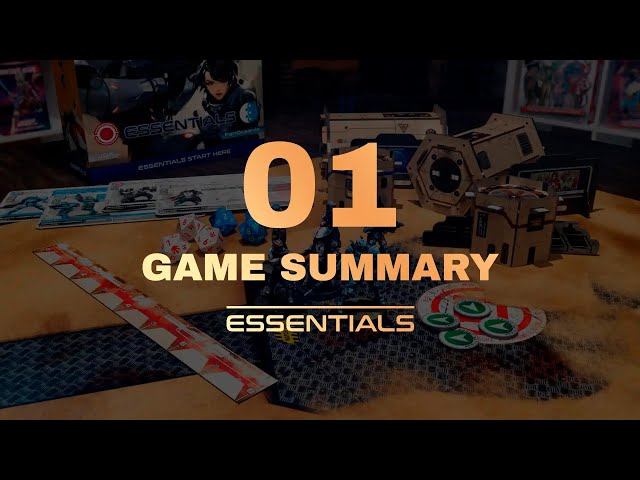
To draw a parallel from board games, this is the “learn to play” rulebook, not the “reference” rulebook, and if you hang onto it it will be because of the lore and art, not because it’s got the rules you need – for that, use the free online Infinity rules wiki.
The missions in the box introduce the core concepts of Infinity very gradually, from the absolute basics through to a few more advanced skills and pieces of equipment. It still caps out a long, long way short of using the complete rules for every model in the set, let alone the full rules of the game. This is fine as an introductory experience – I found playing through the missions to be a brisk reminder of how damn good Infinity’s core rules are, and my opponent Justin was enthralled.
The very, very core of Infinity has three interconnected parts: Orders, Automatic Reaction Orders (AROs), and Face to Face rolls. At the start of a player’s turn they get a pool of order tokens based on the number of troops under their control, which they can spend to activate their troopers – how you spend them is up to you, and it’s possible to ‘go Rambo’ by activating a single hero again and again.
Any enemy models that can see your active model get to make an Automatic Reaction Order in response, potentially dodging out of the way of your fire or shooting back at your attacker. This then turns into a Face to Face roll: both players make skill tests for their models by rolling one or more D20s, trying to get equal to or under their relevant skill value, with the highest success winning.
There’s a little wrinkle to this when it comes to Face to Face ranged attacks: an active model gets to use the full ‘Burst’ value of its weapon, usually rolling two to three dice, while a model using an ARO only gets to take one shot. This gives the attacker a big advantage – usually. Many factors affect accuracy, from weapon range bands, to cover, to holographic stealth projectors, and there’s no limit to how many enemies can react to a model’s movements. The more enemies an attacker has to split their fire between, the more their advantage erodes.

Playing Infinity feels somewhere between a military sim and a Cyberpunk anime. Venturing into the open is a good way to get shot, and one bullet usually means death for most basic infantry. Units will make slow progress against embedded enemies unless they can bring an asymmetrical advantage to bear. Some classics from the 21st century still work – smoke screens, weapons with better range and optics, simple flanking maneuvers – but then there’s a whole armoury of sci-fi tech to play with. Power armor can deflect bullets, cloaking devices let models avoid detection, sci-fi visors can see through smoke and cover, and hackers can disable an enemy’s comms or burst their brain.
The missions in Mazebreaker are almost all just kill fest fests that progressively introduce new rules, new models, and unlock new skills and equipment. At least during the first playthrough this didn’t get dull, and the identity of each faction becomes clearer as you play with more and more capabilities.
The Nomads’ short ranged guns are at a big disadvantage even with the constrained battlefield in the starter set, but that’s mitigated as they gain models who can infiltrate further up the battlefield, or start the game camouflaged, or which enter the battle via parachute. Aleph’s forces are more high tech – most of the force is lighter and flightier, faster, less armored but protected by mimetic camouflage, except for the the Asura heavy infantry, a cutting edge killing machine with thighs that could crush a robot’s head.

One important lesson that’s missing in the starter pack missions is the critical importance of specialist troops for winning scenarios. Without Doctors or Paramedics, Engineers, Hackers, models which can destroy structures, and similar specialist troops, it’s literally impossible to score in many matched play scenarios.
Protecting and delivering specialists while managing your order budget is a critical part of Infinity, and one of many points where the game’s narrative and its mechanics work hand in hand – you’re not just standing dudes on pie plates, you’re getting an hacker into position to decrypt a computer console. It’s something a new player will quickly learn from the community, and should be able to infer from reading any tournament mission pack, but one mission based around the premise would have been a good inclusion.
Expanding from the box set

I also received a review sample of the Beyond Operation Mazebreaker pack, which adds three more figures to each force, and is the recommended way for new players to expand their collection. While it doesn’t get either army to a full 300 points, the models complement the faction identities established in the main set – the Nomads get more forward-deploying skirmishers, this time with more effective ranged firepower, while Aleph gets a hacker with a cloaking device and a pair of rapid-ingress robots.
Expanding the Aleph force to have enough specialists is actually very easy, as Aleph Support Pack Beta includes a Sophotect, a unit that’s both a Doctor and an Engineer, plus two cute peripheral robots which allow it to project its presence in several parts of the table. That gets you very close to a standard 300 point army, and can drop one or two Dikpalas and take a more impressive unit to make up the difference.
Though the Nomads can actually field all the specialists they need with the models in Mazebreaker and Beyond, growing from there out to a full force is trickier. Between the two packs they get to roughly 200 points and either nine or 10 orders (it depends on whether they deploy a robot as a peripheral slaved to another trooper, or as its own unit). If you want to keep all of these models in your force and buy extras to expand it, you might end up fielding the maximum 15 order-generating troopers a list can contain – and that introduces a whole new level of complexity a new player won’t be prepared for.
Models in an Infinity army must be organised into combat groups of no more than 10 models, and models can only use orders from their combat group. The Aleph list will get to 11 models, assuming you add the Sophotect and upgrade a Dikpala, and that’s easy enough to strategize around – you separate your worst mini into its own combat group, put it on sentry duty at the back of the board, and after your main combat group suffers casualties you’ll use one of your very limited Command Tokens (a resource available in the full game) to transfer it in to prop up the order count.

But above that is a zone where you need to balance your orders between two order pools, make tough list-building choices about which elements of your force go in the larger, better-resourced combat group, and likely lean on the advanced rules for Fireteams, so you can move and activate groups of models as groups.
It’s actually easier to cut the gordian knot by benching all three Alguaciles and grabbing a box of Mobile Brigada heavy infantry. Field all four as a Fireteam (accompanied by the Shifta, who can help them forward deploy slightly) and you’ll have a 10 order combat group with an extremely offensive and fairly well-armored mobile fire base that also has a hacker tucked inside it. That’s one of a huge range of unit options – not all of them currently in production – and Mazebreaker won’t prepare a player to choose between them.
Final thoughts
If that sudden deep dive into minutiae was a little bit disorienting, welcome to Infinity. The game has vertiginous depth. Operation Mazebreaker does a good job highlighting all the things that make it interesting – a remarkable core rules system, incredible miniatures, and a compelling world. The design intent is to make a complicated game accessible for new players, potentially even people totally new to wargaming – the back of the book even has solid advice on preparing and building metal miniatures and painting the miniatures.
But I find it telling that one of the recommended painting techniques is zenithal priming with an airbrush – even in a starter product, Corvus Belli is recommending an advanced technique. Between editing problems in the rules, the fact the terrain isn’t the most useful starting point for a collection, and the potential for some feel-bad losses if the imbalance between the two forces becomes especially noticeable in your learning games, this is an on-ramp that needed some more polish. Most people should be able to ride out the bumps, but a few will bounce off, and that’s a damn shame – Infinity is as good as ever.
Keen to try out Mazebreaker, or an Infinity fan with a gorgeous collection or board to show off? Come and join us in the Wargamer Discord community
 Source: Wargamer
