


Verdict

Viticulture: Bordeaux is, above all else, flexible. No longer are your turns dictated by bad luck and lack of space for your workers. This freedom is a boon to beginners, who have more of a shot in these shorter games, as well as veterans, who are spoiled for interesting, strategic decisions. I’ve gone from sort-of-liking Viticulture to loving it thanks to the expansion.
- More approachable
- More strategic
- Finely balanced
- Disrupts a lot of existing strategies
Before now, I was pretty lukewarm about Viticulture. Worker placement fans have long considered it one of the best board games ever made, and maybe they’re right. But for me, it was simply ‘fine’. A supermarket rosé, but no sparkling champagne.
This was true for many reasons. For example, the game’s winning strategies seemed to have very little to do with wine-making. It was thematically jarring and mechanically inflexible. It was also a little too reliant on luck of the draw, with cards making or breaking your score.
The Tuscany expansion did so much to rebalance the game that publisher Stonemaier absorbed its best bits into an Essential Edition. But still, many of the problems persisted. Wine-making still often played second fiddle, and cards, though now better balanced, were still the luck-heavy top draw.
Inexperienced players, who hadn’t already sussed the importance of visitors and early field sales, would miss out on crucial worker placements early on. They were left eating dust rather than grapes, and it’s a long game when, a few seasons in, you realize you’ve already lost.
Now, along comes Viticulture: Bordeaux. It’s the same game, but tighter, snappier, and simply more sensible. It marks the first time I’ve played Viticulture and said ‘oh, this is great.’
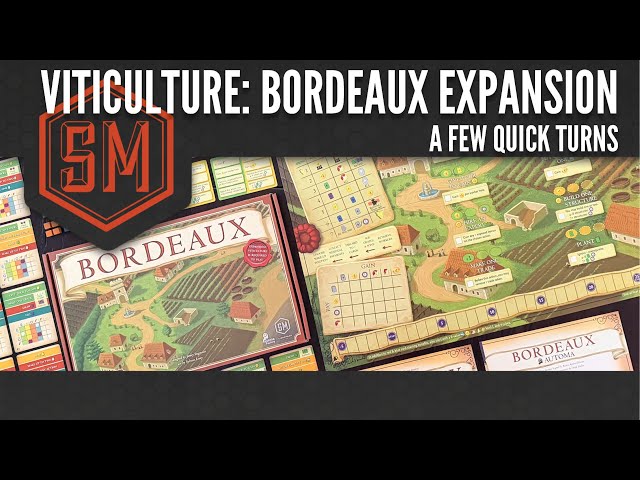
Like Tuscany, Bordeaux plays out over four seasons. Similarly, a modified wake-up chart adjusts the turn order, allowing the first turn to be seized by the last player – though first place now gives benefits to all players as the seasons turn.
This tweak sums up Bordeaux’s design philosophy. In all ways possible, it’s much more generous with resources.
The residual income track now grants victory points when you cross certain thresholds. You start with two of your three fields already sold, but players gain base starting resources instead, as well as those granted by Mamas and Papas. You can take an action to trade pretty much any resource – including victory points – for another.
Plus, perhaps most importantly, vine and wine order cards now appear face-up on the board. Everyone can see the top two available cards or choose to draw at random from the deck instead. This dramatically reduces the randomness of games – especially if, like me, you’re playing with the rebalanced cards from the base game’s Essential Edition.
Bordeaux also addresses crowding issues by making its actions more generous. Fall, for example, now has the Take Any Action section, where you can pay one Lira to use an action you might have missed out on.
Even victory points feel more easily won. Wine and grapes in your stores at the end of the game are now worth Lira, and every 10 Lira is worth a victory point. Near-completed orders are no longer worthless in the final turns, and, at last, going all-in on winemaking feels worthwhile.

You can also pick up extra points from Bordeaux’s most obvious new mechanic: experts. Taking the Hire an Expert action in spring allows you to claim a single, unique space under one of the board’s regular actions.
Now, you have exclusive access to an additional benefit when you take that action. That might mean gaining victory points, using every part of an ‘and/or’ visitor card, or unlocking an entirely new space for your workers only.
These benefits help you flesh out a unique strategy for your vineyard. And, thanks to the above changes, most avenues lead to victory points. Some lucky visitor pulls, combined with early expansion of your workforce, but it takes some serious misplays to lock you out of first place.
You might think this generosity makes Viticulture a kinder, gentler game. Maybe, if you relish the sometimes-brutal bullying of worker placement, you might make a sour face finding out your tried-and-tested tricks have been turned on their head.
You’d be forgiven: in our first test game, we wondered if this version was over-balanced, because everyone found different ways to achieve similar scores. But rest assured: Viticulture is still every bit the cutthroat strategy game. If anything, it’s more intense, because the competition is so fierce.

With luck playing a smaller role, your decisions matter more. The scarcity of expert bonuses still encourages you to pivot based on the crafty moves of other players, but the many avenues to success, more than ever, encourage you to plan, to consider the web of actions ahead of you.
Viticulture: Bordeaux successfully treads a tough tightrope. It somehow makes the base game more approachable – shorter play times and more flexibility – without alienating experts. I may not have been the game’s biggest fan before, but I tested Bordeaux with a roster of Viticulture veterans, and the response was unanimously positive. Jamey Stegmaier clearly states his design goals on the back of the rulebook, and, in my opinion, he’s nailed it.
Bordeaux fixes problems. Bordeaux creates interesting decisions. This is simply Viticulture at its best, and it’s a version I can’t wait to play again.
Want to talk more about board games? You can keep up with our latest news, reviews, and tabletop stories in the Wargamer Discord.
 Source: Wargamer
