


Warhammer 40k Abilities are the capabilities that weapons and units have which make them distinctive. Two guns might have the same Range, Strength and Armour Penetration stats, but one might be a Blast weapon for mowing down hordes, while another is an Anti-Vehicle weapon that can easily smash tanks.
Two similar units might be good at vastly different things, because one can Deep Strike and the other Fights First. This guide tracks every single ability, and explains how they work in-game – and it’s being updated with all the updated rules for 11th edition as GW reveals them.
This standardised list is shared across all the Warhammer 40k factions. We’ve included the current version of each rule from 10th edition, plus all the differences that Games Workshop has revealed so far for Warhammer 40k 11th edition.
Read on to explore the full Warhammer 40k abilities list, or click on an ability in this table to jump to it:
Warhammer 40k Weapon Abilities
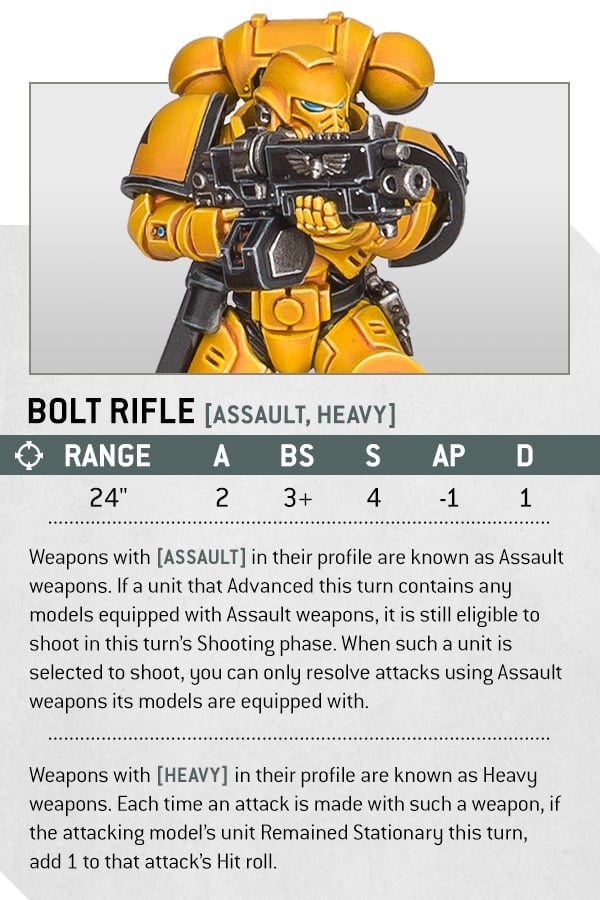
Weapon Abilities describe the capabilities of a weapon. If you last played in an earlier edition of the game, you’ll see that some weapon ‘types’ are now Abilities, and these aren’t mutually exclusive in the way they used to be. Space Marine Bolt-rifles are both Heavy and Assault weapons, which grants them two different firing modes.
These are all the Weapon Abilities in Warhammer 40k 10th edition:
Anti
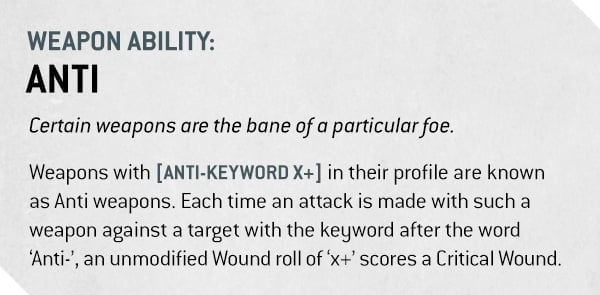
Anti-keyword X+ abilities allow models to score Critical Wounds (that is, automatic wounds irrespective of the target’s Toughness) against particular targets, provided their to-wound roll is X or higher. So an Anti-Vehicle 3+ weapon scores a Critical Wound on a vehicle on any to-wound roll of 3+.
Some other Weapon Abilities, particularly Devastating Wounds, are triggered by scoring a Critical Wound, so the Anti- ability can make it easier to trigger those abilities.
Any keyword could appear in the Anti ability, but its most common to see Anti-Vehicle, Anti-Monster, or Anti-Infantry.
Assault
A unit that Advances during the movement phase can still shoot its Assault weapons.
Blast
When shooting a Blast weapon, add one to the attack characteristic of the weapon for every five models in the target unit. So a Blast D6 weapon would have D6+2 shots against a unit with ten to fourteen models.
Conversion
Conversion weapons are more powerful at longer range. When firing at a target at least half the weapon’s range away, a Conversion weapon inflicts Critical Hits on hit rolls of 4+. Critical Hits don’t do anything in and of themselves, but they can trigger other abilities, such as Lethal Hits or Sustained Hits. Conversion isn’t a Core Ability, but it appears on several datasheets.
Devastating Wounds
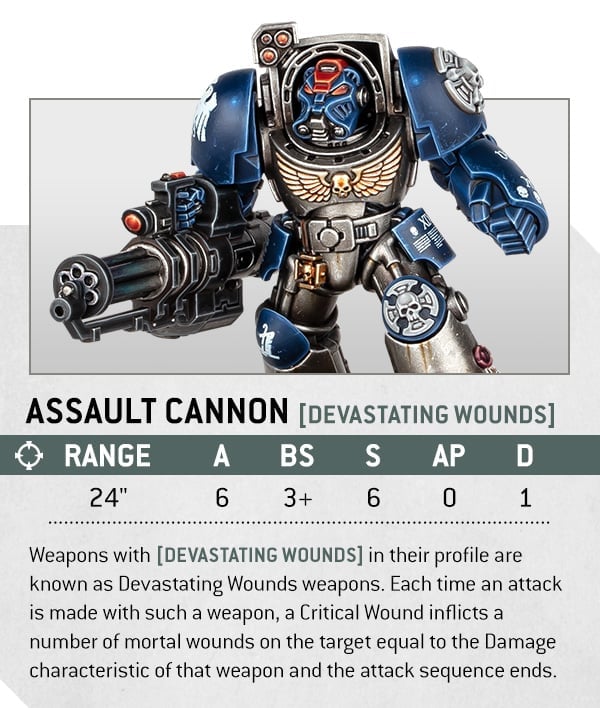
The wording for Devastating Wounds was updated in the Autumn 2023 balance dataslate. When a weapon with Devastating Wounds scores a Critical Wound (normally on a to-wound roll of six), the target cannot take saves or invulnerable saves against that wound.
As the rules were written in the Warhammer 40k core rulebook, the Devastating Wounds ability meant that Critical Wounds inflicted mortal wounds. This is much more powerful than ignoring invulnerable saves when targeting multi-model units, as mortal wounds can spill over to multiple models if they kill the model the hit was initially allocated to.
Extra Attacks
When you declare melee attacks for a model, as well as selecting one of the melee weapons it’s armed with to attack with, you can also attack with Extra Attacks weapons. There’s no way to modify the number of attacks you make with an Extra Attacks weapon.
Hazardous
Hazardous weapons risk killing or harming the model using them. When a unit attacks with Hazardous weapons you roll one D6 for each Hazardous weapon being used. For each roll of a one, you’ll deal three mortal wounds if the weapon was fired by a Character, Vehicle, or Monster, or otherwise remove one model as a casualty.
The 40k Core Rules specify that if a character firing a Hazardous weapon is attached to a unit, and you roll a one, you must still apply those mortal wounds to the unlucky Leader – no offloading the plasma overspill onto your troopers!
Heavy
Units that Remain Stationary get +1 to hit with Heavy Weapons they fire that turn. Note that ‘Remain Stationary’ is a game term; if the unit declares a move but doesn’t go anywhere, it hasn’t Remained Stationary.
Indirect Fire
Indirect Fire weapons don’t need line of sight to the target they’re shooting at, but suffer a -1 to hit penalty when fired in this way, and the target gains the Benefit of Cover.
Ignores Cover
The Ignores Cover ability does just what it says on the tin – weapons with this ability ignore the Benefit of Cover. The 40k terrain rules are changing for 11th edition, and the Benefit of Cover is now a -1 penalty to hit, not a bonus to armor save.
Lance
On the turn that a unit Charges, any weapons with the Lance ability have +1 to wound.
Lethal Hits
Whenever you score a Critical Hit (normally by rolling a to-hit roll of six) with a Lethal Hits weapon, you don’t need to roll to wound, the attack wounds automatically.
If a weapon has both Lethal Hits and Sustained Hits and it scores a Critical Hit, it will cause one automatic wound, and generate one additional hit that must roll to wound as normal.
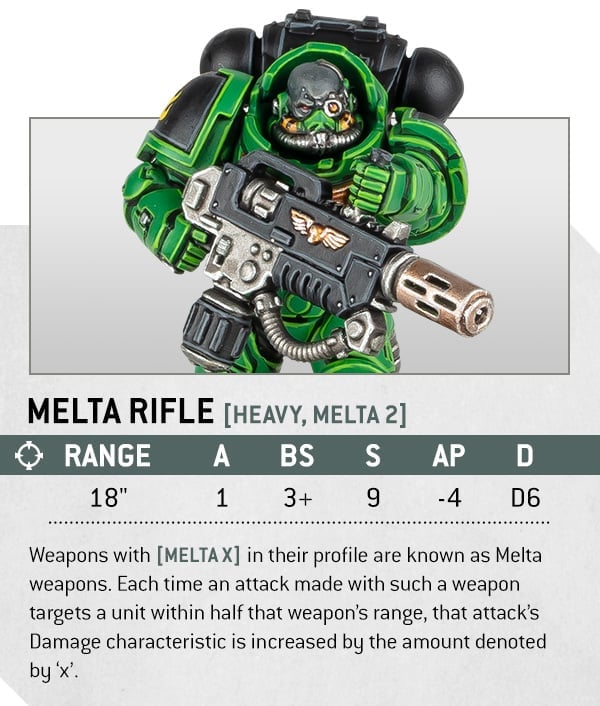
Melta
Melta X weapons do an additional X damage against targets within half their weapon range: a Melta 2 weapon with a 24″ range would deal two extra wounds to targets within 12″.
Pistol
Models can fire Pistol weapons while in engagement range of enemy units (but only at units they’re in engagement range with.) If you choose to fire your Pistol outside of combat for any reason, you can’t fire any other ranged weapons that turn.
Precision
If your weapon has the Precision ability, when you attack a unit with an attached Character, you’ll be able to direct those attacks at the Character instead of its ‘bodyguard’ unit.
Psychic
Psychic weapons don’t have any innate abilities, but some other abilities respond to them. The Space Marine Terminator Librarian’s Psychic Hood ability grants it and any unit it joins Feel No Pain 4+ against Psychic attacks.

Rapid Fire
Rapid Fire X weapons fire X extra shots against targets within half range; a Rapid Fire 2 weapon with a 24″ range would fire two extra shots at a target within 12″.
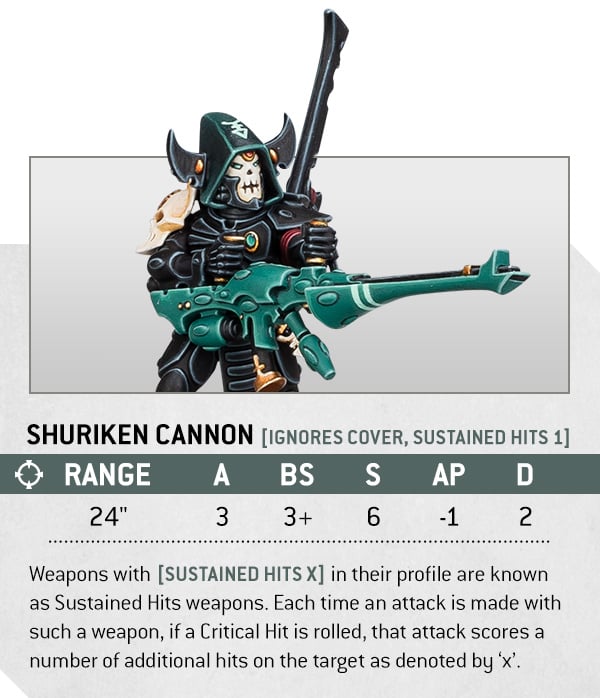
Sustained Hits
A Sustained Hits X weapon inflicts an additional X hits on Critical Hit rolls: usually, this will be on to-hit rolls of six. A Sustained Hits 2 weapon would score two additional hits for every to-hit roll of six.
If a weapon has both Lethal Hits and Sustained Hits and it scores a Critical Hit, it will cause one automatic wound, and generate one additional hit that must roll to wound as normal.
Torrent
Torrent weapons automatically hit.
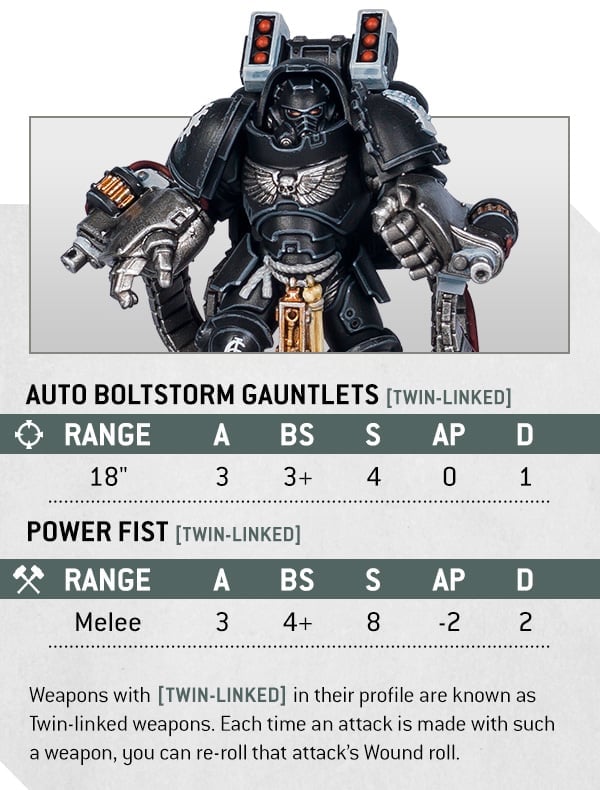
Twin-Linked
Twin-Linked weapons can re-roll To Wound rolls.
Warhammer 40k Core Abilities
Core Abilities appear on unit datasheets, granting that unit a special ability.
Deep Strike
Deep Strike units start the game in Reserves. They enter the battlefield at the end of one of your Movement Phases, during the ‘Reinforcements step’, and can be placed anywhere more than nine inches away from enemy units.
Can you Deep Strike on turn one?
The Deep Strike ability allows models to enter the battlefield on any turn of the game, including during Battle Round one. However, it’s common for competitive mission packs to stipulate that models can’t Deep Strike on Battle Round one. Some models – such as the Space Marine drop pod – have rules that explicitly state this restriction does not apply, and can enter the battlefield on turn one.
Deadly Demise
When a unit with Deadly Demise X loses its last wound, roll D6. On a a six, the unit deals X mortal wounds to all units within range of the explosion.
Fights First
The Fight Phase is split into the ‘Fights First’ step and the ‘Remaining Combats’ step; if your unit has Fights First, it’ll get to make its attacks in that first step of the Fight Phase, potentially getting the drop on a slower opponent that has to wait for the Remaining Combats.
In 11th edition, the player who’s turn it is gets to pick the first unit to fight, unlike 10th edition, when it was the other player. Players alternate attacking with their Fights First units until they’ve all activated. Then other units get to fight, following the alternating activation sequence.
Firing Deck
A vehicle unit with Firing Deck X can make additional ranged attacks in the shooting phase using up to X weapons held by models embarked on the vehicle.
It’s the vehicle that makes the attacks, not the passengers, so any buffs or debuffs that apply to the vehicle’s shooting will apply to these attacks as well.
Infiltrators
If every model in a unit has the Infiltrators ability, the unit can be deployed anywhere on the board more than nine inches away from an enemy unit.
Leader
Leaders are character models that can join other squads during deployment. That squad becomes their bodyguard, protecting the leader from almost all attacks until the bodyguard has been destroyed.
Leaders are restricted to joining certain kinds of units, and usually, only one leader can join any squad. There are exceptions: for example the Primaris Lieutenant can join the same squad as a Captain.
Lone Operative
In 10th edition, while a Lone Operative is not attached to a unit, it can’t be targeted by enemies from further than 12″ away.
In 11th edition, a Long Operative is not visible to enemy units that are further than 12 inches away, and it can’t be targeted by Indirect Fire weapons from further than 12 inches away. This is a subtle distinction that will protect Lone Operatives from abilities that require line of sight but don’t have a target.
Scouts
Units with the Scouts X” ability get a free X” move after deployment.
Stealth
In 10th edition, if every model in a unit has the Stealth ability, then ranged attacks targeting that unit take a minus one to the hit roll.
In 11th edition, models instead gain the Benefit of Cover: which, as it happens, inflicts a minus one on the opponent’s hit roll with ranged attacks. However, this means there’s no no way to stack the to-hit penalty from Stealth and the Benefit of Cover.
 Source: Wargamer

