


 There’s something about the idea of farming and growing crops—at least for the suburban/urbanites like myself who only visit farms during the Halloween season—that is innately charming and comforting. Perhaps that’s why FarmVille has seen over 800 million installs, and there are over 1400 unique farm-themed board games out there.
And yet when a farming theme is mixed with a Eurogame structure, the designers frequently find ways to bring hardship to the experience, including that of forced crop rotation lest your fields lose productivity; depreciating prices due to over-production; occasional slaughtering of animals for sustenance; and, my favorite, having to regularly feed your people lest they starve/go begging.
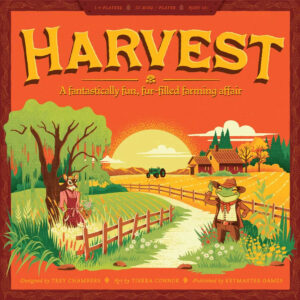
Enter Harvest, a family-weight plus competitive farming Eurogame that truly channels the charm of farming by the plowful. Accommodating 1-4 players over 30-60 minutes, Harvest features worker placement and drafting as a means to grow individual fields into bustling farms full of colorful crops and structures.
Gameplay Overview:
Harvest is played over four rounds, each of which starts with a draft for “sunrise” tiles that provide unique resources/abilities as well as a turn order priority for the current round.
The main actions of each round are executed by placing 1 of 3 wheelbarrows worker-placement-style in various regions of the central board to do the following:
- General Store: purchase seeds and fertilizer.
- Fields: plant, tend, and/or harvest crops
- Workshop: construct buildings and clear trees from the land
- Trading Post: trade goods for services or other goods
- Farmer’s market: take unique actions that change each round
Each region of the central board is subdivided into 3 or fewer spots, which allows its actions to be taken at powers of 3, 2, or 1, correlated to how many actions/purchases/trades can be done in that spot. So while multiple players can visit each region, players can block each other from the higher-powered spots.
Points are ultimately obtained by harvesting crops of varying value and constructing buildings.
Highest score wins.

Game Experience:
While Harvest definitely delivers on the family-weight plus (i.e., medium-light) rating, this heavy-gamer was surprised to find it a surprisingly thinky, resource-tight, and multi-stepped experience. For example, to make the most of a harvest, you must first (1) clear land, (2) acquire up to four unique seed types, (3) obtain sufficient water and fertilizer resources, (4) plant seeds, (5) tend/expand your crops, and then (6) harvest. Six steps!

That’s more than it takes to get your grain going in Agricola. Yet I assure you, Harvest is the much less punishing game. Those steps above are for maximizing a harvest. There are still plenty of points and other benefits to be had from working a small plot, focusing on one or just a few crop types, and/or potentially skipping the crop expansion step altogether. Heck, in one game, an opponent barely planted any crops at all and instead filled his fields with high-scoring buildings. The game encourages players to have at least a few areas of focus, but it does provide players the flexibility to try various strategies. And nobody ever starves.
Nonetheless, there can be some tension in the game, as you really cannot do everything you want. Visiting those 3-value worker-placement spots can let you get a LOT done—ex. planting, tending, and harvesting all in one turn! However, it’s a race to visit since they are limited, and you need to make sure you have enough resources (money, fertilizer, seeds, water) before visiting to maximize the spot’s value. Thus, turn order matters, which makes the sunrise draft so exciting; notably, the trade-off for early turn-order is a weaker bonus. This game constantly has players making trade-offs, whether it’s in the choice of draft, the worker placement spot, or the cost of seeds/buildings to purchase.

Ultimately, the game will be as relaxing or stressful as you want it to be. If you’re attempting to go through four full, bountiful harvest cycles across each of the four rounds, your tolerance for blocking will be low. If you’re okay with just two big harvests and a couple of good end-game buildings, your play may feel more zen. To further encourage diversification of strategy, players will start with one of eight asymmetric characters and one of eight unique farmhouse sunrise incomes. The game also comes with 32 unique building tiles providing different instant and end-game abilities that appear in different orders. Harvest has pretty great replay value overall.
Harvest also adapts well from 2-4 players (have not tried solo). Additional worker placement spots open up at four players, so it’s not too tight. Also, a minimal-maintenance dummy player is used with 2 players, which works quite well.
Fall Festival Expansion

For those seeking further variability, the Fall Festival expansion adds two new asymmetric characters as well as a new sideboard featuring 30 cards that can be purchased with a new fourth worker (a picnic basket) that exclusively visits this expansion board. The expansion does elongate the game from 12 to 16 turns per player. The cards are divided by half into two general types: (1) pies of various types that can be collected for set diversity points and (2) coupons for benefits or discounts later in the game when visiting certain regions (ex: gain a free blueberry and wheat seed next time you visit the general store).
Personally, I really enjoy these coupons as they help me get more done in the game, and they add a small extra layer of strategy, incentivizing me to take an action I may not otherwise prioritize. I am more neutral on the pie set collection, mostly because set collection doesn’t generally excite me, it adds a luck element, and with only 3 cards available at a time, they can block the more exciting coupons. Overall, it’s a nice expansion, but not essential to the gameplay.
Final Thoughts:
Harvest delivers an adorably illustrated, beautifully produced farming-themed game in a family-weight plus strategy design. It represents the perfect stepping stone for players prepping for the transition from gateway to more advanced games, and at the same time, it’s a thinky enough efficiency puzzle that even heavier gamers should enjoy their plays, possibly finding it a cozy time.
The worker placement and drafting elements may not represent anything mechanically novel, but they make the game intrinsically interactive without being mean. Eight asymmetric starting characters and 32 buildings with unique abilities help keep each game fresh. The Fall Festival expansion adds some nice ideas and a bit more game length; it is a nice-to-have rather than essential. Harvest ultimately lets players sow a variety of strategies, reaping colorful crops, prodigious points, and fantastic fun along the way.
Final Score: 4 stars—a medium-light worker placement Eurogame wrapped in an adorably illustrated and immersive farming theme
 Hits:
Hits:
• Surprising amount of decision-space in a medium-light game
• Fun farming theme is thoroughly incorporated into gameplay elements
• Asymmetric characters, farm tiles, and building variety enhance replayability
Misses:
• Nothing mechanically novel
• Only half of the expansion cards integrate into existing gameplay
• Set-up can be fiddly

Source: Board Game Quest

