


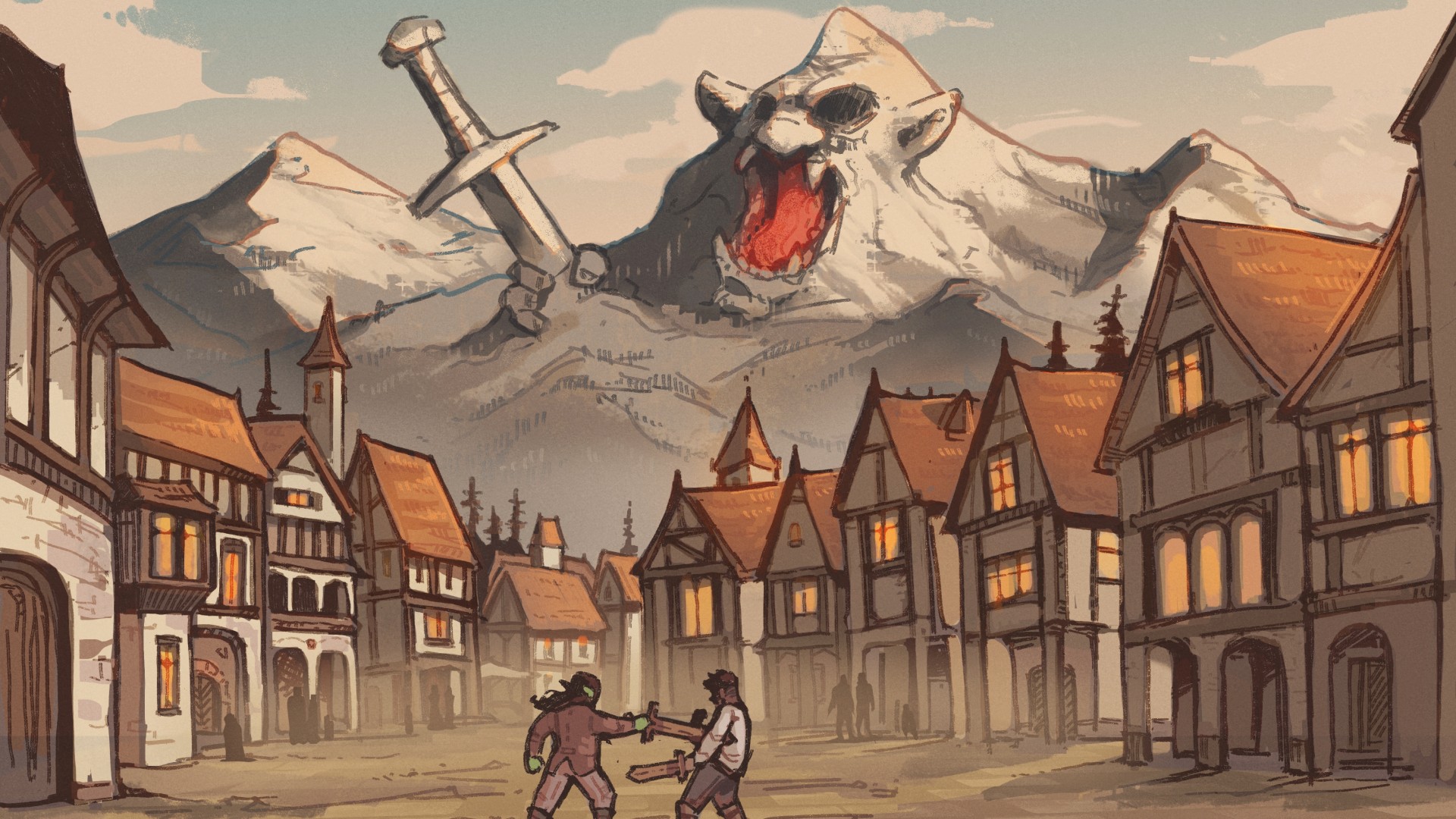
Tunnels and Trolls, the scrappy younger sibling of Dungeons and Dragons, is back from the dead (again). A Kickstarter launched on March 17 is crowdfunding a ‘New Age’ of books for the humorous heroic fantasy game. I’ve taken the Quickstart rules for a test spin early, so I can say with some certainty: Tunnels and Trolls feels like every TTRPG session teenage me ever played. That’s (mostly) a good thing.
The original Tunnels and Trolls was technically the second tabletop RPG ever published. Designer Ken St. Andre loved the idea of D&D, but he dreamt of a simpler, more accessible alternative. And so, in 1975, Tunnels and Trolls was born.
Even now, Tunnels and Trolls feels closer to what people think D&D is than literal D&D does. When my parents watch Stranger Things, this is the game they imagine I’m playing. Newcomers eager to enter the world of TTRPGs are probably expecting something like this. Tunnels and Trolls is the D&D I play when I’m too drunk to follow the rules.
This is all to say: Tunnels and Trolls perfectly captures the vibes of a classic heroic fantasy RPG, but it doesn’t bog you down with the genre’s usual crunch. Ken St. Andre nailed his original concept of ‘D&D, but less confusing’ – and now, publisher Rebellion Unplugged is carrying that same torch.
Instead of a D20, you’ll roll a pool of D6s to overcome challenges. If you have a Strength of three, that’s three dice to roll when you do something athletic. Any dice showing a one to three misses, while four and above hits. A roll can be ‘blessed’ or ‘cursed’, changing the goalposts of success and failure. So far, so tabletop RPG.
Exploding dice are where Tunnels and Trolls starts to stand out. If two or more dice show the same value, you add dice to a separate pool and roll those too. If any of those show the same value, the dice explode again, creating a third pool to roll. This can keep going all night, if you’re lucky enough.
Or unlucky enough, as it turns out. Tunnels and Trolls also includes rolls for exceptional successes (rolling three sixes in a single dice pool) and dramatic setbacks (rolling three ones across all pools). Basically, while it can be tempting to roll ridiculous numbers of D6s, every explosion pushes you closer to an automatic failure.
When it comes to characters, your stats will look very familiar. Six attributes define your abilities, and they’re identical to D&D, bar Wits subbing in for Wisdom. You’ll also need to track your Luck points (useful for talents and rerolls), Mana (for spellcasting), and Stamina (which stands in for the more typically used Hit Points).
The six ‘paths’ shown off in the Quickstart – might, shadow, endurance, spirit, craft, and wizardry – cover much broader concepts than traditional DnD classes. It gives you a lot more flexibility with your character ideas. A sneaky character, for example, no longer has to choose between the rules for Rogues and Rangers.
Each path comes with a starting talent, plus two more bonus talents that you’ll gain with a bit more adventuring experience. Mechanically, these are all pretty simple. Talents allow you to spend luck to enhance dice rolls, add extra actions to your turn, boost one of your stats, learn a spell, or excel in social situations. They’re useful, and they’re easy to understand, but they don’t offer the combos that D&D power builders are used to.
In fact, a lot of a character’s potency is instead decided by the weapon they wield. Tunnels and Trolls uses tags like ‘delayed’, ‘tipsy, and (the delightfully British) ‘knackered’ to replace D&D’s conditions. Tags also do away with damage types altogether, instead opting to give weapons a unique ability.
Axes permanently reduce a target’s armor, while blades add an extra die to their attacks when used to Stunt (an epic, dramatic action that adds risks and rewards to whatever you’d usually do in a fight). A staff removes limits on the amount of mana you can spend on a spell, so it seems pointless for a wizardry character to wield anything else. Once again, Tunnels and Trolls chooses to make rolling a character as simple and as easy as possible – at the expense of interesting rules synergies.
By now, you should have a decent picture of the system. It’s D&D with added beer and pretzels. It’s a dramatic, chaotic game of extreme highs and lows, where luck and risk are welcomed at the table rather than driven away by optimized builds. It proudly touts its silliness, and it has a truly British sense of humor, the kind you’d find in Blackadder or the Fable game series.

For the right kind of roleplayer, this sounds great. Who doesn’t feel nostalgic for their earliest, silliest games of D&D? Why wouldn’t you want a fast-playing blast from the past like Tunnels and Trolls?
The Quickstart gives me one reason: the adventure writing. The Quickstart’s suggested adventure also reminds me of the D&D games I played 15 years ago, but this time, it’s for all the wrong reasons.
Okay, so we start out in a tavern. We’re going to waste a bit of time chatting to locals, and it’s very likely that we’ll get drunk and harass the bar staff. When we do that, we make it up to the barkeep by taking on a quest of immense excitement – clearing rats out of the basement.
Oh, I’m sorry, is that not epic enough for you? Well, what if I told you that you’ll also have to make a skill roll just to see if you can get the door open? Tunnels and Trolls at least has a ‘fail forward’ plan if our party can’t muster the Strength to push open a door – but this still feels like an archaic design choice that we should have left behind in 2003.
Granted, the Quickstart adventure efficiently covers all the basics. Players will learn about tags when they pick up the Tipsy condition from having more than one beer (bloody lightweights). They’ll get a stab at rolling initiative, and there’s plenty of skill rolls.

It’s essential stuff, but it’s just so dull. This is the prequel to your adventure’s prequel. It’s the encounter you skip to get to the real action of the campaign. Tunnels and Trolls isn’t even being tongue-in-cheek about how stereotypical its opening adventure is.
So, I’ve got mixed feelings about the Quickstart. The system itself is simple, robust, and silly in all the right places. The adventure, though, makes me hesitant to invest $200-odd in the campaign book, city book, and solo adventures also promised on the Kickstarter page. That’s one of the pricier pledges, though – a non-all-in one will set you back far less.
Want to talk more about your favorite tabletop games? Join the conversation in the Wargamer Discord.
 Source: Wargamer

