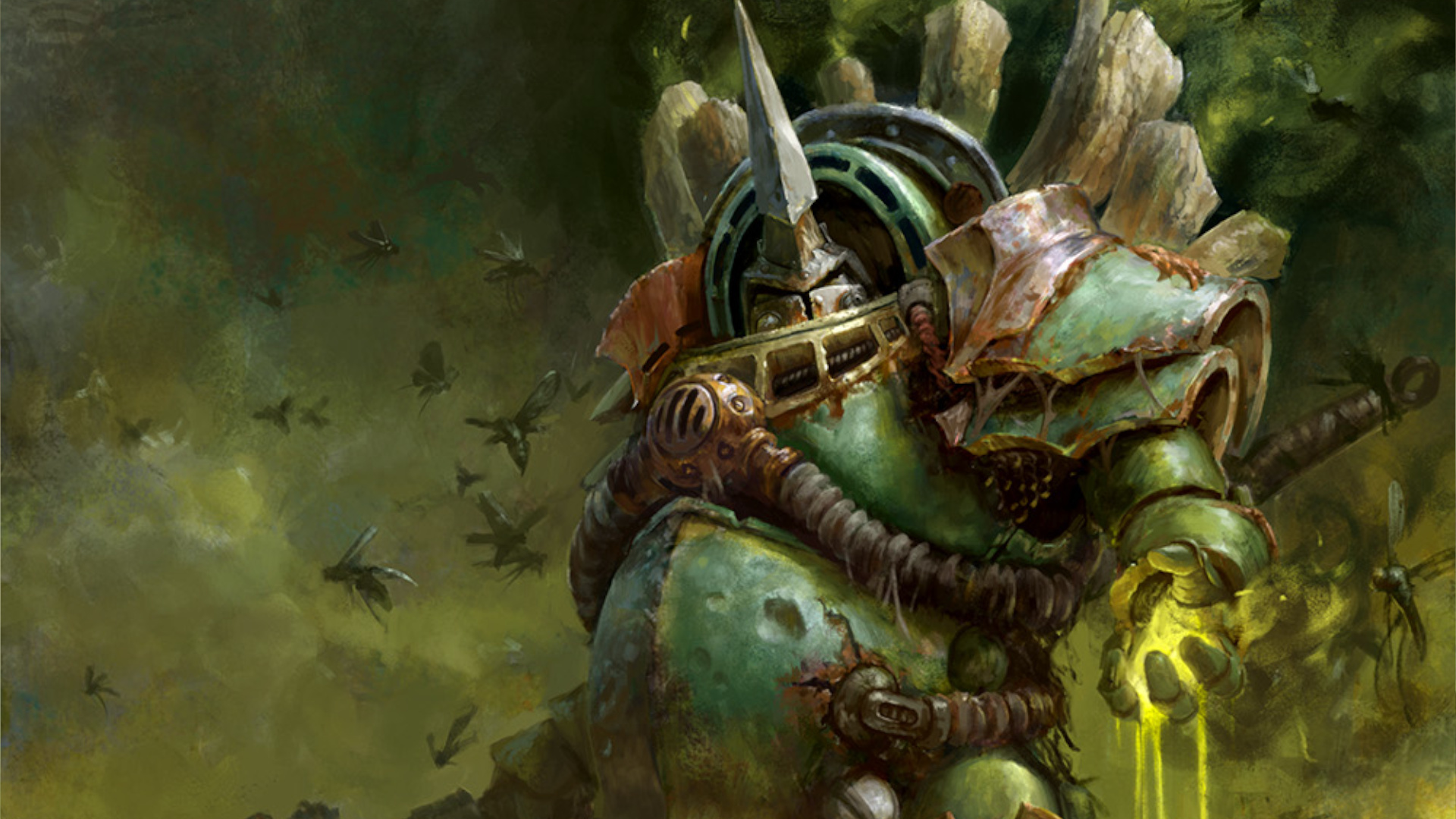
Few foes in the Warhammer 40,000 universe are as viscerally disgusting as the rotting, fungus-infested, parasitized, disease-ridden wretches bound to the service of Nurgle, Lord of Decay, the Grandfather, Chaos God of Disease and Despair. Yet despite existing in a state of continuous undying decay, Nurgle’s mortal servants often rejoice in their pestilence, perceiving their weeping sores, sweltering fevers, and rancid buboes as signs of the Grandfather’s favor. Are they genuinely having a good time, or are they just insane?
The most prominent Warhammer 40k faction associated with Nurgle is the Death Guard. The Death Guard served the Emperor in the Great Crusade as the XIVth Space Marine Legion, but gradually fell into the service of the plague god through the machinations of seventh captain Callas Typhon. Examining their fall is illuminating.
Laughing in relief

Callas Typhon was inducted into the dark secrets of the Chaos Gods by Chaplain Erebus of the Word Bearers, becoming the leader of the secret Seven Pillared Lodge, a warrior society within the Death Guard legion that subverted the Imperial structures of control. The Death Guard prided themselves on indomitability, enduring the unendurable, and the teachings of the Seven Pillared Lodge promised endurance even beyond the Legion’s already superhuman limits.
Typhon delved deeper into the secrets of the warp, and ultimately betrayed the Legion as it made for the final siege of the Emperor’s Palace on Terra. The Death Guard fleet was becalmed in the warp and unable to move when Typon summoned the Destroyer Plague, a supernatural disease that caused the Death Guard to decay and suffer without ever allowing them to die. As well as physical suffering beyond the limits that any mortal could bear, the Death Guard’s pride was utterly destroyed – here was a challenge they truly could not endure.
The Primarch Mortarion struck a bargain with the plague god Nurgle to release his legion from their torment. The Destroyer Plague retreated into the body and soul of Typhon, remaking him as its host, Typhus. The rest of the Legion was ‘blessed’ by the Lord of Plagues. Their bodies were transformed beyond all reckoning into living vectors of sickness and corruption, but they felt no pain, experienced no weakness, and regained their sense of sense – but their perspectives had been greatly altered.
This shows one reason why Nurgle’s mortal servants seem so happy. Nurgle’s gifts don’t cure diseases, but they do bring an end to suffering. For the downtrodden serfs of the Imperium, among whom malnutrition, injury, and disease are endemic and the only reprieve is faith in a distant Emperor, Nurgle’s gifts offer an anaesthetic; for Typhon and the Death Guard, they provided a well of supernatural power fitting to their hubristic ambitions.
False consciousness

Mentally enduring Nurgle’s gifts requires an altered perspective. Some, like Typhon, have the insane egocentrism needed to consciously accept the gifts. But Nurgle’s presence alters the mind as much as the body.
In Siege of Terra: Warhawk by Chris Wraight, the White Scars lead an assault on the Death Guard at the Lion’s Gate Space Port. The Primarch Jaghatai Khan manages to banish the Daemon Primarch Mortarion to the warp. Mortarion’s banishment is like a sinking ship that pulls down smaller vessels with it, causing the influence of Nurgle to recede – without the grandfather’s clammy embrace, many of the Death Guard are suddenly disquieted by their transformations, cut adrift.
In Dark Imperium: Plague War by Guy Haley, Roboute Guilliman begins an assault on a Death Guard position protected by a warp shield. To breach it and allow troops to insert, the primarch launches a rare cache of pariah missiles, each filled with the refined remains of dead psychic blanks. The explosive burst of anti-psychic energy has a devastating effect on the Death Guard, making some react to their bodies as if they have suddenly come to their senses, descending into despair and madness at their ruined forms.
Accepting the inevitable

Truly accepting the gifts of Nurgle means accepting the inevitability of decay and welcoming it as a sign of endurance. This is, in some ways, an exaggerated extension of accepting the natural aging process – like coming to terms with a middle aged beer gut, the fact that you don’t run as fast as you used to, or even the fact that you have more achievements than ambitions. It is comfortable decay.
The novel Lords of Silence by Chris Wraight uses Nurgle to explore this middle-aged comfort from multiple angles. It takes place in the immediate aftermath of the opening of the Great Rift, with the Imperium unable to muster effective responses to Chaos raids. The protagonist Lord Vorx is faced with the philosophical question of what it may mean to have won the great struggle that defined his life, a profoundly middle-aged concern.
Meanwhile, the captive planetary defense force captain Dantine is enslaved by Vorx’s warband, the Lords of Silence. Dantine finds himself face to face with an abominable enemy yet unable to fight, and his captors are surprisingly mellow.
He experiences the fall to Nurgle as letting go, relaxing from the Imperial web of performance and obligations such as his duty or maintaining his physical appearance: he learns to let it all hang out like someone middle-aged letting go of their vanity. Nurgle’s corruption is easeful, which makes it a radical proposition for Imperials expected to live to their fullest (wherever they are within the Imperial hierarchy) and then abruptly die in duty.
Ultimately, people are complicated, and the precise parameters of the Chaos gods are changeable according to the whims of writers. Whether or not the mortal servants of Nurgle are genuinely happy, magically deluded, or living in a psychological false consciousness depends on the author writing them and what they want to achieve in a story.
Daemons of Nurgle

The question of whether the daemons of Nurgle are happy or not is actually very simple – we have categorical answers for every type except for Daemon Princes. Daemon Princes were once individual mortals, and though their souls are now fully absorbed within the great psychic gestalt that constitutes Nurgle, their minds are their own.
Nurglings are giggling and malicious imps with only limited sentience, but they’re extremely happy. Plaguebearers, tasked with counting things for the grandfather – usually diseases, but ultimately anything they cast their single rheumy eye across – are morose, since their task is never-ending and constantly interrupted.
This changes if they contract the Chortling Murrain, which forces them to ceaselessly laugh, dance, and jig. They spend the next phase of their existence as a Sloppity Bilepiper, a mad jigging dance-master, before finally falling to pieces – at which point the next Bilepiper will put their head on a stick to use as a marotter puppet.
Beasts of Nurgle are puppylike entities that are enthusiastic and playful, bounding across battlefields to find new friends to play with. Unfortunately they tend to kill any mortals they contact, crushing them to death with their huge bulk or infecting them with withering plagues. This constant disappoint eventually dims their spirits. They will retreat to the Garden of Nurgle and enter a cocoon, finally emerging as a bitter and spiteful Rotfly.
The mighty Great Unclean ones are almost all avuncular, jolly, generous bestowers of Nurgle’s gifts, mimicking their maker’s gregarious nature. The one exception is Ku’Gath Plaguefather, Nurgle’s favorite servant. Ku’gath was once a Nurgling until he fell into Nurgle’s cauldron of plagues, accidentally imbibing the masterwork plague that Nurgle was brewing. Ku’gath swelled up into his new divine form, but he is so guilty and remorseful for destroying the Grandfather’s great work that he now exists in a constant state of depressed contrition. He diverts all his efforts to brewing new plagues in an attempt to make recompense for his mistake.
Got a niche Warhammer lore question you’d like answered? Let me know in the Wargamer Discord community.
 Source: Wargamer