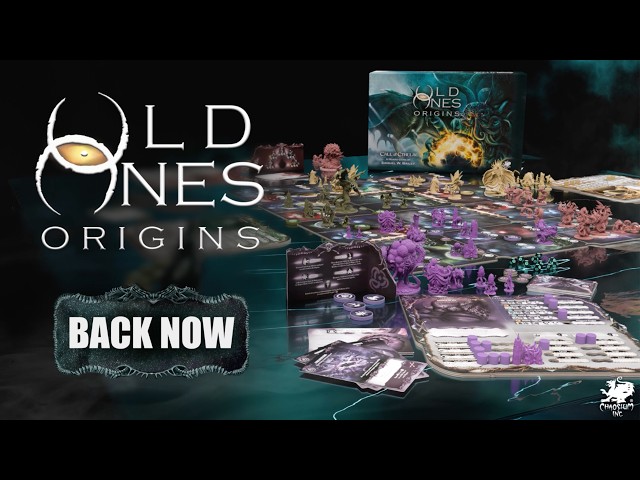
As far back as Risk, board games have seen players wage war for control of planet earth, and Twilight Imperium and many games like it have expanded the scope out into a war for the galaxy galaxy. Call of Cthulhu: Old Ones Origins is set to outdo them all, in narrative scope at least: when I interviewed game designer Samuel Bailey, he explained this Lovecraftian strategy game is set “at the dawn of creation… where the ancient old ones are fighting for control of the universe and all that comes after”.
Old Ones Origins is the newest project from Call of Cthulhu publisher Chaosium. It’s a reimplementation and evolution of the rules from Warhammer 40,000: Forbidden Stars, which Bailey co-designed with James Kniffen at Fantasy Flight Games – a game I fought to get on Wargamer’s guide to the best board games when it covered all-time greats instead of contemporary titles, I fought for it to have a place. Big and bombastic though the Warhammer 40k universe is, Bailey says that his new game is even more audacious.
The game is set “before there were even the laws of reality”, with up to four players each playing the role of one of the Great Old Ones “at the height of their power”. “This isn’t old sleepy Cthulhu that’s been slumbering under the ocean for countless millennia”, Bailey says, “this is him as an awesome god of war and chaos”. Hastur isn’t “a failed emperor, he’s at the height of his decadent imperial power, controlling and manipulating people”.
And Yog Sothoth? “I mean, Yog Sothoth is exactly the same because he’s beyond time and space, so he’s unchanging in that regard”. Of course.
This is an era that Lovecraft’s stories imply, and which the wider Mythos built by August Derleth and generations of nerds have formalized: the first age of the universe, when the Great Old Ones were the Great Young Ones, and their full power was unleashed on a nascent Galaxy. It’s a different angle on cosmic horror. “You’re destroying planets and blowing stuff up and using people as pawns, and to the Old Ones, it’s just moving pieces around the board”. it’s slightly meta
Old Ones Origins is a wargame, with players competing to lock down this nascent reality by applying arcane magical seals onto sections of the map to “seal away that part of the universe for yourself, following your rules and your power”. These seals are the main tiebreaker if the war ends without an obvious winner – but if they’re tied, “then Azathoth” – the blind idiot god, who dreams reality into existence – “wakes up, and reality ceases to exist”.
I’m a big fan of the original Forbidden Stars, and while I was an easy mark for the Warhammer 40k theme, what made it mechanically compelling (and such a shame that planned expansions were never released) was the deeply asymmetrical playstyles between the factions. And you don’t get much more asymmetrical than the Great Old Ones…

Cthulhu
Cthulhu may be the simplest of the Great Old Ones – his monsters are massive. “Even though this is before him being under the ocean, it still has that theme of him really toughing it out… being in a transient state and resurrecting”. That is not dead which may eternal lie… Aside from spawning physically imposing Cthonians, a big mechanical focus for Cthulhu is ‘fractures’, a mechanic “representing reality tearing apart because these entities are battling and no one has control over it”.
At the end of each conflict, “you add fractures for how many factions still have figures there at the end, up to a max of five” – an interesting admission, since the base game only ships with four factions. Then, when you start a conflict, “everyone takes psychic damage equal to the amount of fractures there”. Cthulhu is particularly toxic to the fabric of reality, “getting bonuses for having fractures… able to spread them around or add them in certain places”.
Not that Cthulhu’s minions are immune to their ill effects. “You resist psychic damage with your unit’s Power” – which, as in the Call of Cthulhu RPG, represents magical facility – “and his units don’t have a huge amount”. But there is an upgrade option for chaff cultist units, Graven Idols, which allows fractures to be harnessed into bonus magic.

Hastur
Hastur, the King in Yellow “focuses on having people bow to him by exhausting them, so he has a lot of mechanics that exhaust your enemies and yourself, and then gets bonuses on the amount of exhausted people that are around”. ‘People’ is a word used advisedly in this case. Exhausted units can’t defend themselves in a fight, so this has the potential to be devastating.
“He has a lot of tricky stuff, playing with resources, some more wild effects”, Bailey adds. He gives the example of “one of his schemes, which I think is called the ‘The Players Unmasked’ – you just awaken everyone’s avatar on one planet for a turn”, inducing a spontaneous royal rumble between reality shattering godlings.
Other abilities are subtler. One forces “everyone with units in a region to exhaust one unit, but they get a resource for it”. Hastur can target one of his own weak cultists as a way to get a little economic boost, or pick a location where their opponent only has a single powerful unit, giving them no choice but to knock over their big bruiser and open the way for an invasion. “It’s a nice little troll faction for people who like that sort of thing”, Bailey says.

Yog Sothoth
Yog Sothoth, as previously mentioned, exists outside time and space. “His main theme is breaking the rules… I don’t need to move my guys, I’ll just appear over here because what even is space?” One upgrade to the Pack of Tindalos – a variant name for the Hounds of Tindalos because, as the game is set before planet earth exists, neither do doggos – allows them to “pass through the rifts in time and space that normally block everybody”. These changeable rifts separate areas of the map and can naturally fluctuate throughout the game, isolating and connecting areas unpredictably, so this ability gives incredible flexibility.
Combat between units is resolved partly with unit strength and dice rolls, and partly with combat cards. Yog Sothoth’s magical nature means “his combat power comes less from his units and more from his spells and conflict cards”. He has some particularly nasty tricks. Some parts of the board are ‘nexus areas’, where players can participate with their cards even if they have no units. Yog Sothoth’s superior card power makes him very good at influencing these battles, and he has cards that can teleport his own troops in to claim victory from the exhausted forces of other Old Ones.

Shub Gorath
Shub Gorath, the Black Goat of the Woods with a Thousand Young, “focuses on filling the board with as many units as possible”. Their base unit is the Spawn, which are “zero statted units – no dice, no defense, no magic, but when you summon one, you get two of them”. There’s even an upgrade, “unending numbers, you can have any number of Spawn and effectively just fill the board with meat”. They have no inherent defenses or offensive abilities, but there are ways to “give your spawn a defense, or a die, or a power for a round”, and “they have a lot of conflict cards that get bonuses if you have more units than your opponent”.
Bailey recalls one game “fighting Cthulhu, they were sitting on a planet with four fractures on it, and I invaded with like 12 Spawn, and immediately four of them just died because they’re not rolling any dice, I have no way to block the the psychic damage from the fractures”. But seven Spawn remaining was enough: “I still won that battle by playing cards and stuff that gave me bonuses”. Cthulhu’s Starspawn were dragged down by “a wave of flesh”.
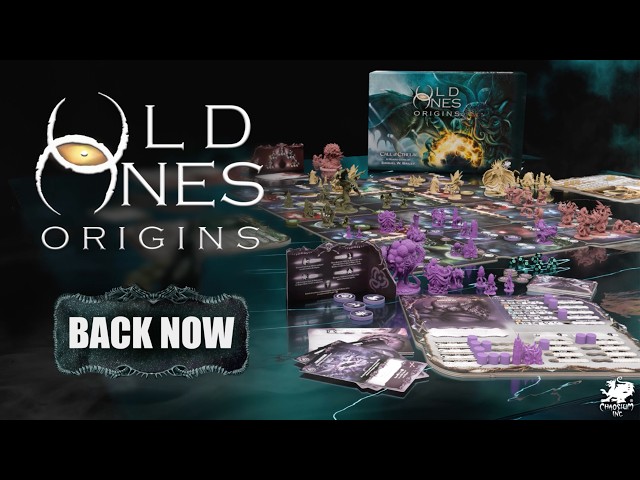
A Gamefound Campaign for Call of Cthulhu: Old Ones Origins is currently live on Gamefound, and is open until October 15. The standard edition of the game is going for $94, while a mini-heavy deluxe edition is $157 – plus shipping fees and tariffs.
As ever with crowdfunding campaigns, consider whether the discount on offer is enough to outweigh the wait for fulfilment and the uncertainty of crowdfunding. Chaosium’s last crowdfunded boardgame, Horror on the Orient Express, is currently shipping its final pledge rewards to backers, two years and five months after the campaign closed.
I was excited for this game when I heard it was a remake of Forbidden Stars. Chatting to Bailey I found he was brimming with ideas to improve on that classic design, and a had creative flair for presenting the Lovecraftian cosmos in a genuinely fresh way. I’m hoping to get a demo game with him soon, and I’ll share the results with you here, and in the Wargamer Discord community.
 Source: Wargamer